


Switzerland is the only country in Europe that has four official languages. New data sheds light on who speaks what.
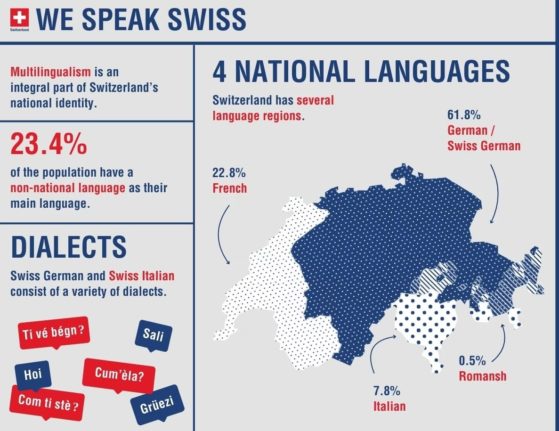
In Switzerland, the majority of the population speak (Swiss) German — nearly 62 percent — followed by 22.8 percent of French speakers, and 7.8 percent who speak Italian.
The smallest group, 0.5 percent, still speaks Romansh but, although for all intents and purposes it is an official language (which means all official documents must include the Romansh version), these people live in canton Graubünden, where German is the predominant language.
This chart from the Foreign Ministry (FDFA) shows where each linguistic region is, and also provides information about what other languages are commonly spoken in Switzerland (including English — read more about this below).
FDFA
READ ALSO: How did Switzerland become a country with four languages?
Who speaks what in Switzerland?
Although each linguistic group relies on its own language (and often also various dialects thereof, as the chart above indicates), the vast majority of people (86 percent) believe that knowledge of several national languages is important for the country’s cohesion.
This is what emerges from the Federal Statistical Office’s (FSO) Survey on Language, Religion and Culture released – in all four languages, of course – on August 14th.
Therefore, almost two-thirds of the population regularly use several languages in everyday life.
The highest number of multilingual people (66 percent) is found in the French-speaking region.
The study also found that the regular use of several languages gradually decreases with age, falling from 81 percent of multilingual people aged 15 to 24, to 38 percent of those aged 65 and over.
For a portion of the population, this multilingualism begins early: 38 percent of young people under 15 hear at least two languages spoken at home, and 21 percent speak several languages with their parents.
Advertisement
The role of immigration
While German, French, Italian, and Romansh are ‘historic’ Swiss languages, people who have immigrated to Switzerland brought their own into the mix.
In fact, 23.4 percent of the population have a non-national language as their main language, which coincides with a 26-percent share of foreigners who live in the country (keeping in mind that those coming from neighbour countries Germany, France, Italy, and Austria) already speak one of the national languages.
Advertisement
What about English?
Widely considered an ‘international’ language nowadays, it is the most widely used non-national language in Switzerland, regularly spoken by 44 percent of the population – both native speakers and not.
According to the FSO, “it is used regularly by more people in German-speaking regions than French (45 percent versus 15 percent).”
It is even more widespread than German in French-speaking regions (41 percent versus 16 percent).
Just over half (52 percent) of people aged 15 to 64 believe they have good to very good active knowledge of English when it is not their native language.
Young people more often consider themselves to have good to very good knowledge of English than older people: 65 percent of 15 to 24 year olds compared to 56 percent of 25 to 44 year olds.
A larger proportion of the working-age population (for whom it is not their native language) has a good grasp of English as well.
READ ALSO: How English has become more prevalent in Switzerland


