


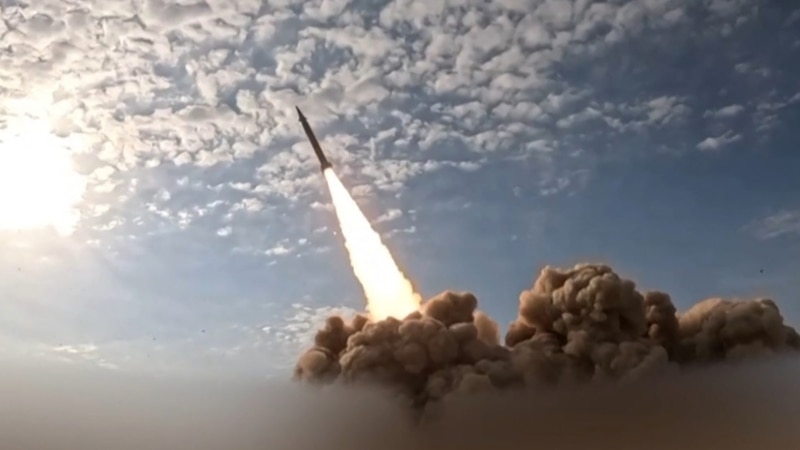
The war in Iran is giving Beijing a real-time window into how the United States wages modern war.
The war has shown the reach of US military power while also raising questions about Washington’s ability to manage multiple crises at once. For Beijing, that combination could influence how it assesses risk, timing, and opportunity in any future confrontation with the United States and any kind of future scenario toward Taiwan, a self-governing island of 23 million that China claims as its own.
To better understand what China may be learning from Iran, RFE/RL spoke with Mick Ryan, a retired Australian major general and military strategist who is now a senior fellow at the Lowly Institute, an Australian think tank.
RFE/RL: What is the biggest lesson that Chinese President Xi Jinping has learned so far from the war in Iran since it started in late February?
Mick Ryan: There are many lessons, but the biggest one that Xi has probably learned is that the US military is still a very powerful organization. It can deploy overwhelming force and conduct sustained precision operations, at least from the air and from the sea for some time. That will be very important for him and the People’s Liberation Army (PLA) to understand if they’re ever going to undertake some kind of blockade or invasion of Taiwan.
RFE/RL: War is part of a wider environment, so if we’re speaking about lessons Xi might be drawing from the war in Iran, how should this one about US military power be seen in the wider context?
Ryan: Notwithstanding the US military’s very powerful capability, it’s being used by an administration that really is only able to fight one more at a time.
I think the attention span of the administration only allows it to do that, but it’s stripped out many of the normal decision support mechanisms that would come through the National Security Council. These decisions look to be being made much more on impulse, and as we’ve seen from the meandering set of different strategic objectives from this war, it’s an administration that is OK with launching something like this without necessarily knowing what it wants from this kind of large-scale conflict.
RFE/RL: How might that then apply toward something like Taiwan? How might that inform their preparations, or what they’re going to be doing next in the coming years?
Ryan: I think this shows the Chinese that if they have a better strategy in place, they do have an improved chance of success. Being good at military operations is important. If you can’t win battles, then you can’t win wars. But strategy is even more important, and having the right strategic assumptions and the right strategic decision mechanisms for executing that strategy is something the Chinese might think that they’re better at than the United States at the moment. A strategy gap when you’re planning for a war and executing a war can be a real advantage.
RFE/RL: You spoke about some impulsiveness coming out of Washington. For Beijing, I imagine that’s something that can cut both ways?
Ryan: Yeah, absolutely. It’s obviously a double-edged sword.
As Americans would understand, General Stonewall Jackson was a great example of an unpredictable leader from the US Civil War. He was known for an unpredictability that hurt the enemy, but it also sometimes hurt his own forces. I think US President Donald Trump is very much in the same mold.
He is very unpredictable, and the Chinese are uneasy about that unpredictability. Trump is very unlike any of his predecessors, and the Chinese can’t really war game what his reaction to any kind of event might be because he just really is all over the place when it comes to his responses. That will, more than anything, probably induce caution in Xi and the PLA just because of the deep uncertainty they probably feel with Trump’s decision making.
RFE/RL: We’re talking about war in Iran right now, but obviously there’s been another war going on for several years in Ukraine. What sort of lessons have the Chinese taken from Ukraine and how might those compound with these lessons from Iran?
Ryan: The Chinese have been very good at studying other people’s wars ever since the Falklands War in 1983 [between Britain and Argentina] and all the way through the succeeding 43 years.
Starting from the top, they’ve learned political lessons about how NATO as an alliance works and how it makes decisions. They’ve also learned lessons about how they might split NATO allies away from the United States. I think they’ve learned lessons about the global misinformation campaign and the conduct of information warfare, which we’ve also seen both Iran and the United States engage in since late February.
Then there’s the obvious ones around drone warfare. In their last big military parade last year, all of the armored vehicles the PLA had on display had drones on them. They’ve taken those different lessons from Ukraine and they’ve been reinforced by their learning from the current war in Iran.
RFE/RL: If you’re Xi today and you’re watching what’s happening in Iran, how are you feeling about it as a whole? There’s a global energy crisis, and some of that is definitely going to be affecting your economy, but how do you think Beijing feels about the United States beyond the strict military perspective?
Ryan: If I’m Xi, I’m probably thinking that his narrative about the West being in decline is probably right. You’re seeing the breakdown of US alliance systems and deepening distrust between America’s allies and the Trump administration. For Xi, that confirms his long-term prognosis about the rise of China.
Whether that’s right or not remains to be seen, but I think from his perspective — and it’s important to note that he lives in an echo chamber, like many dictators do — that’s probably what he sees.
I don’t think that means he’s going to instinctively want to invade Taiwan next week, but I think he will be looking for opportunities. A Trump administration, which has degraded its military munition stockpiles because of this war and is potentially distracted by a bitter Congressional elections campaign through October into November, might be distracted enough that the Chinese could see an opening that might be too good to pass.
RFE/RL: We’ve been focused about China and its designs on Taiwan, but that’s also a huge spectrum in terms of what that could actually look like, ranging from installing a loyal local government to a blockade of the island to the most extreme case — an actual military invasion.
If you’re a Chinese planner right now and you’re looking at this slew of options, does anyone look more appealing or perhaps increase its chances of success now based on what you’re seeing happen in Iran?
Ryan: We should all understand the desired endgame, which is that Xi believes Taiwan should be part of the People’s Republic of China. The ways and means, as you point out, are uncertain. There are many different options. I think two paths will be particularly attractive to them.
One would be a mega deal between Trump and Xi, where essentially Trump throws Taiwan under the bus or at least indicates that he wouldn’t defend them. Another one would be the opportunity for some kind of lightning Chinese military strike against Taiwan to decapitate and degrade them and potentially invade them.
Those are probably two prominent ones they would be planning for, but there’s lots of other iterations that Chinese strategists have been thinking about for decades.
The interview below has been edited for length and clarity.


