


Toplessness is fairly common in Spain, but not without its confusions and controversies.
Toplessness at Spanish pools and beaches is quite common compared to many other European countries, and has been for several decades.
However, it has always existed in somewhat of a grey area both legally speaking, with local councils implementing different rules, but also in a cultural sense.
READ ALSO: Spanish women resist European trend to ditch topless sunbathing
That toplessness would be so popular in Spain, a traditionally Catholic and still relatively socially conservative country in many regards, is something of a paradox.
Perhaps even more interestingly, toplessness among Spanish women is actually becoming less popular over time, despite young españolas often being more progressive or feminist in their politics.
But why is that? And what’re the rules on toplessness in Spain?
Advertisement
The law
The Spanish Constitution of 1978 allowed nudity in public places but banned the loosely defined crime of ‘exhibitionism.’
However, as we will see with regards to legal grey areas that still exist in Spain today, back then, as Spain began its transition to democracy, although the Constitution made the practice legal (or more accurately, it wasn’t illegal) the old penal code continued to occasionally prosecute it under the guise of toplessness (and nudity) creating “public scandal”.
In Spain, topless sunbathing emerged following the Franco regime, partly as a rejection of the ironclad Catholic morality that was imposed on women during the dictatorship, and quickly took root as a custom along the Spanish coasts during the transition to democracy.
It had become so embedded as a cultural norm that by 1989 the Spanish Congress finally eliminated the ‘public scandal’ clause from the penal code and there was no longer any existing legal basis to penalise toplessness.
READ MORE: Bare all! Top ten nudist beaches in Spain
Advertisement
Local bans
However, despite the technical legality of toplessness on Spanish beaches and at its public pools, that doesn’t mean that it’s always accepted or even allowed. Rules for local beaches and pools are done on a local level, so the practice still exists in somewhat of a legal grey area, and the more conservative cultural Catholicism in Spanish society has completely gone away.
As was demonstrated in Catalonia recently, some small towns in Spain enact informal or de facto bans on topless swimmers and sunbathers, and the rules at local pools and beaches are, technically speaking, the responsibility of local councils and town halls.
Around 20 women place a formal complaint every year in Catalonia after being told they couldn’t go topless at public pools, in some cases being kicked out of the premises for going topless, with local rights group Mugrons Lliures (Free Nipples) estimating it’s just the “tip of the iceberg”.
Local level rules can in theory contradict regional or even national equality law, meaning that toplessness in Spain can, in some places, exist in a sort of legal limbo where local legislation says one thing and regional or national rules another.
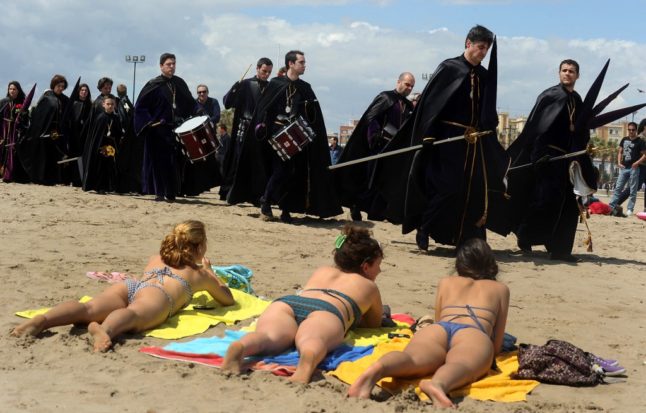 A Holy Week brotherhood walk past women sunbathing at the beach in Valencia. That toplessness is so popular in traditionally Catholic Spain is something of a paradox. (Photo by JOSE JORDAN / AFP)
Spain leading the way
Despite this legal grey area, and the paradox of Spanish Catholic conservatism, Spain has long been a leader in Europe when it comes to toplessness.
Survey statistics from French statistics body Ifop for the Vie Healthy website showed that while fewer Frenchwomen are likely to remove their bikini tops in 2019 compared to previous generations, it’s a very different scenario in Spain.
While only 19 percent of French women under 50 have gone topless the percentage shot up to 48 percent for Spanish women, putting them top of the podium for Europe.
READ ALSO: Bare necessities: The rules you need to know in Spain for taking your clothes off
Advertisement
Changing attitudes?
Yet despite Spain’s pro-toplessness position, attitudes towards the practice seem to be changing.
According to the same study by Ifop, these changing views surrounding toplessness seem to be a generational phenomena and might seem somewhat counterintuitive at first.
It is Spanish women under 25 years of age who feel most uncomfortable sunbathing topless. Why is that? There are various explanations. One is that many feel threatened by the leering men, with 51 percent of women under 25 polled saying they are afraid of being attacked while topless.
Similarly, many younger women, often more sensitive and attuned to sexual harassment than older generations, feel that toplessness attracts unwanted attention, something that has been particularly compounded by the prevalence of social media.
Many younger women are also turning away from topless sunbathing for fear of strangers taking pictures or videos of them and uploading them to social media, something the older generations of topless Spaniards didn’t have to worry about.
Furthermore, social media could have also played a role in the sexualisation and self-consciousness of the female body.
Whereas for the wave of topless sunbathers that emerged in the post-Franco years going without a bikini top was a show of defiance and rejection of social norms, and therefore less associated with sexuality perhaps, younger women of today must contend with the hyper-sexualised connotations of toplessness and the female body more widely that social media amplifies.
Academic and writer Janine Mossuz-Lavau told Spanish outlet Xataka that toplessness has had a change of meaning: while for women in the 70s and 80s it was a sign of struggle against patriarchy, dictatorship and cultural Catholicism, nowadays women under 25 do not feel that toplessness is a “liberating” act.


