


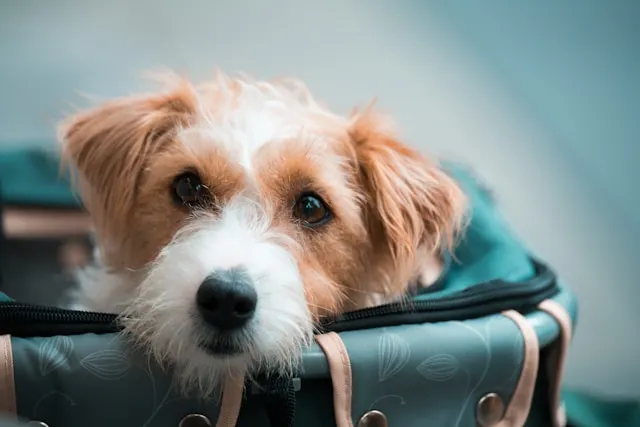
The regulations for travelling by air with animals differ from country to country and, often, from one airline to another. What is the situation on SWISS and Edelweiss?
Swiss media recently reported an incident that occurred on a SWISS flight from Zurich to São Paulo, during which a passenger repeatedly took his dog out of its carrier, ignoring the repeated requests of the cabin crew not to do so.
The animal reportedly roamed freely in the aisle, allowing other passengers to pet it.
Though this may seem harmless enough (unless the dog was a Pitbull), the Federal Office of Civil Aviation didn’t think so: the passenger was fined 791 francs.
This case raises a question of what rules pet owners must comply with on board Switzerland’s airlines, so they don’t find themselves in the doghouse.
But first: what animals are you allowed to bring on board?
SWISS mentions dogs and cats, but also…rabbits and hares.
This basically excludes any other small animals you may keep as pets, like ferrets or hamsters, and even more so, tarantulas and pythons.
(There are reports of people actually trying to board with a live rooster and other poultry, a miniature horse, a peacock, and a baby kangaroo under the guise of ‘service animals’).
Advertisement
The rules on SWISS
As cats rarely (if ever) create problems on board (aside possibly from loud meowing), most regulations concern dogs.
As is the case on most airlines (including SWISS’ sister airline, Edelweiss), service animals are allowed on board, but under certain conditions.
According to SWISS website, “to ensure that the flight can operate safely and securely, your dog must be trained to obey you and behave appropriately in a public space (e.g. no barking, growling or jumping up at people).”
Before you board, the ground crew will check whether the dog meets all the qualifications for an assistance dog – for instance, how it behaves in public or whether it exhibits any disturbing or aggressive behaviour that might suggest that the dog has not been properly trained; they will also ensure that it wears a harness.
“If your dog does not behave appropriately, SWISS may charge you to carry the dog as cargo or refuse to carry the dog altogether. You will be liable for damages and additional costs that arise in connection with the carriage of the dog.”
Advertisement
What about ordinary, non-assistance dogs?
Each passenger is permitted to take a maximum of two animals, provided they are in the airline-approved transport container.
One would be allowed in the cabin and the other would be transported in cargo.
“Whether your animal travels in the cabin or in the hold depends on its weight and the size of its transport container,” the airline stipulates.
Also, dogs and cats are only permitted to travel from the age of 12 weeks and no pregnant animals are allowed.
Advertisement
Are dangerous breeds allowed on airplanes?
Dogs that are considered dangerous may only be carried in a suitable cargo crate and are not permitted in the cabin. (Dogs aged between 3 and 6 months old are exempt from this regulation).
But even in the cargo hold, these breeds must be kept in fortified cages – for instance, ones made from wood, metal, synthetic materials (not plastic), welded wire mesh or standard wire mesh.
The door must be made from a heavy-duty wire mesh, metal or reinforced wood and must be equipped with a safety lock that prevents accidental opening.
The rules on Edelweiss, by the way, are in line with its big sister’s (that is, SWISS’).
Advertisement
Mind where you are going
Both airlines have a list of countries where either total embargos, or restrictions ,are in place for incoming pets.
You can see them here:


