


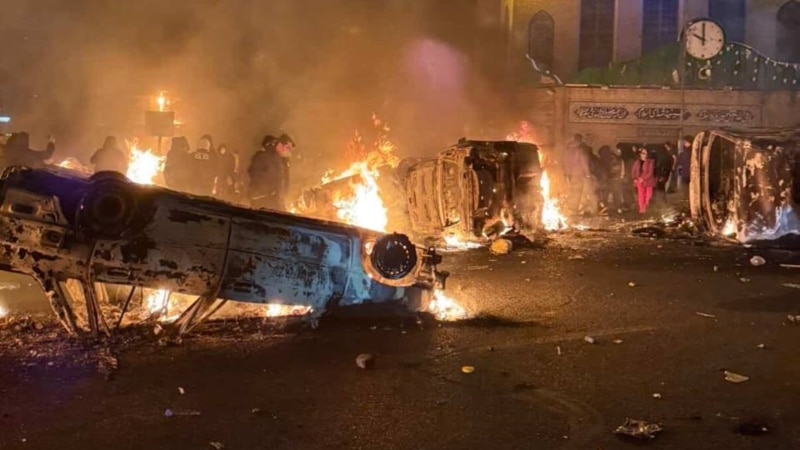
Iran has entered a 14th night of protests as authorities seemed to be intensifying their crackdown and Western leaders — including US President Donald Trump — stepped up pressure on Tehran.
Speaking at a meeting with oil and gas executives at the White House on January 9, Trump said that “Iran is in big trouble. It looks to me that the people are taking over certain cities that nobody thought were really possible just a few weeks ago.”
“We’re watching the situation very carefully. I’ve made the statement very strongly that if they start killing people like they have in the past, we will get involved. We will be hitting them very hard where it hurts. That does not mean boots on the ground, but it does mean hitting them very, very hard where it hurts.”
This was followed up by a short post on X by US Secretary of State Marco Rubio on January 10, stating that the United States “supports the brave people of Iran.”
The protests, which began on Tehran’s Grand Bazaar on December 28, quickly snowballed, spreading to dozens of towns and cities.
By the evening of January 8, videos poured in from nearly every corner of the country showing huge crowds chanting and marching.
Authorities first throttled nationwide Internet speeds before enforcing a near-total blackout at 10:15 p.m. local time on January 8, severing phone lines too.
With the blackout now lasting more than 40 hours there is no precise information about the number of people killed, injured, or detained across the country with widespread fears that the cut is being used to hide state violence against protesters.
Amnesty International released a statement on January saying that it was investigating “distressing reports that security forces have intensified their unlawful use of lethal force against protesters” which has “led to further deaths and injuries.”
There have also been media reports, including by AFP, that hundreds of people had been taken to a Tehran hospital with “severe eye injuries” caused by pellet gun fire.
The Human Rights News Agency (HRANA), which covers human rights-related news, has reported that at least 2,311 people were arrested in the first 13 days of the protests and that demonstrations were reported in 512 locations across 180 towns and cities amid a near-total Internet shutdown. Additionally, the Norway-based Iran Human Rights has said that 51 protesters have been killed as of January 9.
In a joint statement issued on January 9, the leaders of France, Germany, and the United Kingdom expressed “deep concern about reports of violence by Iranian security forces, and strongly condemn the killing of protestors.”
The text also added that the Internet blackout “has sparked fears among activists that authorities are now violently cracking down on the protests, with less chance the proof will reach the outside world.”
An EU statement issued on the same day also called for “the right of access to information, including by restoring access to the Internet for all” while expressing “solidarity with the Iranian people as they voice their legitimate aspiration for a better life, freedom and dignity.”
Prince Reza Pahlavi, whose father — Iran’s last shah Mohammad Reza Pahlavi — was ousted by the Islamic Revolution in 1979, issued a message of support on social media for the protesters, telling them that they have “won the admiration of the world with your courage and steadfastness” while announcing that he was planning to return to Iran in the near future.
Protesters came out in force on January 8 and January 9 night following calls by Reza Pahlavi for sustained street demonstrations.
Iranian Supreme Leader Ayatollah Ali Khamenei addressed supporters of the regime on January 9, saying that “saboteurs, agitators” had “destroyed the country’s buildings to please” President Trump.
He added that Trump has the “blood of Iranians on his hands” following US strikes on Iran in June, and that the US leader would be “overthrown.”
The Iranian army later issued a statement announcing it would join other armed forces to “guard and protect the country’s strategic infrastructure and public property” during the protests.
Separately, the authorities said several members of the security forces have been killed as state TV broadcast images on January 10 of funerals of security officers allegedly killed in the protests, including a large gathering in the southern city of Shiraz.


