


Iran’s Assembly of Experts is set to meet to select a new supreme leader, one of its members said on March 7, as the White House said it was looking for an “acceptable” candidate to lead the country.
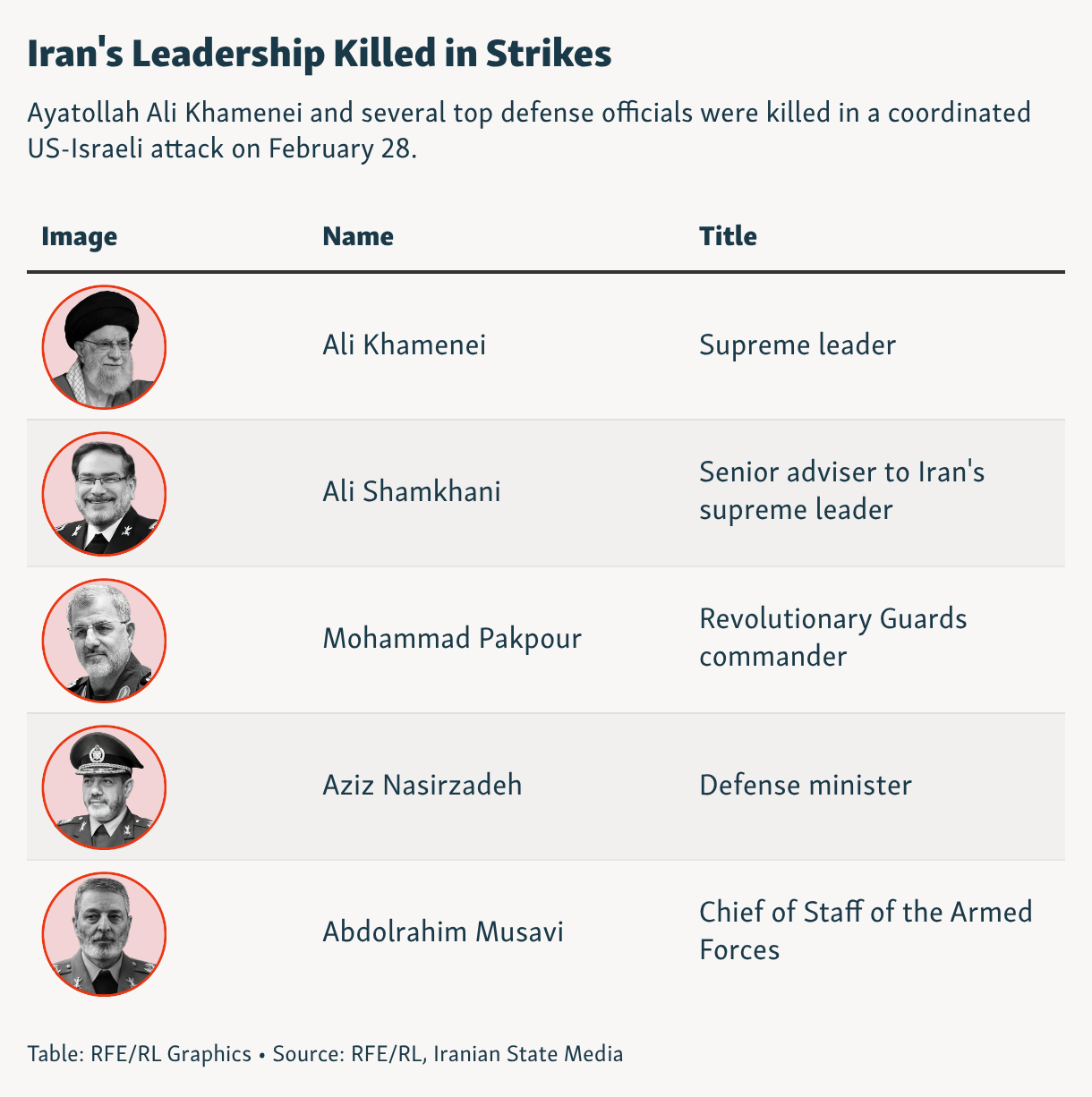
With Supreme Leader Ayatollah Ali Khamenei killed on the first day of a joint US-Israeli military campaign against Iran on February 28, it is the first time in 36 years that Tehran finds itself having to pick a new supreme leader.
According to Fars, a semiofficial news agency that is close to Iran’s Islamic Revolutionary Guards Corps, Hossein Mozafari, a member of the 88‑seat Assembly of Experts, said he had “strong hope” that a decision would be made within the next 24 hours.
Meanwhile, the United States has voiced its interest in being involved in the selection, with President Donald Trump saying the next leader should be “GREAT & ACCEPTABLE.”
“I know there are a number of people that our intelligence agencies and the United States government are looking at, but I won’t go any further than that,” White House press secretary Karoline Leavitt told reporters at the White House on March 6.
Leavitt’s comments came after Trump ruled out Khamenei’s son, Mojtaba Khamenei — a hardliner who has been considered a favorite to succeed his father — as a successor and suggested that the only acceptable outcome of the US military campaign in Iran would be its “UNCONDITIONAL SURRENDER.”
“What the President means is that when he, as Commander in Chief of the US Armed Forces, determines that Iran no longer poses a threat to the United States of America, and the goals of Operation Epic Fury has been fully realized, then Iran will essentially be in a place of unconditional surrender, whether they say it themselves or not,” Leavitt said.
“Frankly, they don’t have a lot of people to say that for them,” she added, saying the Untied States and Israel killed at least 50 leaders of the Iranian regime since the beginning of its military campaign a week ago.
On March 7, Iranian President Masud Pezeshkian has rejected Trump’s demand saying that “the Americans can take their demand of a surrender of the Iranian people to their graves.”
Shortly afterward, Trump announced that the United States is considering expanding the range of targets inside Iran, including areas and individuals.
“Under serious consideration for complete destruction and certain death, because of Iran’s bad behavior, are areas and groups of people that were not considered for targeting up until this moment in time,” he wrote on social media.
In a fact sheet published later on March 6, the US military said that during the first week of the war it struck over 3,000 Iranian targets, including Tehran’s command-and-control centers, air defense systems, missile sites, ships, and submarines.
Now, Washington expects its achievable objectives in Iran to be completed in four to six weeks, Leavitt said, adding that the United States is well on its way toward controlling Iranian airspace.


