


Addressing the International Atomic Energy Agency (IAEA) Board of Governors, Director General Rafael Grossi said the agency remains focused on preventing a nuclear accident as fighting continues to endanger critical infrastructure.
“The conflict in Ukraine is about to enter its fifth year,” Mr. Grossi said. “It continues to pose the world’s biggest threat to nuclear safety.”
IAEA teams remain deployed at all nuclear power plants affected by the conflict and publish regular updates on nuclear safety and security conditions.
The Board of Governors is the IAEA’s main decision-making body, bringing together representatives of 35 countries to oversee nuclear safety, security and safeguards, and to guide the work of the UN nuclear watchdog. Its current membership includes, among others Russia, the United States, United Kingdom, and France.
Off-site power a critical safety lifeline
Mr. Grossi stressed that a central safety requirement is reliable off-site power – the electricity a plant receives from the national grid. Without it, nuclear sites must rely on backup systems to run cooling and other essential safety functions.
“There must be secure off-site power supply from the grid for all nuclear sites,” he said, pointing to the IAEA’s “Seven Pillars” guidance for nuclear safety during armed conflict, where off-site power is pillar number four.
He also cited Principle 3 of the IAEA’s Five Principles for protecting the Zaporizhzhya Nuclear Power Plant (ZNPP) that “all efforts should be made to ensure off-site power remains available and secure at all times.”
Mr. Grossi said both sets of guidance have broad international support, including from the parties directly involved, and that he has repeatedly called for adherence to them, including at the UN Security Council.
Progress at Zaporizhzhya amid ongoing risks
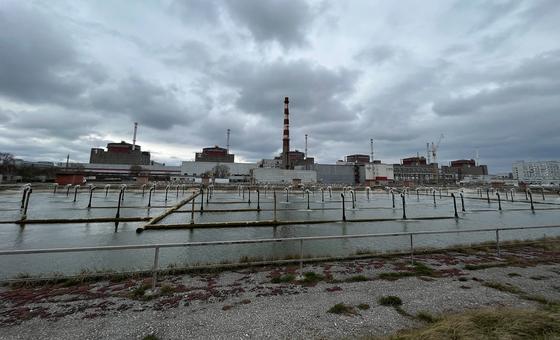
He reported recent progress at ZNPP, where Europe’s biggest plant was reconnected on 19 January to its last remaining 330-kilovolt backup power line after repairs were carried out under a temporary ceasefire negotiated with Ukrainian and Russian counterparts.
The line had been damaged and disconnected since 2 January, reportedly due to military activity.
Until the reconnection, ZNPP relied on its last remaining 750-kilovolt main line to provide off-site power for safety systems needed to cool its six shutdown reactors and spent fuel pools. IAEA teams are also monitoring the plant’s ability to manage winter conditions, including keeping water in cooling and sprinkler ponds from freezing.
Beyond the plants themselves, Mr. Grossi warned that Ukraine’s electrical substations are also crucial to nuclear safety. “Damage to them undermines nuclear safety and must be avoided,” he said. An IAEA expert mission is now assessing 10 substations vital to nuclear safety amid ongoing strikes on the country’s power infrastructure.
Other nuclear sites also affected
IAEA teams have also reported military activity near other nuclear facilities, including the Chornobyl site, where damage to a critical substation disrupted multiple power lines and forced temporary reliance on emergency diesel generators. The affected lines have since been reconnected.
Mr. Grossi said the IAEA has shown how international institutions can help reduce risks and provide predictability in a volatile war. But, he added, technical measures have limits.
“The best way to ensure nuclear safety and security,” he said, “is to bring this conflict to an end.”


