


Universal Music Group and Believe have settled the copyright infringement lawsuit filed against the Paris-headquartered music company and its distribution platform TuneCore in late 2024.

A Joint Stipulation of Dismissal With Prejudice was filed today (April 3) in the US District Court for the Southern District of New York, confirming that all claims in the case have been dismissed.
The dismissal “with prejudice” means the claims cannot be refiled. The financial terms of the settlement have not been disclosed.
UMG confirmed to MBW that the litigation was resolved amicably.
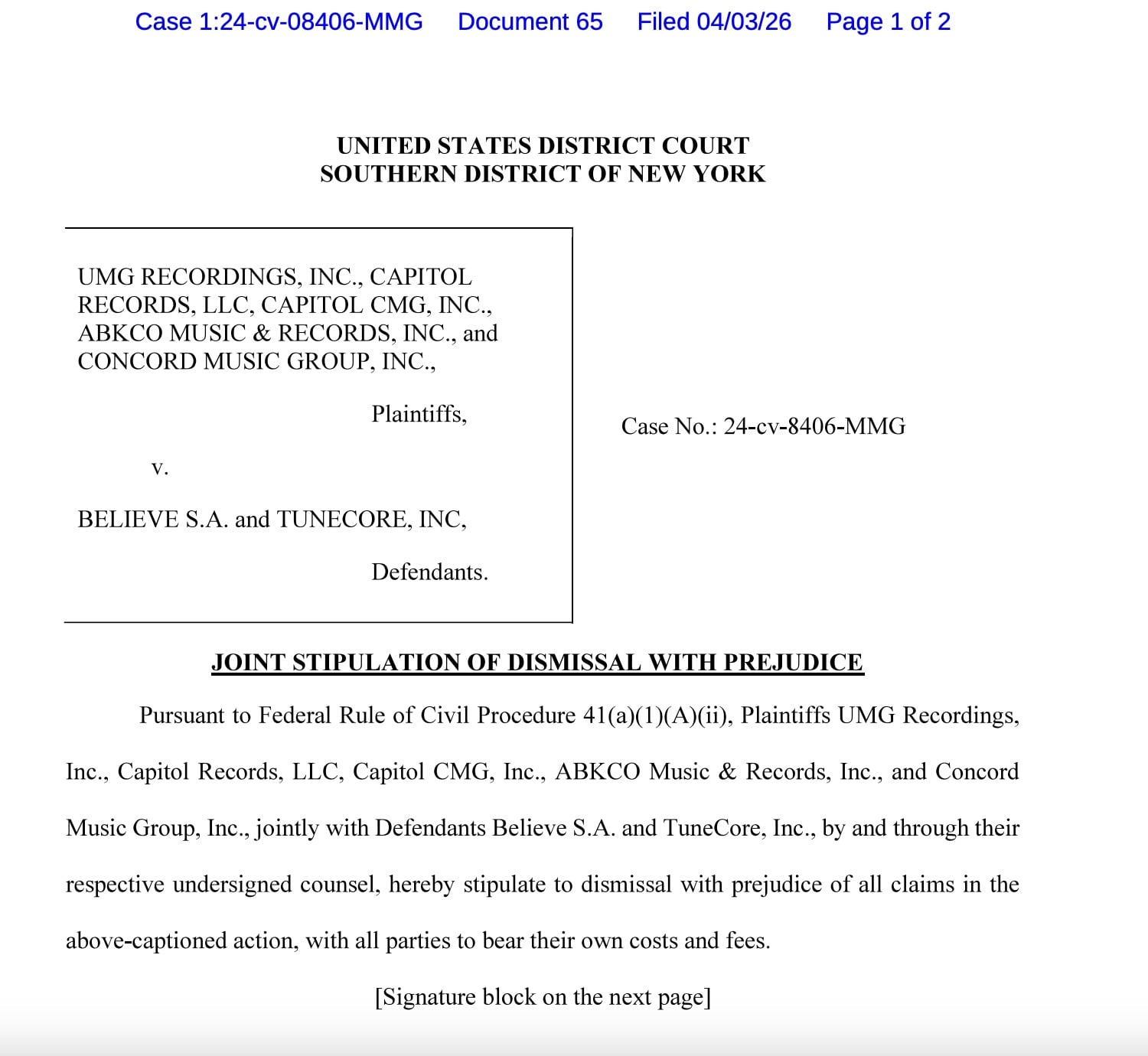
The plaintiffs listed in the dismissal filing are UMG Recordings, Capitol Records, Capitol CMG, ABKCO Music & Records, and Concord Music Group.
The defendants are Believe S.A. and TuneCore, Inc.
UMG, alongside ABKCO Music & Records and Concord Music Group, filed a complaint against Believe and TuneCore in the US District Court for the Southern District of New York on November 4, 2024, seeking damages of at least $500 million.
At the heart of the case was a sweeping allegation: that Believe had built its business through what UMG described as “industrial-scale copyright infringement” of some of the world’s most popular copyrighted recordings.
The complaint focused heavily on the distribution of so-called “manipulated” audio — tracks that were typically sped-up or remixed versions of copyrighted recordings, uploaded to major streaming platforms including Spotify, Apple Music, YouTube, TikTok, and Instagram without authorization.
The settlement arrives in the same week that TikTok’s distribution service SoundOn announced a partnership with content recognition firm ACRCloud to deploy new detection technology designed to intercept manipulated audio before it reaches streaming platforms — signaling that the industry at large is moving to tackle the legitimacy of uploads at the distribution level.
UMG presented numerous examples of tracks uploaded under deliberately misspelled artist names — “Kendrik Laamar,” “Arriana Gramde,” “Jutin Biber,” and “Llady Gaga” among them — described as thinly veiled copies of original recordings by the likes of ABBA, Drake, Elton John, Kendrick Lamar, Lady Gaga, Nirvana, and the Rolling Stones.
A key strand of the case centered on YouTube’s Content ID system.
The plaintiffs alleged that Believe had manipulated Content ID to claim ownership of copyrighted recordings and monetize content it had no right to exploit — and that even after losing ownership disputes on YouTube, Believe continued to distribute the same infringing tracks on other platforms.
In its original statement issued in 2024, a spokesperson for Universal Music Group said: “Believe is a company built on industrial-scale copyright infringement. Their illegal practices are not limited to cheating artists on major labels but artists on independent labels as well—including artists on the independent labels within the trade bodies of which Believe is itself a member.
“It’s no wonder that Believe has been outspoken against the streaming reform principles for which so many major and independent labels have been advocating. Why? Because such reforms would undermine and expose their system of building scale and market presence by distributing music for which they have no rights and illegally collecting royalties to enrich themselves and their coconspirators.”
Believe responded swiftly to the filing, stating that it “strongly refute[d]” the claims and would fight them, emphasizing its nearly two decades in the digital music ecosystem and its Tier 1 status across major music stores.
The lawsuit emerged against the backdrop of broader concerns in the industry over unauthorized “modified” tracks.
It followed UMG’s high-profile fallout with ByteDance earlier in 2024, which saw UMG pull its catalog from TikTok between February and May before the two sides struck a new licensing deal that included commitments from TikTok to protect UMG’s roster against AI-made and manipulated music.
In October 2024, TikTok walked away from licensing negotiations with indie collective Merlin, citing concerns over significant volumes of sped-up and manipulated versions of existing recording copyrights being uploaded by some Merlin-repped parties.
It also came amid intensifying scrutiny of distributor liability, following Sony Music‘s case against rapper Trefuego, who was ordered in March 2024 to pay $802,997.23 in damages over his track 90mh, which sampled a 1986 composition by Toshifumi Hinata without authorization.
That case targeted the individual artist rather than his distributor, DistroKid — $14,078.82 of which was money held by DistroKid, frozen after it learned of the lawsuit. UMG’s decision to pursue Believe directly, rather than individual uploaders, represented a significant strategic escalation.
It was also not the first time Believe and TuneCore had faced such litigation. In 2020, it was hit with a lawsuit by Round Hill Music over the unauthorized distribution of compositions it controlled, a case that was also resolved through settlement.Music Business Worldwide


