


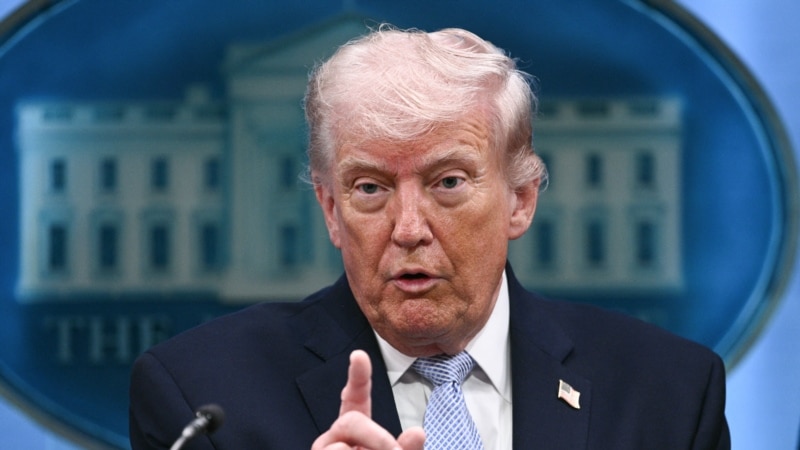
WASHINGTON — US President Donald Trump renewed his threat to wipe out Iran’s power plants and bridges if it doesn’t reach an agreement to end the war and open the Strait of Hormuz, warning the country could be “taken out in one night.”
Speaking on April 6 at a White House news conference alongside Defense Secretary Pete Hegseth, Joint Chiefs Chairman Dan Caine, and CIA Director John Ratcliffe, Trump framed the moment as a defining point in a rapidly escalating confrontation.
“The entire country could be taken out in one night — and that night might be tomorrow night,” Trump said, underscoring an April 7 deadline for Iran to comply with the US demands.
“This is a critical period. They have a period of, well, till tomorrow, at eight o’clock.”
Tehran has shown little sign of backing down. Earlier in the day, Iranian officials rejected a 15-point ceasefire proposal from Washington as “excessive” and “unreasonable,” while fighting with Israel intensified overnight.
Trump said he couldn’t discuss the proposal, but added Washington has “an active, willing participant on the other side” of negotiations.
Asked if he’s worried that the bombing of power plants and bridges would be seen as war crimes, Trump added, “No. I hope I don’t have to do it.”
Iran’s so-called Top Joint Military Command, the body coordinating operations between the Islamic Revolutionary Guards Corps (IRGC) and the regular army, called the president’s comments “rude, arrogant rhetoric and baseless threats,” the Nour News media outlet reported, citing a statement from the body..
Trump’s briefing opened with what he described as a “very historic” rescue mission: the extraction of two US servicemen whose F-15 fighter jet went down over Iranian territory.
According to Trump and his military leadership, the operation involved a massive deployment of more than 150 aircraft — including bombers, fighters, refueling tankers, and rescue units — operating under heavy enemy fire.
“We leave no American behind,” Trump said, acknowledging the risks. “We could have ended up with 100 dead.”
One of the downed airmen, badly injured, survived nearly 48 hours behind enemy lines, evading capture in terrain controlled by Iran’s Islamic Revolutionary Guards Corps (IRGC).
Trump described how the pilot “scaled cliff faces, bleeding rather profusely,” treating his own wounds while transmitting his location.
General Caine detailed an “air armada” shielding the rescue, while Ratcliffe said the mission relied on a “deception campaign” to mislead Iranian forces hunting the pilot.
“It was a race against the clock,” Ratcliffe said, noting the use of both human intelligence and advanced surveillance technologies.
Military analysts say the operation stands out for its complexity.
Speaking to RFE/RL on April 5, retired US Air Force Lt. Gen. David A. Deptula described it as a rare and highly dynamic combat rescue.
“This combined deep recovery inside hostile Iranian territory, uncertain survivor location, enemy pursuit, mountainous terrain, and real-time adaptation under fire,” he said.
He emphasized that such missions require coordination across intelligence, airpower, and communications — and signal both US capability and the persistent dangers of operating over Iran.
During the White House briefing, Trump revealed that not all military officials supported the rescue mission, with some citing concerns about the risks of sending hundreds of personnel into heavily defended Iranian territory.
“Usually it’s not done,” he said. “Hundreds of people could have been killed.”
Despite those objections, Trump said he personally approved the operation, calling the outcome — both airmen recovered with no fatalities — “almost impossible.”
Ultimatum and escalation
Trump’s warning centers on Iran’s control of the strategically vital Strait of Hormuz — a chokepoint for global oil shipments.
He argued that even limited disruption, such as the deployment of naval mines, could paralyze international shipping.
While claiming US forces have largely neutralized Iran’s navy and air force, Trump acknowledged residual threats remain.
“It only takes one terrorist with a truck and a water mine,” Trump said, highlighting the vulnerability of maritime traffic through a key shipping chokepoint for about 20 percent of the world’s oil and gas.
Despite the harsh rhetoric, Trump suggested negotiations are ongoing and “in good faith,” hinting at a possible diplomatic off-ramp. “They would like to make a deal,” he said, while declining to elaborate.
Earlier in the day, Trump struck a more ambivalent tone, saying he ultimately wants to end the war to satisfy the American public — even as he suggested continued conflict could secure US access to Iranian oil.
“They want us to keep bombing”
Trump repeatedly asserted that many Iranians support US strikes as a path to freedom, citing alleged intercepted communications.
“They’re saying, ‘Please keep bombing,’” he claimed, arguing that civilians are willing to endure hardship to overthrow the regime.
At the same time, he acknowledged the dangers faced by protesters, describing past crackdowns in which demonstrators were shot by security forces.
“I actually tell them don’t go out,” Trump said. “It’s not a question of bravery — it’s intelligence.”
He cited executions and repression, including the killing of protesters and dissidents, to justify his hardline stance against Tehran.
Trump also used the briefing to threaten action against a journalist who reported details of the stranded airman before the rescue was complete. “We’re going to say: ‘National security — give it up or go to jail,’” Trump said, referring to the source of the leak.
He argued the disclosure may have alerted Iranian forces and complicated the operation, though he did not name the outlet involved.
The developments come as the conflict continues to escalate across the region.
Israel said on April 6 that it struck key Iranian targets overnight, including energy infrastructure, while Iran launched new attacks in response.
Meanwhile, at least 19 people were killed and 20 injured in US and Israeli air strikes near Tehran, Iranian state media reported on April 6.


