


US President Donald Trump has warned of possible further action against Kharg Island, a key oil terminal of Iran and a major cog in the country’s economic machine.
But experts say three other Iranian islands in the Persian Gulf could also be part of efforts to pressure Tehran into reopening the Strait of Hormuz, a key artery for global oil and gas supplies.
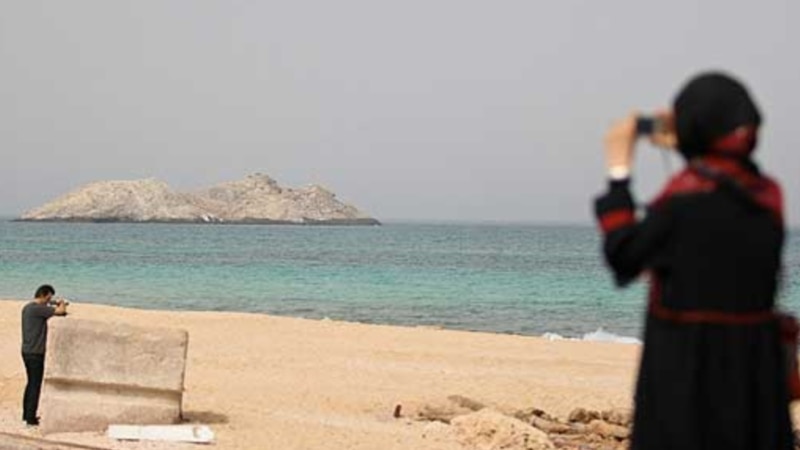
The tiny islands of Abu Musa, Greater Tunb, and Lesser Tunb sit near the mouth of the 39-kilometer-wide waterway, giving them strategic value.
Internationally recognized as part of Iran, the islands are also claimed by the United Arab Emirates (UAE). Tehran gained control of the territories just a day before the creation in 1971 of the UAE, which was until then was an informal British protectorate.
The largest of the islands, Abu Musa, is home to around 2,000 people. The two smaller islands are mostly uninhabited and home to naval and military facilities.
Pressure Tactic
The United States could seize control of the islands to break Iran’s chokehold on shipping through the Strait of Hormuz, experts say. Global oil and gas prices have soared since Iran effectively closed the narrow passage since the war began on February 28.
Seizing the three strategic islands could also give Washington a bargaining chip in any negotiation with Iran to end the war, experts say.
“The likelihood that they intend to occupy these islands is very high,” Mohammad Farsi, a former Iranian military officer who was stationed on Kharg Island in the northern Persian Gulf before the Islamic Revolution in 1979, told RFE/RL’s Radio Farda.
The deployment of two American expeditionary units, with thousands of Marines and supporting ships and aircraft, has added to speculation that Trump could order the invasion of the islands.
US media outlet Axios reported on March 26 that the Pentagon is preparing a range of military options for a potential “final blow” against Iran. They include seizing Abu Musa and the two other islands.
Iran’s speaker of parliament Mohammad Baqer Qalibaf wrote on X on March 25 that Tehran’s intelligence indicated that “Iran’s enemies, with the support of a country in the region, are preparing an operation to occupy one of Iran’s islands.” His comment was seen as a reference to Abu Musa and Iran’s claims that the UAE could help the United States take it.
The capture of other Iranian islands, including Qeshm, Larak, and Kharg, are also on the table, according to Axios. The country has over 400 islands along its southern coast.
RFE/RL requested comments from the White House, which forwarded a March 21 statement by Press Secretary Karoline Leavitt.
In the statement, Leavitt said: “It’s the job of the Pentagon to make preparations in order to give the Commander-in-Chief maximum optionality. It does not mean the President has made a decision, and as the President said in the Oval Office recently, he is not planning to send ground troops anywhere at this time.”
Would It Actually Work?
Farsi said he was skeptical that seizing Abu Musa, Greater Tunb, and Lesser Tunb would achieve its stated goal of keeping the strait open for oil tankers.
“The threat from Iran doesn’t require ships or vessels,” he said. “Iran can strike from a distance with drones and missiles.”
As long as Iran’s missile and drone infrastructure on the mainland remains intact, Farsi said, no island garrison or naval escort force can reliably guarantee safe passage through the strait.
“Even the occupation of these islands and any naval force trying to enforce free passage would face enormous difficulty,” Farsi said. “In my view, the situation may not end up any better — or any easier — than it is now.”
The US capture of any Iranian islands would also trigger major retaliation from Tehran, observers say, and put American ground forces in danger.
Farsi also noted the human cost of any operation. Several thousand people live on the three islands and any assault, he said, would require preliminary bombardment before ground forces could move in.


