


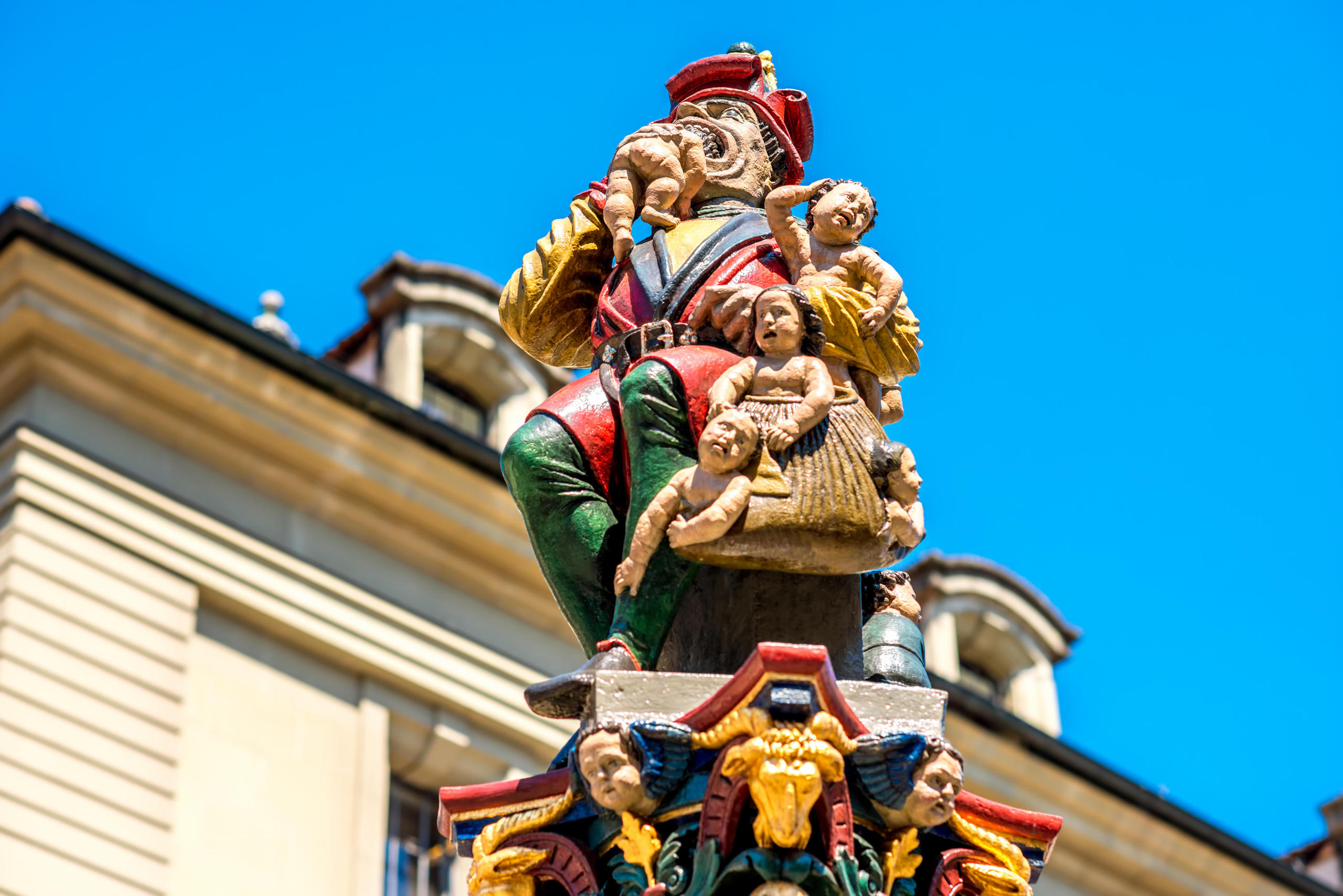
The Kindlifresserbrunnen was created in 1545/46 by the sculptor Hans Gieng.
Rosshelen Editorial / Alamy Stock Photo
If you visit Bern with children, best stay away from Kornhausplatz, where a fountain could well give them nightmares.

Fountains generally instil a sense of peace and tranquillity. It is no coincidence that they are an important element of living principles inspired by the Taoist doctrine of feng shui (literally “wind and water”).
However, passing in front of the Kindlifresserbrunnen (baby-eater fountain) in Bern, this sense of peace and tranquillity is in short supply.
In fact, the fountain in the centre of the Swiss capital depicts a kind of ogre devouring a baby and holding others crying in a bag, ready to be gobbled in turn.
Created in 1545/46 by the sculptor Hans Gieng, the Kindlifresserbrunnen is one of the most visited monuments in Bern and is located a stone’s throw from the Zytglogge, the Clock Tower, one of the city’s most famous landmarks.
But what exactly is this fountain meant to depict? According to the websiteExternal link of the tourist office of the city of Bern, “the most plausible [theory] is that the fountain represents an educational measure and the frightening figure is intended to instil fear in children in order to teach them good behaviour”.
A suspicious hat
No doubt, but the reality is a bit more complex. Some have seen in the character depicted on the fountain a humorous figure linked to carnival. This explanation is doubtful, however, given that carnival was banned in Bern after the Reformation in 1529.
A slightly more plausible interpretation is that the ogre represents the Greek god Kronos (Saturn in the Roman equivalent). In order to prevent the fulfilment of the prophecy of an oracle, which had announced that one day a son would oust him, Kronos swallowed his newborn children, as he could not simply kill them, as they were immortal.
Leading to this hypothesis is the figure’s hat, similar to that of the Saturn painted around 1530 by German artist Georg Pencz or depicted on a Nuremberg woodcut of 1492.

On the left is Peter Wagner’s woodcut from 1492 (Wikipedia) and on the right a detail of Georg Pencz’s painting ‘Saturn’ (zeno.org).
Wikipedia & Zeno.org
However, the hat has another peculiarity: it is the cone-shaped (and often yellow) headgear that Jews were forced to wear for centuries well after the Middle Ages in various European regions.
Is the Kindlifresserbrunnen therefore nothing more than yet another depiction of Christian anti-Semitism? The hypothesis seems highly probable.
The accusation of blood
The Bernese fountain would be a perfect illustration of one of the most infamous prejudices, especially in the Middle Ages but also in more recent times, against the Jewish community: the accusation of blood.
Appearing around the 12th century, this hoax, as we would call it today, was based on the belief that for their obscure rites, particularly the Passover rites, Jews would kill a Christian child and use its blood to make unleavened bread.
More
More
How Christian Europe created anti-Semitism in the Middle Ages
Bern was not immune to this legend. In 1294, members of the Jewish community had been accused of murdering – crucifying no less – a child named Rudolf, later beatified by the Church. The murder resulted in a pogrom. Although the city authorities didn’t believe in the hypothesis of ritual murder (and probably not even in the guilt of the two accused), they seized the opportunity and decided to expel the Jews from the city, thus avoiding, above all, having to pay the debts they had run up with them.
This fountain has come up again much more recently. In 2020, writer and journalist Roy Oppenheim asked the city authoritiesExternal link to at least add an explanatory text, putting the sculpture in its historical context and to “unequivocally distance themselves from the resolutely anti-Semitic character of the fountain”. As a result, in 2024 the city affixed an information plaqueExternal link in front of the fountain.
Be that as it may, for those boys and girls who can’t yet read, the Kindlifresserbrunnen will continue to serve as a terrifying warning: be good, or else…
Edited by Samuel Jaberg. Translated from Italian by AI/ts
We use automatic translation tools, such as DeepL and Google Translate, for some content.
Each translated article is carefully reviewed by a journalist for accuracy. Using translation tools gives us the time for more in-depth articles.
Learn more here about how we work with AI.


