


During the summer holidays, traffic on Swiss roads is quite a bit heavier than the rest of the year. Here are the dates when bottlenecks are set to be the heaviest.
If you don’t want to spend hours sitting in traffic, or else move at a snail’s pace, you’d do well to abstain from driving on peak travel dates and opt for alternative dates instead.
But first, you need to know where the busiest roads are.
The roads most travelled
When it comes to traffic jams, not all roads and motorways are equal.
Typically, roads around urban areas, as well as those leading to popular holiday destinations in Switzerland and abrod, are the most congested during the summer.
According to the Federal Roads Office (ASTRA), “the effects of holiday travel will be felt primarily on the A2 and in the Zurich, Bern, Basel, Lucerne, and Lugano regions, around the Gotthard Tunnel, and on the San Bernardino road.”
Therefore it makes sense to avoid those roads during peak travel times.
“If possible, don’t drive from Friday to Sunday, and travel during the week instead,” ASTRA suggests. “Do the same for day trips to areas where traffic jams are common.”
Advertisement
The Gotthard: Switzerland’s major bottleneck
There is a good reason why ASTRA listed this road among Switzerland’s most congested.
It is a well known fact that the 17-km-long Gotthard tunnel, which connects the canton of Uri with Ticino, is terribly jammed during summer vacations, as well as before and after public holidays.
Its hours-long traffic jams are notorious, as not only Swiss drivers take it, but foreign ones transiting through Switzerland use it too because it is a gateway to Italy.
Advertisement
Follow the colours
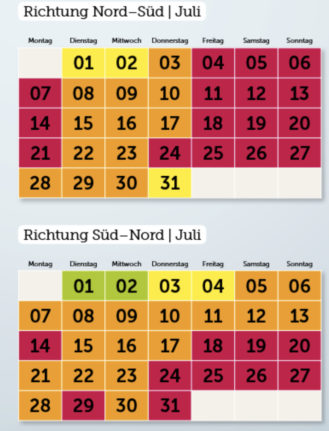
Therefore, each year at this time, Swiss motoring organisation TCS publishes a colour-coded calendar showing when to avoid this route and when it is ok to take it.
This is what the 2025 version looks like going both ways — that is, north to south and vice versa.
TCS
The red boxes designate ‘very heavy travel’ days, orange ‘heavy travel’, yellow ‘slow traffic’, and green ‘fluid traffic.’
However, there are only two ‘green’ days during the whole month of July when the traffic is expected to move smoothy — July 1st and 2nd (of course, if everyone decides to hit the road on those two ‘good’ days, then the traffic will be heavy then as well).
The worst days to travel are long weekends, that is from Thursday to Monday, with Tuesday July 29th included in there as well.
If unsure about the flow of traffic on any given day, you can check real-time traffic information here.
Advertisement
What about August?
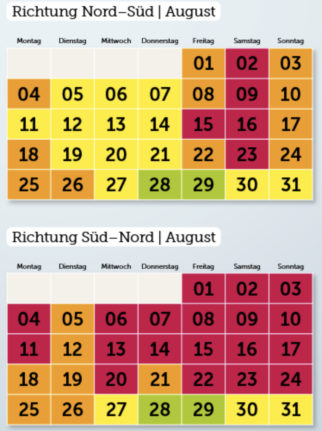
This month not only marks the return of holidaymakers for the beginning of the new school year, which ranges from August 8th to August 15th in most cantons, but also the Swiss National Day on August 1st, which this year falls on a Saturday.
This means — and the TCS calendar confirms it, that August will be extra heavy traffic month.
While the southbound traffic toward Ticino and Italy will be lighter (because people are returning home), the traffic toward Switzerland is expected to be heavy on most weekends and sometimes during the week as well.
TCS
In fact, the only ‘safe’ days to travel (both south- and northbound) are August 28th and 29th.
For the rest, expect heavy traffic on most days, though to varying degrees.
And by the way, it follows that the road leading up to the Gotthard — the A2 motorway — will be congested on the ‘red’ days as well.
Here you can see the traffic on the tunnel-bound traffic on the A2 live.
READ ALSO: Where are the roads in Switzerland to avoid this summer?


