


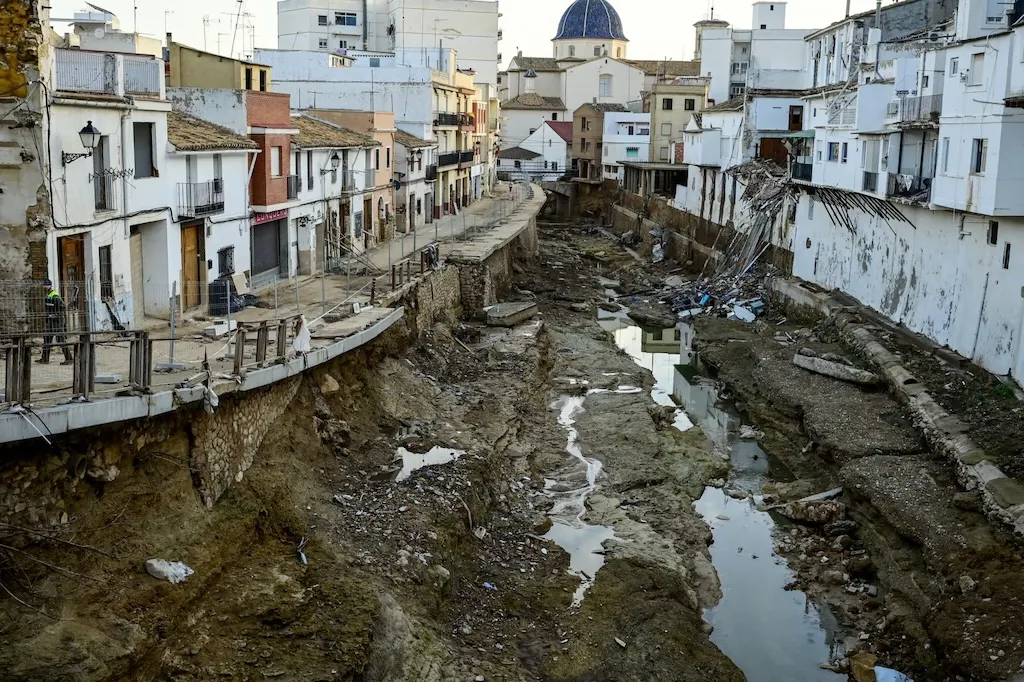
A year on from the destructive and deadly floods that hit Valencia, a new study has found that more than 4,000 key buildings are still at risk of being destroyed if a similar storm were to hit Spain.
The anniversary of the devastating floods in Valencia and the surrounding areas is coming up on October 29th, in which over 220 people lost their lives. This widespread flood damaged or destroyed homes, bridges, schools, shops and more.
One year on though, the risk from flooding in Spain hasn’t changed.
In fact, according to the Sustainability Observatory, Spain has a total of 4,340 critical buildings and infrastructures located in areas at risk of flooding.
READ ALSO: Tens of thousands protest in Valencia on anniversary of deadly flood
These buildings include hospitals, Civil Guard barracks, schools, chemical plants, fire stations, factories, bus stations, nursing homes and more according to official data.
A total of 10,197 of these were actually built on floodplains. The study estimates that 71 percent of these are in very serious danger, 13 percent are serious and 16 percent are in minimal danger.
Catalonia is the region with the highest number of sites in a very serious danger, with 37 percent, followed by Galicia with 16 percent.
This is surprising since many of the most serious floods in recent years have mostly taken place in Valencia, Murcia and the Balearic Islands. Nevertheless, there have been several in Catalonia, especially the southern part of the region during this time too.
Out of these sites, the Sustainability Observatory has identified 4,340 critical sites, 2,673 of which are at very serious risk, located in flood zones.
READ ALSO – ‘Hard to move on’: Spain’s flood survivors rebuild and remember one year on
Advertisement
A total of 1,994 or 56 percent are where vulnerable people are housed, 283 or 9 percent are state security owned, 115 health or 3 percent are health-related buildings, 534 or 17 percent have to do with environmental security, 1,152 with basic services and industries and 262 with transportation.
The largest percentage where vulnerable people are housed include nursing homes, special education centres and schools.
Because of these shocking numbers, the Observatory emphasises that one of the first actions to adapt to climate change must be the protection of the most vulnerable populations and critical infrastructure.
To do this it has recommended installing early warning systems with strict protocols and implementing a flood risk ratings label for certain buildings.
Other steps it suggests are moving developments away from high-risk areas, halting new construction in these places and reviewing previously approved plans to check they’re not in flood risk zones.
READ ALSO: Why is Spain’s Valencia region so prone to destructive flooding?
Advertisement
Some of these were also measures that locals in Valencia have been demanding during their many protests at the handling of the flood warnings and the response by authorities.
The study also calls for the importance of creating sustainable infrastructure to replace the most critical ones in danger like water supply plants, wastewater treatment plants, sewage treatment plants, telecommunications plants, communication routes, energy networks, and hospitals.
Thirdly, it demands urgent protective measures for the most vulnerable people in society. This includes relocations of those living in very high-risk areas.
Lastly, it calls for the mandatory accountability when it comes to public policies, flood risk plans and plans for an uncertain future due to climate change.


