


Photo: Serhii Nuzhnenko/RadioSvoboda.org (RFE/RL)
After years of Russian drone and missile barrages, piles of broken concrete are becoming a towering problem in Ukraine.
“You can’t landfill it, you can’t just ignore it, you can’t even use it for filling holes because there aren’t that many holes that need filling,” Leon Black told RFE/RL. The expert on infrastructure materials at Leeds University is one of the leads of S3RoU, (safe, sustainable, and swift reconstruction of Ukraine), an initiative led by British, Ukrainian, and Dutch engineers, which is turning the rubble of war into raw building materials.
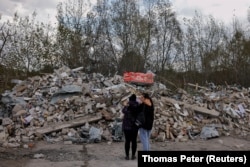
“Before Russia’s invasion, there wasn’t much emphasis on recycling,” Black said, citing Ukraine’s plentiful stone and mineral deposits used in concrete production. “What the conflict has thrown into sharp perspective is that there’s simply too much rubble to either bury it in landfill or to use for low-grade applications.”
The S3RoU project uses fledgling technology to crush, “ballistically separate” and heat concrete rubble, reverting it to its constituent parts of gravel, sand, and dried cement paste.
The deafening mechanical process is comparable to taking a cake and reverting it into flour, sugar, and eggs from which another dessert can be baked.
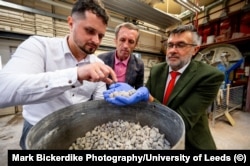
The project’s founders claim the resulting aggregate will be 30 percent cheaper than virgin cement mix. Black says the upcycled material is adequate for most building applications.
Breaking the rubble down emits only a tiny fraction of the carbon dioxide emitted by primary cement production, which is responsible for an astonishing 8 percent of all man-made greenhouse gas emissions worldwide.
The S3RoU project’s end goal is a fleet of “fully mobile, truck-mounted concrete separation” stations that can be transported from site to site throughout Ukraine to grind rubble into bagged cement.
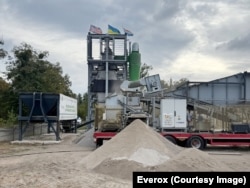
One such processing plant arrived in Ukraine this summer for testing and is currently undergoing trials just outside Kyiv. Demonstration products, including concrete paving stones made from processed rubble and imprinted with QR codes to promote the upcycling project, are currently being planned.
If large-scale rubble upcycling becomes a reality in Ukraine, one of the chief hazards will be bomb-shattered asbestos. The cancer-causing mineral has been prohibited in construction in the EU since 2005 but was only banned in Ukraine in 2022 and is commonplace throughout the country.
Black says a handheld asbestos detector was being developed that looked promising but the company behind it eventually cancelled the product. “So we’re back to the drawing board, back to square one in terms of how we deal with this,” he says.
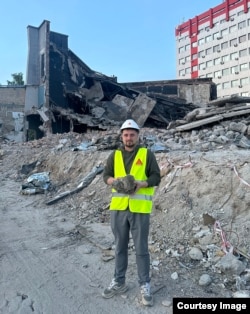
Oleksii Hunyak is one of the Ukrainian academics working on the British-funded project. His own home in Lviv was nearly reduced to rubble when a Russian missile struck his neighborhood, blowing out the windows of his apartment.
He says the upcycling project “will directly contribute to the safe and rapid recovery of Ukraine by helping us transform demolition debris into a resource for resilient rebuilding.”


