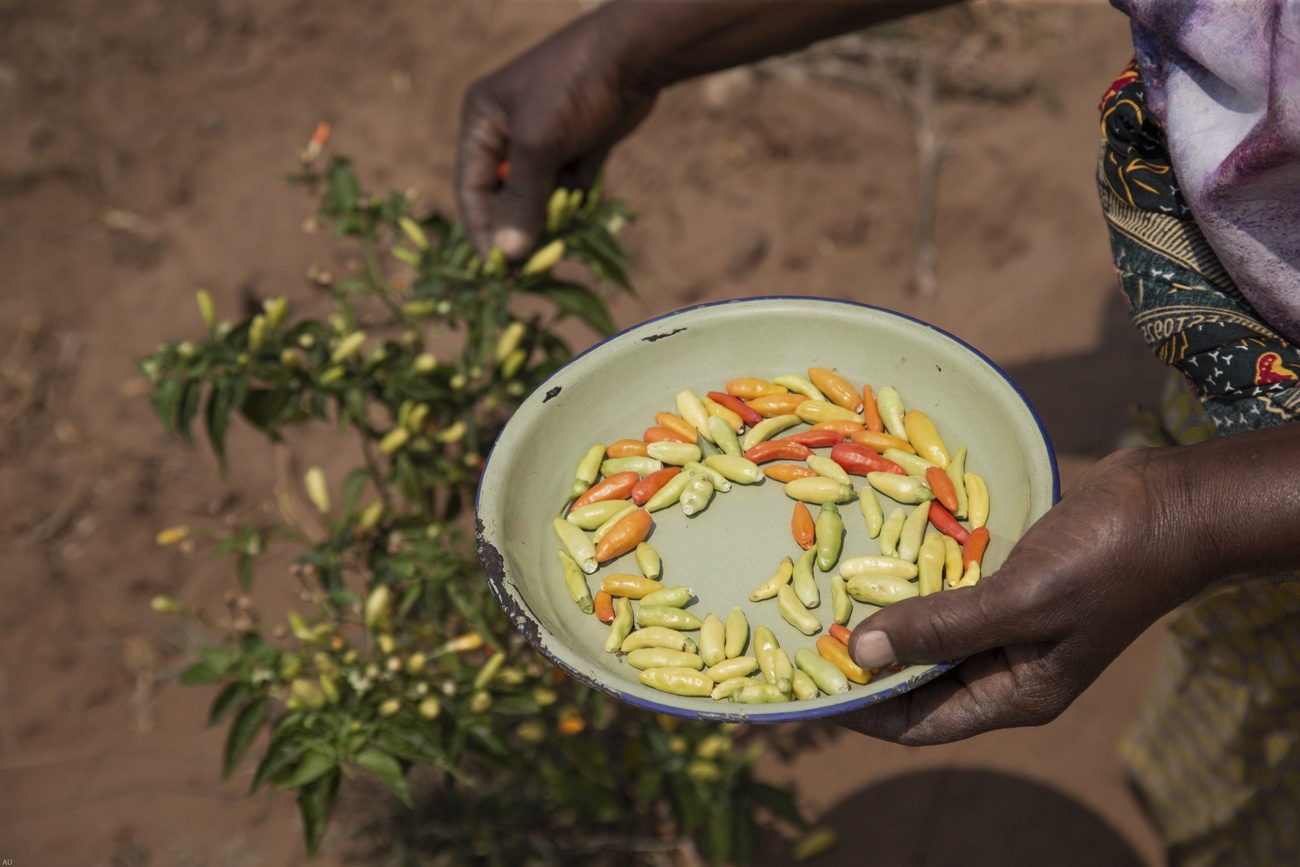
Chilies are harvested in a plot that is part of a climate-smart agriculture programme funded by the United States in Chipinge, Zimbabwe, September 19, 2024.
Ap
Climate funding for developing nations dominates the COP29 agenda in Azerbaijan. A recent study suggests Switzerland is already contributing beyond its “fair share”, yet environmental groups like Greenpeace and Alliance Sud see things differently.
When it comes to helping poor countries deal with the climate crisis, Switzerland is doing more than it should. At least that’s according to a recent studyExternal link by the Overseas Development Institute (ODI), a London-based think tank that focuses on international development and humanitarian issues.
$100 billion – that’s how much industrialised nations pledged in 2020 to funnel every year to low- and middle-income countries in order to fight climate change. Switzerland is one of 12 countries that have contributed to this goal with a “fair share”, or even gone beyond it, according to ODI.
More

More
Newsletters
The fair share is based mainly on two key principles: historical responsibility, i.e., cumulative greenhouse gas emissions and economic capacity. The money goes towards helping developing countries adapt to climate change and move away from fossil fuels.
Currently, 23 countries are bound to contribute to international climate finance under the Paris Agreement. Each country is free to decide the amount of its contribution. However, environmental NGOs accuse the rich countries of failing to meet their fair share. They also argue that the current finance goal is insufficient to address the needs of developing countries.
+ Climate finance: what about international solidarity?
The Paris Agreement is an international climate treaty that aims to limit global warming to 1.5°C compared to the levels recorded at the end of the 19th century, when the use of fossil fuels began to cause significant global warming.
To stand a chance of achieving this goal and avoiding the worst consequences of climate change, scientists agree that it is necessary to halve or nearly halve global emissions by 2030, and to achieve a net zero emission balance around mid-century.
Who pays what for climate adaptation?
Norway and France have been the most generous countries so far. In 2022, their contribution to the $100 billion goal was more than double their fair share, according to ODI. Switzerland, Germany and Japan are among the nations that have also provided more than their fair share.
Switzerland’s fair share is estimated at $930 million per year (about CHF814 million), according to the think tank. With a contribution of $1.33 billion (CHF1.16 billion) in 2022, the Alpine nation is therefore considered a generous donor.
Meanwhile, a number of industrialised countries, including Italy, the UK and Spain have not met their fair share. At the bottom of the ranking are Greece and the United States: in 2022, they provided about a third of what they should have.
The United States contributed over $14 billion to international climate finance, the largest amount overall. But as the independent analysis shows, the US should have made available three times this amount considering its carbon footprint, population size and gross national income.
Climate aid – but with interest rates and strings attached
The ODI figures should be interpreted with caution. As the think tank itself points out, many countries provide much of their climate funding as loans, adding to recipients’ debt. According to a 2023 reportExternal link by the British NGO Oxfam, loans account for about three-quarters of that funding. If only grants (i.e. non-repayable aid) were counted, progress toward fair share goals would be much lower, says ODI.
In its analysis, the ODI also considers money provided by multilateral development banks (MDBs) and attributes these amounts to member countries based on their shareholdings or voting power. These figures are “vastly higher than Switzerland’s official figures,” says Laurent Matile of Alliance Sud, a coalition of NGOs focused on international cooperation and development.
More
More
Switzerland to call for climate finance contributions from China and Russia at COP29
NGOs call for doubling Swiss financial aid
The Swiss government has set a fair shareExternal link of between $450 million and $600 million per year (approximately CHF400 million-532 million at current exchange rates). This takes into account emissions generated in the country.
In 2023, Switzerland allocated about CHF546 million from public sources and about CHF301 million from private sources, according to the Federal Office for the Environment (FOEN). The CHF546 million mainly comes from the annual budget for international development cooperation – a source that has been sharply criticised by NGOs.
“The Swiss government must propose new sources of funding that are based on the polluter pays principle,” says Matile. This means that those who cause environmental damage, in this case climate change, are responsible for it and must bear the costs.
” The Swiss government has so far downplayed the country’s responsibility in the climate crisis”
Georg Klingler, Greenpeace Switzerland
Alliance Sud calls for public funding to be doubled to at least $1 billion per year. Matile explains that this amount would correspond to Switzerland’s real global climate footprint considering not only domestic emissions but also those related to imports. Emissions generated abroad from imported goods in Switzerland are more than twice as high, in per capita terms, as those on Swiss soil, accordingExternal link to the FOEN.
For Georg Klingler, a climate expert at Greenpeace Switzerland, the Swiss government has so far “downplayed the country’s responsibility in the climate crisis”. He also estimates Switzerland’s fair share in public funding at around $1 billion per year. This money should be mobilised without affecting the level of funding for international aid, he says.
More
More
Most Swiss doubt politicians’ ability to deal with climate change
What developing countries really need
Financial aid for the poorest countries and those most affected by global warming is the focus of the ongoing 2024 United Nations Climate Change Conference (COP29) in Baku, Azerbaijan. Representatives from some 200 countries, including Switzerland, are set to adopt a new finance target (New Collective Quantified GoalExternal link) for the period after 2025.
The industrialised countries recognise that $100 billion per year is not enough to cover the needs of developing countries. However, the amount of the future international contribution and the modalities of this financing are the subject of controversy.
>> Switzerland proposes to expand the base of donor countries. This article explains why China and Russia should also participate in climate financing in poorer countries.
Organisations gathered in the Climate Action Network and many developing countries included India and the Arabs States have called for a total public financing of at least $1 trillionExternal link per year.
Switzerland should contribute 1%, or $10 billion a year, argues Klinger of Greenpeace. The 1% estimate comes from Switzerland’s economic strength, as Switzerland’s gross domestic product (GDP) accounts for about 1% of world GDP, he explains. By comparison, the Swiss government spent about CHF7 billion in 2023 on security and defence.
As the closing deadline nears, and division and discontent over the climate funding issue spill out into the open, it’s difficult to guess what Switzerland will eventually pledge. For Matile one thing is certain: the Swiss contribution “will have to increase massively”.
Edited by Sabrina Weiss/sb