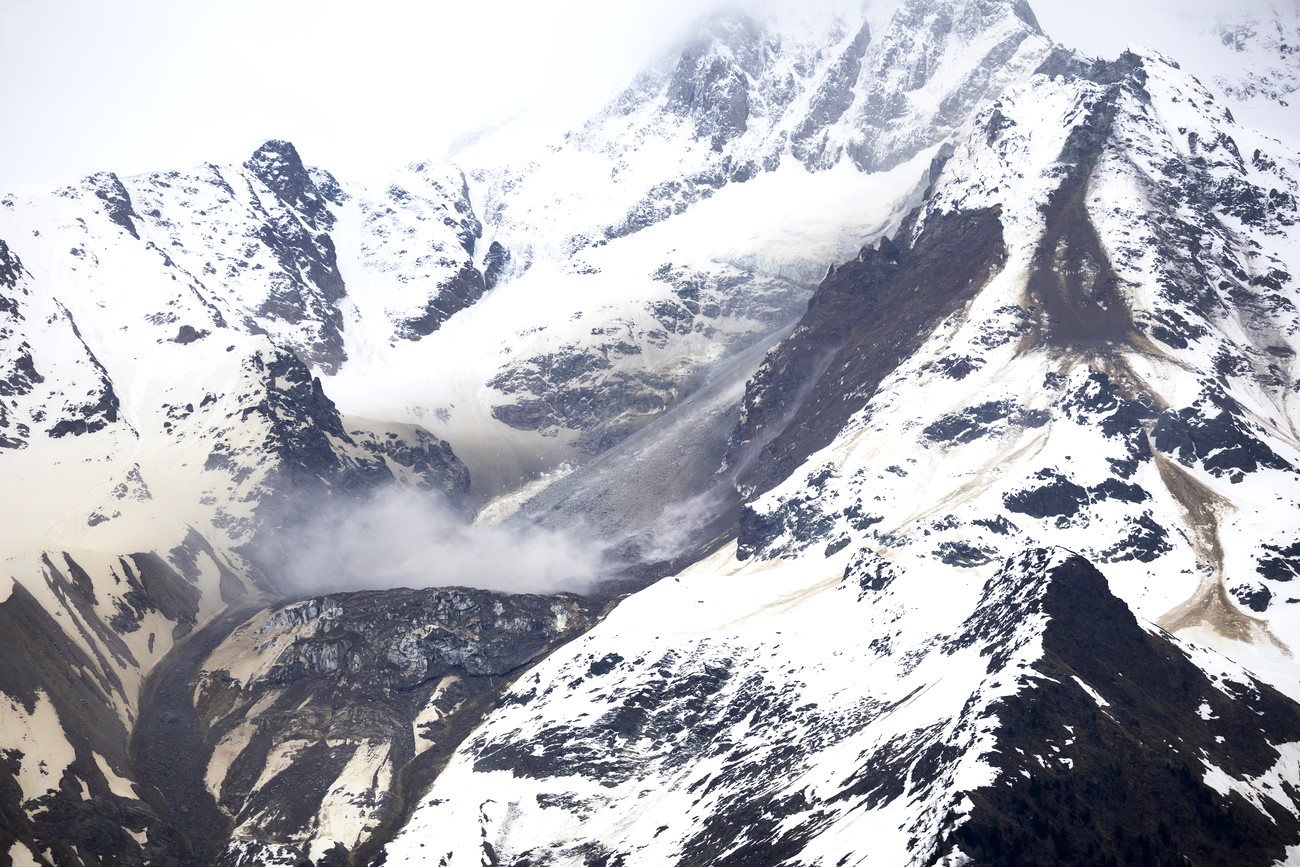
The village of Blatten in the Loetschental valley had to be completely evacuated due to the risk of a rockfall.
Keystone / Jean-Christophe Bott
Generated with artificial intelligence.
The Swiss government wants to detect previously unknown ground movements, particularly those related to thawing permafrost. To do this, it plans to use data from the European Space Agency’s (ESA) Sentinel-1 satellite, according to the NZZ am Sonntag.
This content was published on
As landslides continue above the Valais village of Blatten, preventing residents from returning home, the Swiss government wants to monitor ground movements across the country to anticipate landslides, rockfalls and other subsidence, writes the NZZ am Sonntag.External link
To this end, it is planning a national monitoring system based on data from the European Space Agency’s (ESA) Sentinel-1 satellite, the Sunday newspaper reports, citing internal reports and documents. The satellite in question, orbiting at an altitude of 700 kilometers, continuously scans the Earth’s surface. It feeds into the European Copernicus program, which allows the European Union to monitor water, soil, air, and the atmosphere using accurate and regular data.
More
More
Why do Swiss mountains collapse? It’s complicated
This content was published on
Small landslides are on the increase in the Swiss Alps owing to climate change. But the link with global warming is less obvious for large natural disasters.
“The goal is to identify instabilities that are not yet known,” the Federal Office for the Environment (FOEN) explained to the German-language newspaper. The monitoring should, in particular, make it possible to detect major movements due to the thawing of permafrost throughout Switzerland.
Spanish company commissioned
The FOEN has commissioned a specialist company in Barcelona to obtain and process its data. The first maps and analyses are expected by the end of 2025 – more than a year behind the original schedule. The FOEN has mentioned a change of supplier to better meet technical requirements, without providing further details.
Geographer Yves Bühler, an expert in alpine remote sensing at the Institute for Snow and Avalanche Research in Davos, hails the project as a valuable early warning tool. Cantons have also shown great interest. Other countries, such as Norway, are already using this type of monitoring nationwide, reports the NZZ am Sonntag.
But the project could be compromised even before its launch. For economic reasons, the Swiss government decided a year ago not to join—at least initially—the European Copernicus program, which would have cost around CHF45 million per year. This cost savings jeopardises long-term access to the strategic data needed for national surveillance.
More
Swiss railways launch project to prevent electrocution of large birds
This content was published on
Railway contact line masts can be deadly for large birds. The eagle-owl, a rare species, is particularly affected.
Switzerland to host European Political Community summit in 2027
This content was published on
The EPC summit brings together the continent’s heads of state and aims to be a platform for political and strategic discussion on the future of Europe.