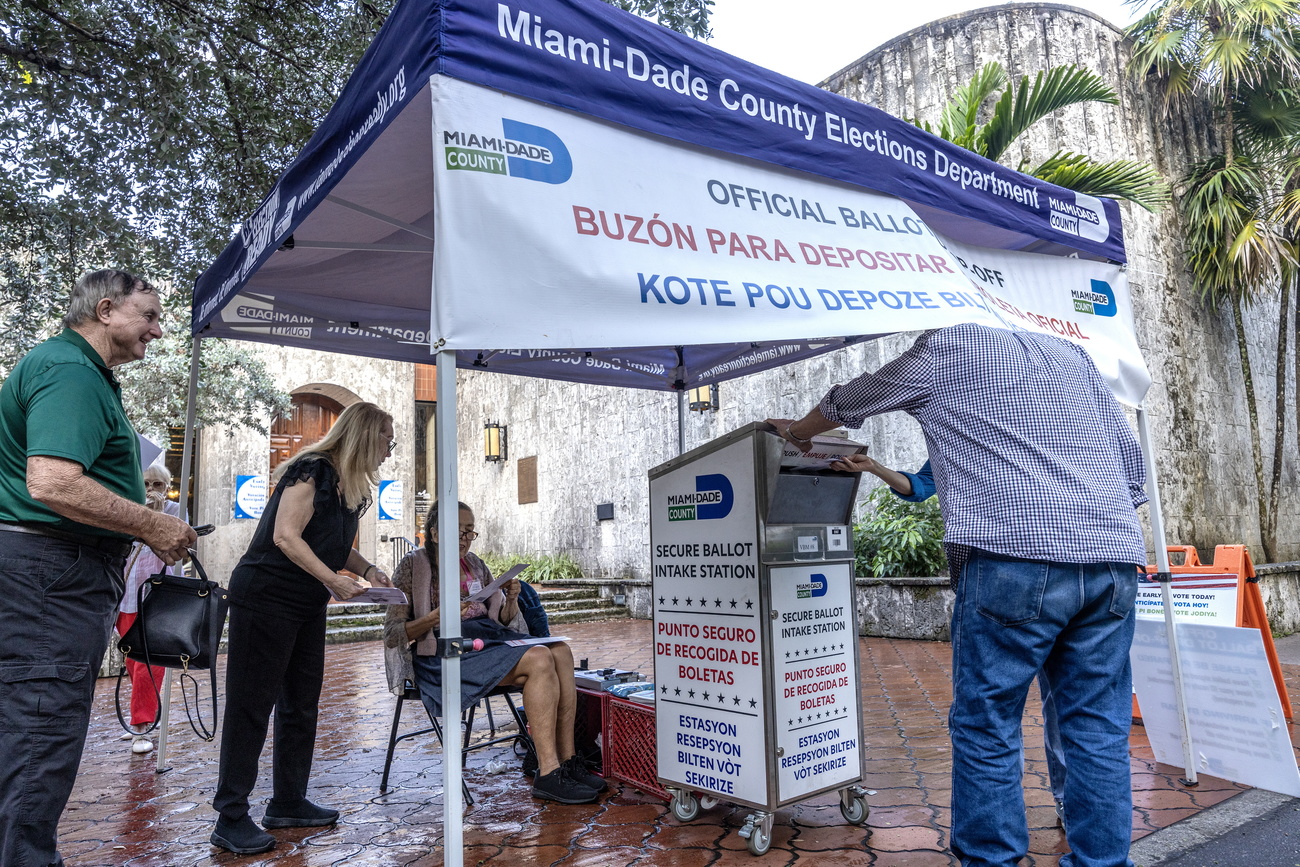
In many states, voting operations have already begun, as here in Florida on October 21.
EPA/Cristobal Herrera-Ulashkevich
In an electoral climate fraught with allegations of misconduct and fraud, the Organization for Security and Co-operation in Europe (OSCE) has sent nearly 250 international observers to the United States. Among them are two Swiss. The goal of the observer mission is to boost public trust in the electoral process. How does this work in practice?
“I arrived in the United States on October 3. After a briefing session in Washington, I set off for Salem, the capital of Oregon. Now I am in Burns,” explains one of the Swiss observers, Sascha Alderisi, an election expert from canton Ticino. It is early morning in the US. Over the phone, he tells us that he has been travelling from town to town for more than two weeks, together with another observer from Norway.
“We visit county election offices, meet with officials and civil society organisations and check how preparations are going for the vote on November 5,” he explains.
More

More
What Trump’s return or a new Harris administration would mean for Switzerland
Alderisi is part of the OSCEExternal link election observation mission. First established in 1990 with the adoption of the CExternal linkhExternal linkartExternal linker of Paris for a New EuropeExternal link, such missions have a mandate to monitor compliance with international democratic standards and ensure free and fair elections in the 57 OSCE member states. After the fall of the Berlin Wall and the end of the Cold War, many countries in Eastern Europe and Central Asia embarked on a process of democratisation that the OSCE wanted to support, in order to strengthen voter trust in institutions.
Switzerland took part in an election observation mission for the first time in 1989, when it sent experts on a UN mission to Namibia.
The end of the Cold War saw the emergence of new states whose democratic institutions had
to be built afresh and whose governments had to be endorsed through free and fair elections. Switzerland wanted to support this process in order to promote peace and democracy.
This commitment is reflected by Swiss participation in numerous OSCE missions each year. The experts pool monitors elections and democratic processes in many different countries.
This is not Alderisi’s first observer mission. He has been part of the Swiss observer pool since 2008 and has monitored elections all around the world, though never in the United States.
“In all, we are 64 observers from 17 countries, including six Swiss. We’ve been divided into teams of two experts, and each team has been assigned two states,” he explains. “I’m monitoring the election process in Oregon and Washington, together with another member of the mission.”
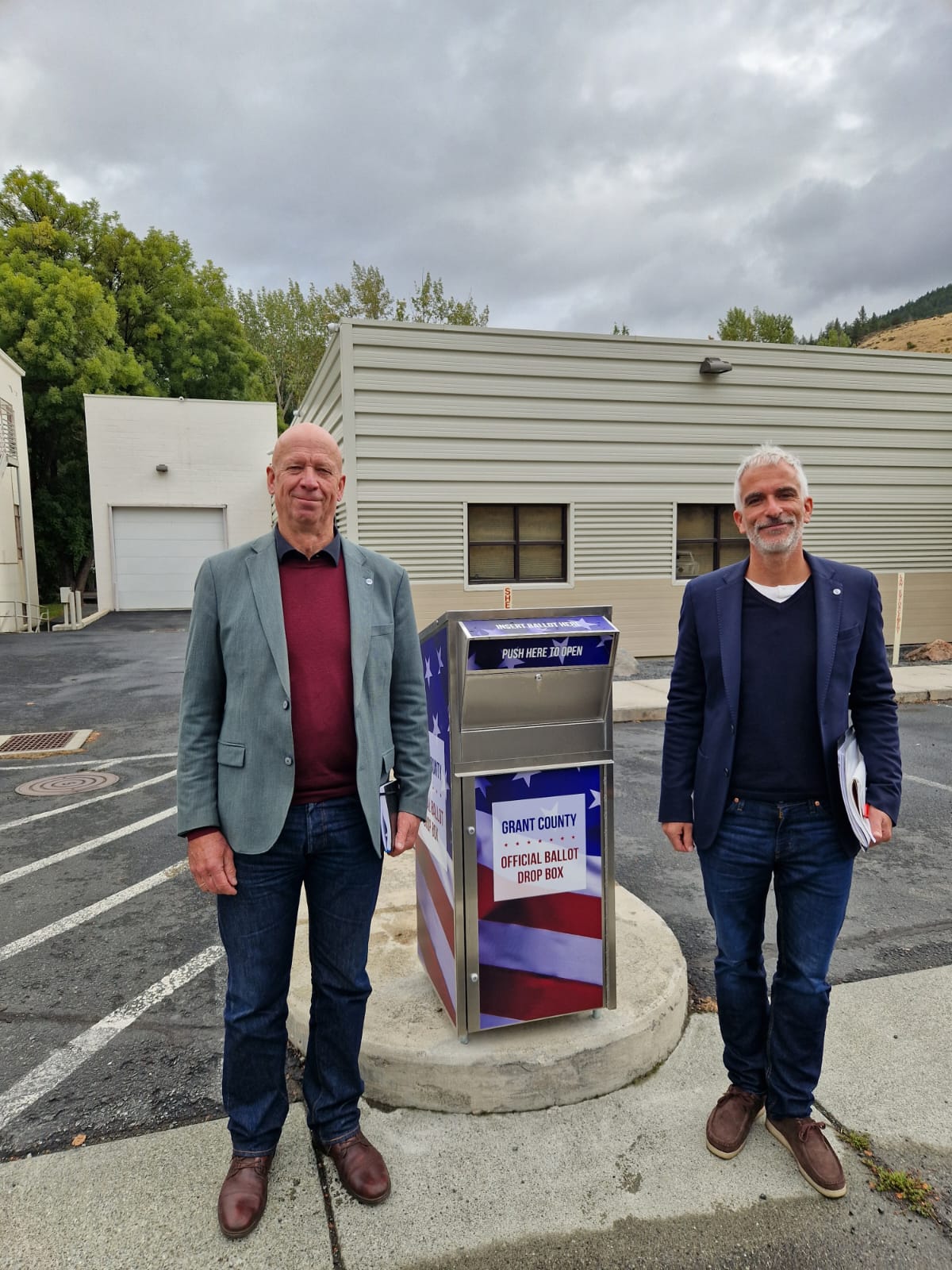
Sascha Alderisi (right) with his Norwegian colleague Hans Christen Knaevelsrud in front of a drop-box, a box where ballot papers can be deposited, in Canyon City, Oregon.
Sascha Alderisi
The elections and the possibility of observation are governed by local laws. Thus Tennessee, like 17 other states, forbids the presence of international observers, while other states, such as California, Missouri and Nebraska, expressly allow it.

More
Sister republics: Switzerland and the US
‘I’m not a cop’
Alderisi is what is known as a long-term election observer. He is on a roughly one-month assignment to observe, assess and report on the pre-election period, election day and the days following the election. It is a very important task, especially in light of the accusations of fraud and vote-rigging made by Donald Trump after the 2020 presidential election – a scenario that could easily be repeated this year.
“As a technical expert, my job is to monitor application of the local legal framework,” Alderisi explains. “I take note of what I see, without interfering in the electoral process. I’m not a cop. What I do is write a report that includes my observations, any irregularities and recommendations.”
Every January the Swiss foreign ministry determines which election observation missions Switzerland will take part in. It bases its decision on criteria such as the political and security situation in the countries concerned.
The observers, who are selected from the pool of experts, complete a week-long training course before being deployed on their first mission.
Partner organisations (the European Union, the OSCE and the Organisation of American States) inform the Swiss expert pool which missions are planned, providing key details such as the country of deployment, the language required, the length of the mission and the security situation on the ground.
After the logistical preparations, which include obtaining visas, booking flights and attending briefings, the long-term observers set off first, followed six to eight weeks later by the short-term observers. After the mission has ended, the election experts summarise their observations in a report to the Swiss foreign ministry.
The OSCE Office for Democratic Institutions and Human Rights (ODIHR) published a first interim reportExternal link on October 23. As well as summarising the objectives of the observation mission and the rules of the electoral process, the document highlights the key issues, including media coverage of the election campaign.
In the report, the experts express their concern about widespread disinformation from domestic and foreign players. “The campaign is highly polarised and characterised by aggressive rhetoric, personal attacks and instances of election-related violence,” they note.
More
More
How centuries of Swiss emigrants left their mark on the US
The text also presents the legal framework for resolving election disputes and highlights the large volume of lawsuits filed by candidates, political parties and their affiliate organisations, for instance concerning voter registration procedures.
Around 180 OSCE parliamentarians on mission
Election observation missions are coordinated by the ODIHR. No short-term observers have been sent for the current US elections. These usually arrive shortly before voting day to observe the conduct of the election and counting of the ballots. This time, however, around 180 members of the OSCE Parliamentary AssemblyExternal link – a platform for dialogue and cooperation comprising over 320 parliamentarians – will be observing the elections.
Swiss federal parliamentarian Jean-Luc AddorExternal link, from Sion in western Switzerland, will be monitoring the vote for the Swiss dExternal linkelegaExternal linktionExternal link. “I’ll fly to the United States on November 1 and then attend a briefing in Washington the next day,” he explains.
Addor, who is a lawyer by profession and a member of the right-wing Swiss People’s Party, expressed his External linkpreferenExternal linkce for External linkTrumpExternal link in the previous elections in 2020. “Together with 15 other parliamentarians, and in tandem with a colleague from the German federal parliament, I’ll be observing the ballot in Nevada, one of the swing states,” he says.

Parliamentarian Jean-Luc Addor will observe the presidential ballot in Nevada.
Keystone / Anthony Anex
Addor joined the Swiss delegation to the OSCE Parliamentary Assembly at the start of the current legislative period in December 2023, so it is his first mission as an election observer.
“Our main focus will naturally be on election day, November 5,” he says. “It will be very intensive, starting in the early hours and ending late in the evening when the polling stations close.” He will have to visit as many polling stations as possible to check, for instance, that enough staff are present and that voters can cast their ballots freely. At the end, he will send his observations to the OSCE mission’s core team in Washington.
OSCE not well known in the United States
“The stakes are high, not only for the United States but for the whole world,” Addor says. “The outcome of the election will determine international politics for the years ahead and have repercussions, for example, on the US position on the war in Ukraine, the conflict in the Middle East and America’s commitment to NATO.”
No one, he adds, has forgotten the election four years ago when Trump did not accept defeat, crying fraud and corruption. “The presence of OSCE observers can help boost public trust and the credibility of the vote.” However, “we are not an international authority and it is not up to us to determine the validity of the election. Moreover, the OSCE as an institution is not well known in the United States. It is the American people who will judge whether the outcome is legitimate or not”.
Meanwhile, international experts are not the only ones monitoring the vote. The proceedings are also being followed by national observers from civil society, political parties and the academic world.
The mission of the OSCE Parliamentary Assembly delegation will end on November 6, with the publication of a preliminary report and a joint press conference with the ODIHR. The heads of the two missions – Tamás Meszerics, a Hungarian expert leading the ODIHR mission, and Pia Kauma, a Finnish parliamentarian – will present an initial assessment of the elections.
“A few months later, the final OSCE report on the US elections will be published,” Sascha Alderisi explains. “The text will include a full analysis of all the stages of the election and recommendations for improvements to the processes.” Alderisi’s own assignment will end on November 10, when he will return home after more than a month in the United States.
More

More
US disinformation surge rings alarm bells for Swiss direct democracy
Edited by Daniele Mariani and Benjamin von Wyl. Adapted from Italian by Julia Bassam/ts