


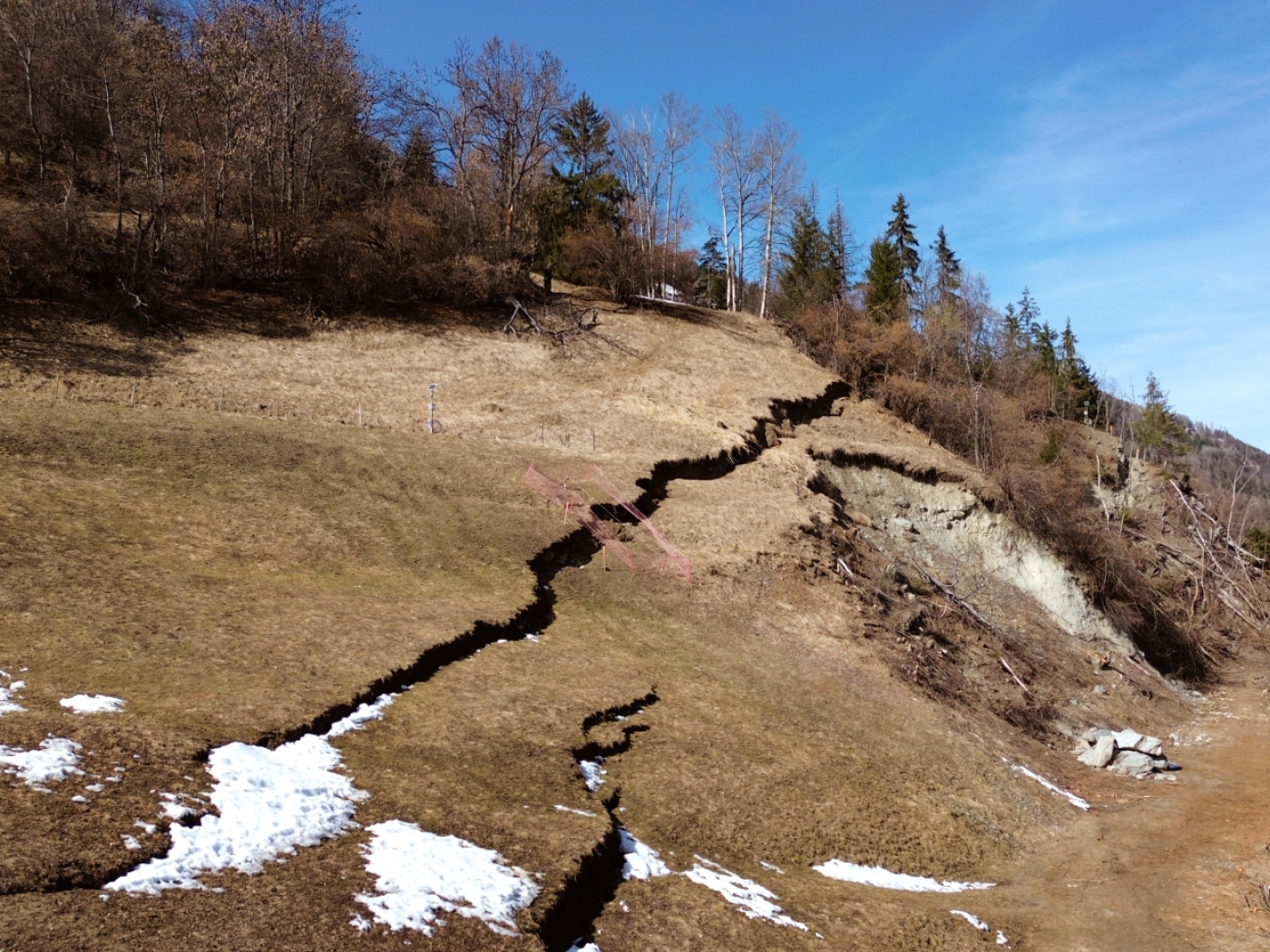
A 250-metre-long fault line in the “Les Fios” district near Grimentz in Val d’Anniviers, Switzerland, is widening by 2-4 mm daily, raising fears of a 500,000 m3 landslide.
Keystone-SDA
The “Fios fault” in the Val d’Anniviers region in southern Switzerland has now stretched to 250 metres and continues to grow. Authorities fear part of the mountainside could give way and are preparing safety measures and local evacuation plans.
+Get the most important news from Switzerland in your inbox
Geologists examining the main fault near Grimentz in canton Valais have identified several additional secondary cracks. The unstable section is estimated at around 500,000 cubic metres.
The site has been under active surveillance since October 2025, when the fault was first discovered. It was formed after flooding in 2018 and 2024. The riverbed, which served as the ‘bedrock’ of the mountain above, was weakened by the water. As a result, the mass of earth slowly began to slide, revealing a crack 250 metres long and 80 cm to 1 metre wide.
Several scenarios envisaged
Monitoring instruments have been installed to continuously measure the deformations. These include extensometers, a laser scanner and a webcam. A drone flies over the site every week. Large trees on the slope have also been cut down.
More

More
Unstable slopes and warming peaks: Scientists race to understand Blatten collapse
For safety reasons, the general public is asked to stay away from the area. If the movements accelerate, an alert may be triggered.
The “disaster” scenario would involve a general movement of the entire sliding mass. But at this stage, the preferred scenario remains a collapse in successive sections.
Risk to the Navizence River
A collapse of the mountain could block the Navizence River below the fault and create a temporary lake. There are fears of major flooding, particularly when the snow melts. This could then threaten the village of Chippis in the valley, as well as the Val d’Anniviers electricity network. An emergency line should be ready by early summer.
More

More
Long-term return to landslide-threatened Swiss village deemed possible
In Chippis, the authorities are closely monitoring the situation. The Navizence runs through the village and could overflow its banks in the event of flooding. As a precaution, places have already been reserved in the civil protection shelters in the surrounding villages if Chippis has to be evacuated.
Reassuring the population
On Monday, the residents of Chippis were invited to a public information session for an update. Nearly 300 locals, or around 20% of the population, were present, Olivier Perruchoud, president of Chippis, told the Keystone-ATS news agency on Tuesday morning: “Those present were able to ask any questions they wanted to a number of experts, particularly in geology and hydrogeology.”
“The main concern was how much time they would have to evacuate, if they had to do so, and what measures were planned for the Bord district and its 50 or so residents,” said the president.
A bridge will be destroyed
In Chippis, one of the main concerns is the Cimetière bridge. “There’s a risk that it could become blocked,” said Perruchoud.
“Even though this structure is listed, we are going to destroy it for safety reasons. We are awaiting authorisation from the canton before proceeding (editor’s note: in principle during April).”
Additional measures upstream are also planned. Work to raise and extend the dykes will be carried out before the summer in order to limit the risk of flooding.
A 15-metre-long road structure is also used to carry infrastructure (fibre, electricity, gas, drinking water, sewers). These will have to be moved before the bridge is demolished. In the short term, the idea is to create a temporary ramp on the right bank to allow access to the riverside district before a new bridge is built in a few years’ time.
Adapted from French by AI/sb
We select the most relevant news for an international audience and use automatic translation tools to translate them into English. A journalist then reviews the translation for clarity and accuracy before publication.
Providing you with automatically translated news gives us the time to write more in-depth articles. The news stories we select have been written and carefully fact-checked by an external editorial team from news agencies such as Bloomberg or Keystone.
If you have any questions about how we work, write to us at english@swissinfo.ch


