Who decides on new agreements with the European Union? A simple popular majority should suffice.
Keystone / Gaetan Bally
The Swiss government is hardly brimming with enthusiasm for the new package of agreements with the European Union. Reactions to the government’s first tactical manoeuvre show that, on this issue, playing for time won’t work. Here is an analysis.
Nothing is clear. This is about the only thing that is truly certain about Switzerland’s relationship with the EU. In such cases, the Swiss government is often reluctant to take a decision – and sometimes avoids doing so completely. “If a decision is not yet ripe, then deciding not to decide may be a good decision,” former government spokesman André Simonazzi once said.
The government is sticking to this approach on the EU question. It knows just how divided Switzerland is on the matter. After the formal end of negotiations with the EU, Foreign Minister Ignazio Cassis said: “I’m sorry you don’t feel any enthusiasm, but it’s like always: no one is overjoyed, but nor is it doom and gloom.”
More
More
The Swiss are deeply divided over relations with the EU
The government acted as though the zealous Swiss negotiators had brought something home from Brussels all by themselves; something that should now be put in the garage and examined later at leisure. This caused irritation among those who are keen to maintain good relations with the EU. For the issue certainly sparks passionate feelings – but only among the opponents. A passionate dislike.
And among the supporters? No one is cheering; no one is taking the lead.
‘Setting the course’
When, people wondered, would the government come out of hiding? When would it perhaps even say: “Yes, we want these treaties”? It did so at the end of April. Or did it? In its somewhat veiled statement of intent it spoke of an important step that “set the course”.
More

More
Swiss government favours simple majority referendum for EU vote
It was a groundbreaking decision, which affects how the Swiss population will be able to vote on the treaty package: a simple majority of the people should suffice. A double majority, also requiring a majority of the 26 cantons, should not be necessary.
Parliament will have the final word on the voting procedure. However, the government is already recommending that it proceed without a cantonal majority, on the grounds that this was also the case for the previous bilateral agreements with the EU.
When is a cantonal majority also necessary?
In Switzerland, votes on constitutional amendments, urgent federal decrees or membership of international organisations require a double majority. This was written into the constitution in order to integrate the rural, Catholic cantons into the then young federal state. They were the losers in the last Swiss civil war in 1847, defeated by the large, liberal cantons.
It is a balancing mechanism, which gives greater weight to a political minority. Thus, today, a vote cast in Appenzell counts 40 times more than one from Zurich.
This has little to do with democracy in the literal sense of the term, political science Adrian Vatter told Swiss public broadcaster, SRF. “The cantonal majority is not about democracy, i.e. a majority of the people, but about federalism, about protecting the small, more conservative cantons,” he said.
According to Vatter, the current question about the need for a cantonal majority in favour of the EU deal is not a legal one, but rather a “fundamental political question”. It is clear that the new treaties stand less chance if the conservative cantons have more weight. Back in 2005, the Bilateral Agreements II and the vote on the Schengen and Dublin agreements would not have cleared the hurdle of a majority of cantons either.
Meanwhile, if the veto right of the small rural cantons is circumvented, the treaty package is more likely to be accepted. “We cannot deny that there is also a tactical aspect to these considerations,” Cassis said on presenting the government’s decision.
An almost religious dispute is thus raging over this fundamental political question. The opponents of the new EU treaties feel betrayed. They are calling for full-scale democracy and federalism for the vote on the deal – that is, a double majority by the people and the cantons. They argue that the new treaties are of a constitutional character, at least in essence (“sui generis”), because of the dynamic incorporation of the law.
More

More
The Swiss-EU bilateral treaty updates, explained
Those in favour of the deal, meanwhile, back the government’s formal legal argument: for this treaty package, as for the previous ones, a popular majority is sufficient.
Perfect timing?
It soon emerged that Cassis had tipped the balance in the seven-member government’s controversial decision. Such indiscretions are a sure sign of tension within the government.
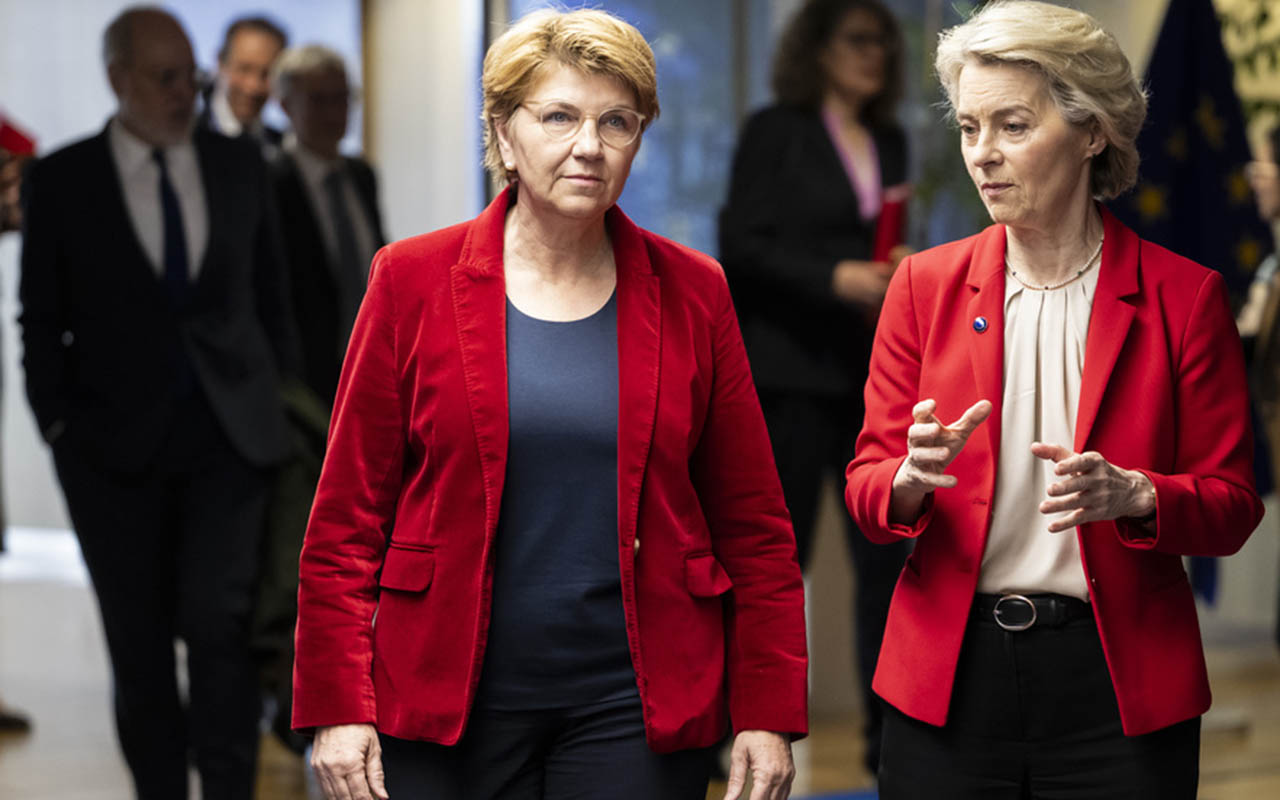
It also became known that the government had repeatedly postponed the decision on the type of referendum required to validate the treaty package. The decision was not yet ripe, but the issue was already on the table, as Defence Minister Viola Amherd, who held the rotating Swiss presidency in 2024, wanted to conclude her term of office with a breakthrough on the EU.
More
More
Our newsletter on Swiss politics
It also came to light that Cassis not only pushed for the decision against a cantonal majority, but that, in so doing, he had to turn his back on the centrist four-party bloc in the government and join the progressive, pro-European minority.
The foreign minister, representing the economically liberal Radical-Liberal Party, is today considered a turncoat by much of the centre-right. Conservative circles have even called him a “traitor” and a “puppet”. The media, meanwhile, acknowledge his courage.

Foreign Minister Ignazio Cassis has a great sense of timing.
Keystone / Anthony Anex
In reality, he seized an opportunity. Before joining the government, Cassis represented the interests of health insurance companies in parliament. His career was thus long that of a lobbyist integrated into the political system. He not only knows how to read power dynamics, but also how to play them – and he knows the right timing.
And in late April, the timing seemed perfect. US President Donald Trump’s tariff crackdown on Switzerland was making politicians uneasy. And while some called for calm, it was clear that Switzerland could not afford a trade war with the United States and a war of nerves with the EU.
Limited and confidential preview
The treaties are not even public yet. They are not due to be published until June, once they have been initialled, signalling that the parties have agreed on the text. This sparked new tensions: the government has authorised a limited number of parliamentarians to view the agreements in advance. This makes others envious.
A reading room has been set aside for those entitled to consult the documents. Nothing may leave the room. The readers may take handwritten notes only. They may not divulge any details of the agreements. Supporters and opponents of the treaties alike balk at this “secret-mongering”.
Meanwhile, a referendum is in the pipeline to demand that, in future, international treaties can only be concluded if a majority of the cantons also agrees. The requisite signatures for the initiative, known as the Compass Initiative, appear to have been gathered, and the official go-ahead could be given this summer. If the question makes it to the ballot box, the first battle over the EU treaties in Switzerland would be launched, with a proxy debate on the need for a cantonal majority or not.
As ever, the overarching question is how best to strike a balance between political costs and economic benefits. There is no clear answer to this, and the situation is not going to get any clearer. And if anyone in the government was hoping things would fall into place with time, they are in for a rude awakening.
Edited by Samuel Jaberg. Adapted from German by Julia Bassam/ts
More
Swiss-EU ties finally find a sense of stability