


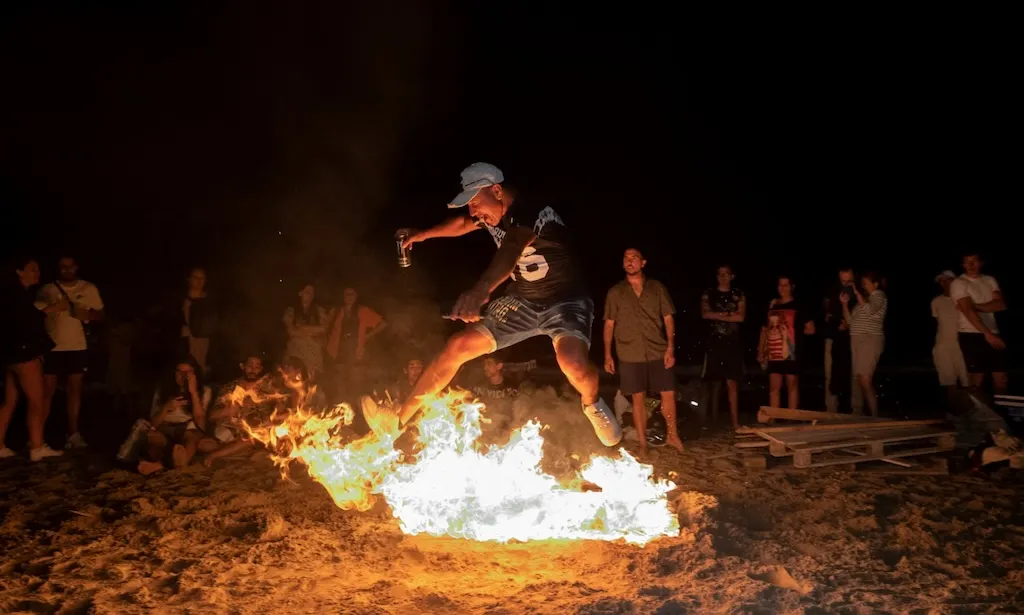
Spain celebrated the festival of San Juan or Saint John’s Eve with bonfires, fireworks and firecrackers on beaches all over the country on Tuesday. Unfortunately, thousands of revellers left behind hundreds of tonnes of garbage in its wake.
While cities, towns and villages across Spain all celebrate San Juan a little differently, bonfires on beaches and booze-fuelled revelry are common to most festivities.
Celebrations in coastal cities in particular like A Coruña, Barcelona, Valencia, and Málaga have grown into massive gatherings that sometimes even turn into impromptu raves.
This brings inordinate amounts of rubbish with it, including thousands of remnants of fireworks and firecrackers, cigarette butts, plastic bags and bottles and cans strewn across the sand – with many partygoers just leaving their mess all behind.
In recent years, these parties have grown even bigger thanks to social media and the lack of control in public spaces.
READ MORE: The weird ways Spain celebrates San Juan
Most fireworks are just let off by individuals on the beach – there is typically no official display and so it’s difficult to control all the hundreds of smaller firework shows going off at once.
In 2024, official data revealed the extent of the problem. Valencia was the city that accumulated the most waste after the festival, with 70 tonnes collected on its beaches.
In Barcelona and A Coruña, the figure was similar – 57 tonnes each. Cádiz had more than 45 tonnes, while in Málaga 23 tonnes were collected and more than €14,000 in damage to public property was recorded. In Gijón, on Poniente beach alone, six tonnes was collected.
This year, San Juan revellers in Valencia left a total of 60 tonnes of waste, 10 tonnes less than last year, but still a staggering amount for one night of partying. Local police were also called out to extinguished 15 bonfires that were lit outside authorised areas.
This amount of rubbish doesn’t even account for the thousands and thousands of pieces of fireworks that end up in the sea and damage the ecosystem further.
READ ALSO: A quick guide to Alicante’s Hogueras de San Juan festival
Advertisement
In recent years, the celebration of San Juan has been at the forefront of the debate over the use of public space and the impact of collective partying.
The accumulation of waste, neighbourhood complaints, and the deployment of clean-up operations reflect a growing tension between culture and the consequences of it.
In order to try and improve the situation, some municipalities have begun implementing control measures and even banning bonfires.
This is the case in Alicante and Elche, where you can be fined up to €1,500 for setting up bonfires on the beaches. There were, however, official ones in certain areas such as El Campello and Santa Pola.
Bonfires are also prohibited in places such as Orihuela, Guardamar del Segura, Pilar de la Horadada and Marín in Pontevedra (Galicia). And in Benidorm and Torrevieja, if you build a bonfire you could be fined up to €300.
Similarly, Barcelona does not allow beach bonfires, but instead each neighbourhood is permitted to set alight its own hoguera. Inevitably, this this goes hand in hand with fireworks and firecrackers being let off on the beaches.
Advertisement
So can anything be done to stop the mayhem and littering? The town of Nigrán in Galicia’s Pontevedra province this year managed to achieved an ‘environmentally sustainable’ San Juan on Playa América and Panxón. This resulted in 95 percent less rubbish than usual.
They achieved this through unprecedented surveillance and issuing of fines. “We proved that the festival can be held properly without damaging the ecosystem, and in that sense we are proud to be the first local government in Nigrán, and certainly in Galicia, to develop a campaign on this matter; it was clearly a great success,” stated the town’s mayor Juan González.


