


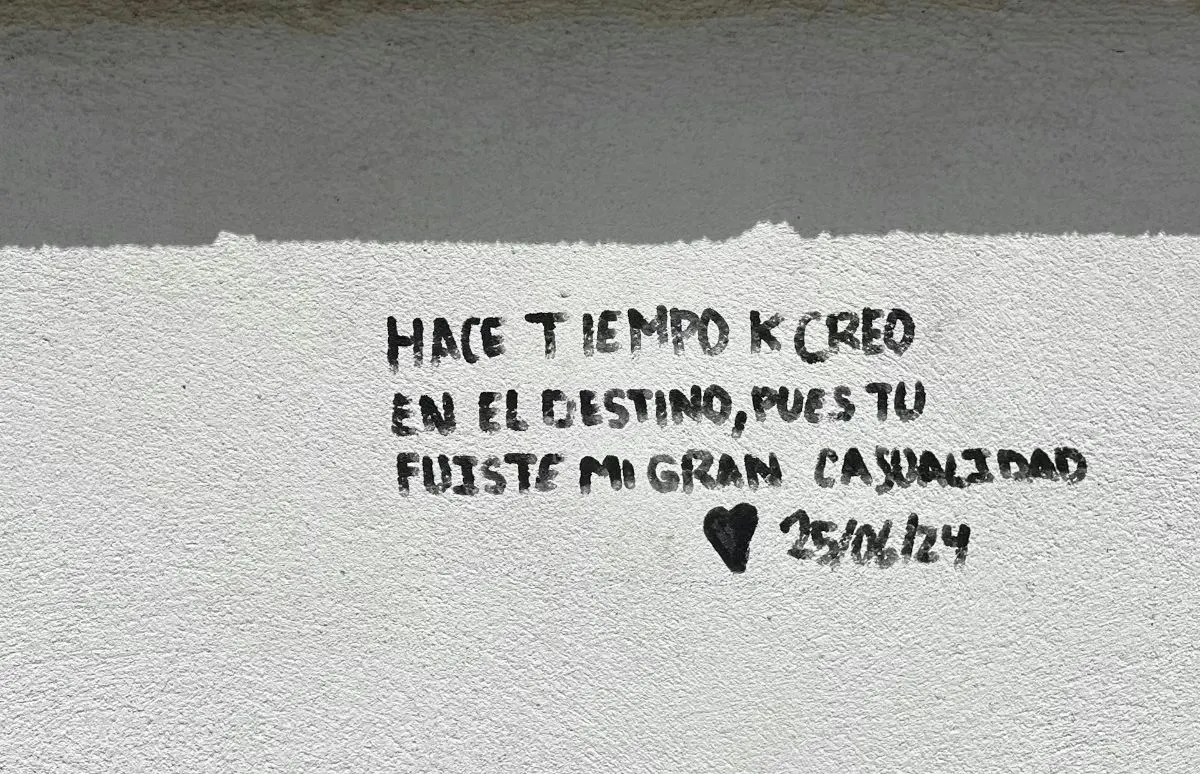
The southern Spanish city of Granada is currently in a battle against graffiti tags and poetic messages plastered all over its white walls, particularly by tourists in the city’s historic Albaicín neighbourhood.
The problem of graffiti has been brought to the forefront of public debate in Granada once again after a woman was caught on camera over the Easter weekend scribbling a message on a wall in broad daylight without trying to hide it.
Even when the tour guide who filmed the woman confronted her, she barely acknowledged her and simply continued.
This fad has come to be known as ‘poetic vandalism’ by the local press. Holidaymakers visiting Granada’s Moorish quarter of El Albaicín write messages in permanent marker on the white-washed walls, deteriorating the UNESCO World Heritage Site with the best views of La Alhambra.
It’s yet another case of tourists unknowingly behaving badly – with other global examples including the love padlocks weighing down a Paris bridge, or the holidaymaker who carved his name into Rome’s 2,000-year-old Colosseum.
Alain González, president of the Professional Association of Tourist Guides in Granada, told local daily Ideal: “This happened on Holy Saturday. But it doesn’t matter, because it’s happening every day in the Albaicín”.
After the video went viral, González warned that many of the visitors inspired to ‘leave their mark’ on the 11th century hillside neighbourhood are unaware that they are committing an offence.
Due to the rise in unwanted graffiti recently – including unsightly tags by non-professionals – deputy spokesperson for the Socialists in Granada, Eduardo Castillo, has called for a more rigorous approach from Granada’s PP mayor Marifrán Carazo.
Castillo has demanded information campaigns for tourists as well as new regulations that serve as a “true deterrent” against this type of vandalism.
READ ALSO: Hundreds of tourist flat lockboxes vandalised in Spain’s Granada
Advertisement
In February, Granada authorities launched a special urban cleaning operation, with two specific brigades tasked with removing graffiti from the façades of public spaces and buildings, allocating a total of €300,000 to the project.
The plan not only included cleaning and painting 1,700 square metres of surface area but also applying preventative anti-graffiti treatments to another 1,000 square metres in the city.
Unfortunately, this doesn’t appear to be having enough of an positive impact, as the graffiti and scribbling reappears within days. In fact, the amateur poets often include the date on which they wrote their musings, making it clear to see when new messages are added.
READ ALSO: Six great reasons to visit Granada (besides the Alhambra)
Advertisement
“Tackling this scourge requires a much more comprehensive approach that combines cleaning with education and awareness campaigns,” Castillo stated.
“This means providing information and regulations to tour guides and hotels, using all available institutional communication channels to educate visitors.”
Castillo has also called for a significant increase in police presence on the streets of Albaicín “as an essential preventative measure to protect the environment and ensure compliance with the rules”.
Advertisement
The Albaicín, whose origins date back to the Moorish rule of Granada, is a listed UNESCO Heritage Site, recognised for its Nasrid architecture, narrow cobbled streets and small squares.
According to UNESCO, “it’s the best-preserved illustration of a Hispano-Muslim city in the South of Spain”.
All the houses are whitewashed here, adding to its charm and cohesive nature, but they also create a blank canvas for graffiti.
Residents of the district told Granada Digital that “there’s a complete lack of awareness” surrounding graffiti rules in the area. Tourists see a wall has already been written on and they add to it, without thinking of the consequences.
The defacement spreads like wildfire, tarnishing the beauty of one of Spain’s most unique neighbourhoods.
Despite this, there are certain areas in Granada where graffiti, specifically murals or street art rather than tags, is legal. One of the most famous Granadino street artists is known as El Niño de las Pinturas.
READ ALSO: What’s the law on graffiti in Spain?


