


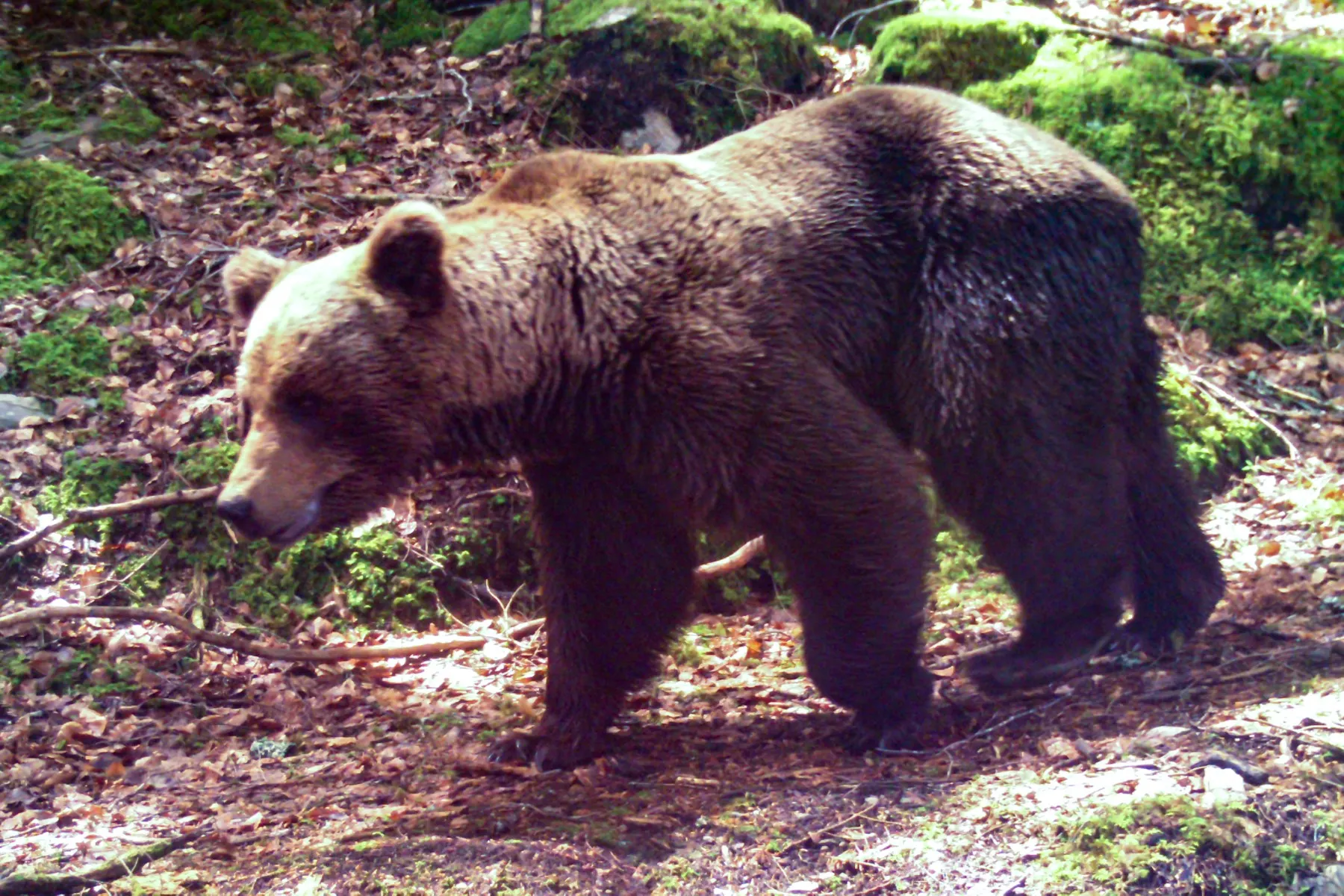
Conservation measures have helped the Spanish brown bear population from 70 three decades ago to more than 400 currently, with the animals now venturing into areas where they hadn’t been seen in more than a century.
Spain’s wild bear population is recovering, with sightings in parts of Spain not seen for decades.
The resurgence, however, has caused some concern among farmers in areas of the country where wild bears are increasingly appearing.
Others welcome a burgeoning bear tourism industry, while some locals complain the increase in bear numbers has changed their lives for the worse.
“In less than three decades, populations of brown bears have risen from fewer than 70 to over 400,” said Spain’s Minister for Ecological Transition and Demographic Challenge, Sara Aagesen, at the presentation of the project LIFE Osos con Futuro.
In Spain, there are two main bear habitat areas, the Cantabrian mountains and the Pyrenees.
The former is now by far the most significant, although this has not always been the case. In areas of northwestern Spain such as Asturias, Castile y León, Cantabria and Galicia, bear populations declined dramatically until the 1990s, when a recovery began.
Advertisement
Their expansion is now spreading to other areas, such as Ourense and Zamora, where the number of sightings is also rising.
An article published in the scientific journal Quercus reported a slow but encouraging increase in the presence of brown bears in certain mountain ranges of northwestern Spain.
Under the title ‘The return of the brown bear to the Cabrera region of León and surrounding mountain ranges’, experts have compiled up to 85 pieces of evidence of their return to northern Spain, all collected between 2012 and 2025.
These include direct sightings, tracks, footprints, camera trap records and damage to beehives. This not only demonstrates the presence of bears, but also their movement and stable existence in these areas of Spain.
The Cantabrian brown bear population was on the brink of extinction in the 20th century, but thanks to conservation measures, habitat improvement and a reduction in direct persecution, the number of bears is on the up.
Great efforts were made to prevent poaching and Slovenian bears were reintroduced to replenish the populations.
Advertisement
As a result, young males in particular are beginning to explore new territories in search of resources and breeding opportunities, which could explain their presence in areas such as La Cabrera or Sanabria, which act as connecting corridors between different populations.
Although sightings and encounters with humans have increased, experts dismiss this as a cause for concern.
“How many decades have bears been in the Cordillera and there have never been any attacks? Here, for genetic reasons, bears are very accustomed to people because they live in a humanised environment. It is one thing for this to be a problem and quite another to present it as such,” says Vincenzo Penteriani, from the Spanish Council for Scientific Research.
There is a danger, he adds, of creating “the idea that sooner or later there may be a human casualty”.
News agency Reuters recently reported on a special bear patrol unit in the Palencia area that aims to monitor the bears and ensure coexistence between locals and the animals.
However, despite no evidence of an uptick in bear attacks, livestock farmers in the area have reported more than average as a result of the bear population growth.
According to data from the Aragonese Pyrenees, in 2024 there were 33 confirmed attacks (29 in Ansó and 4 in Hecho) which killed 44 sheep and two goats.
Many farmers have complained that compensation schemes for those who lose livestock are inadequate.


