


The first total eclipse visible from mainland Spain in 114 years will take place in August 2026, one of three eclipses people in the Iberian Peninsula will be able to witness in the next three years.
The total eclipse is set to take place on August 12th 2026 and is expected to attract many astronomers, astrophysicists and ‘astro-tourists’ to the country.
The last time un eclipse total was visible from the Iberian Peninsula was in 1912.
“It’s a unique opportunity, a cosmic gift to be able to see this wonder of nature,” Stelyanos Pyrzas, an astrophysicist at the Centre for Physics of the Cosmos Studies of Aragón, told leading Spanish daily El País.
Advertisement
“We won’t have another chance like it in our lifetime”.
This isn’t quite true, as this will be the first of three eclipses that will be visible in the skies of Spain until 2028.
The second will be another total eclipse on August 2nd 2027, followed by an annular eclipse on January 26th 2028.
The Spanish government has established an Interministerial Commission to coordinate the logistics, security and scientific outreach initiatives during these historic events.
During the first total eclipse on August 12th, the moon will completely obscure the sun and travel across northern Spain, from Galicia to the Balearic Islands.
The best cities and areas to see it in will be A Coruña, León, Bilbao, Zaragoza, Valencia, and Palma de Mallorca, where the phenomenon will last up to one minute.
The entire province of Teruel in Aragón (northeast Spain) is considered by astrophysicists as being the best place to witness this once-in-a-lifetime event given the propensity for clear skies, its altitude and the lack of obstructions on the horizon.
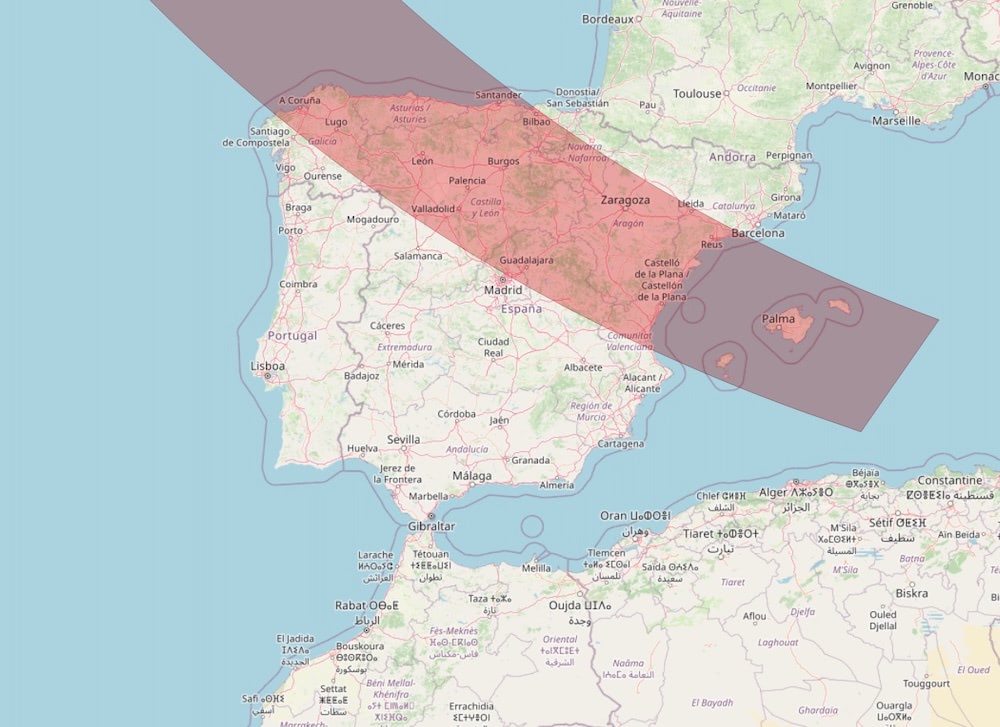
Map of Spain showing total solar eclipse path on August 12th 2026. Photo: Sociedad Española de Astronomía
The total eclipse will also be visible in Oviedo, Palencia, and Soria, where it will last up to 40 seconds.
The Spanish Tourism website also has a useful list of where you will be able to see the total eclipse, listing specific towns across the country.
Advertisement
Experts at National Geographic Spain have said that this first one will occur at sunset, so anyone wishing to see it will need to find high points with clear visibility to the west.
It will also be accompanied by the Perseids meteor shower on the same night, when the Moon will not block visibility of them.
National Geographic Information Centre, along with the National Geographic Institute (IGN), have created a webpage to allow users to plan their eclipse viewing.
It offers important information such as the start and end times in certain areas, weather forecasts provided by Spain’s weather agency (Aemet) and an animation that shows how the shadow of the eclipse will move across the country.
It will also feature information on how to look at the eclipse safely, so you don’t damage your eyes.
And if you aren’t able to make it to any of these areas this year, there’s always the second total eclipse taking place in August 2027, which will be best seen from the Strait of Gibraltar and Andalusian cities such as Cádiz and Málaga.
The one after that, which will be an annular eclipse in January 2028, when the moon will pass in front of the Sun without completely covering it, forming the mythical “ring of fire”, according to National Geographic.


