


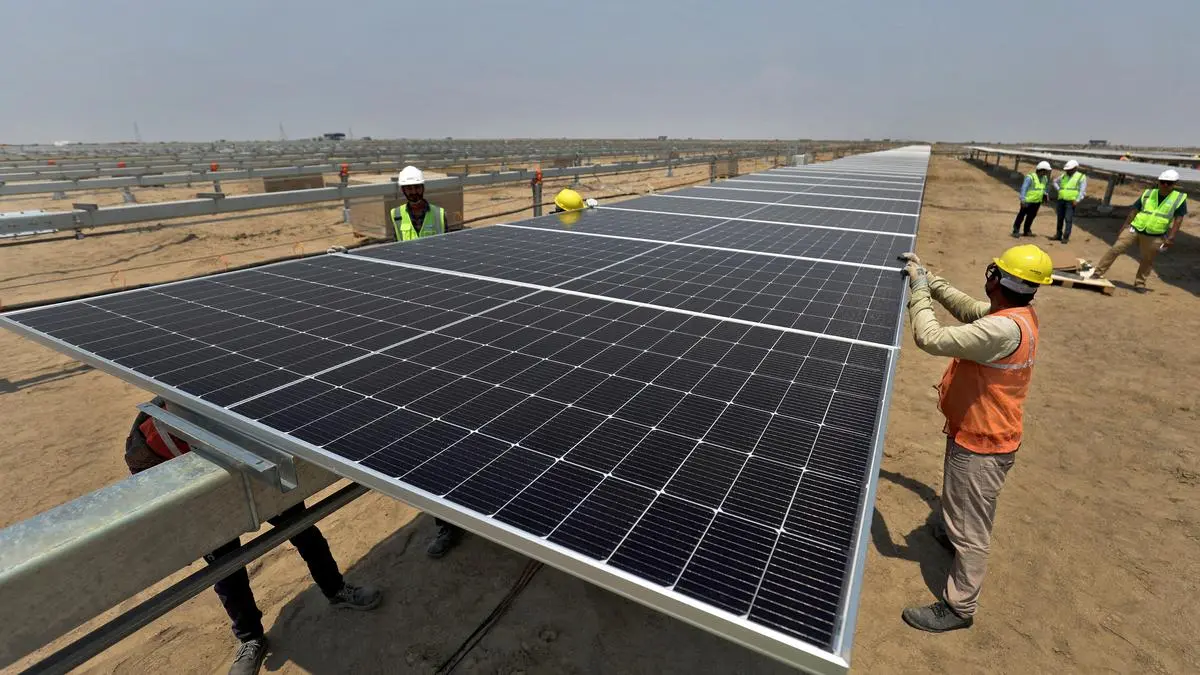
“The Solar Park Scheme requires at least 5 acres of land per MW for solar projects but lacks clarity on the justification for excess land acquisition.
| Photo Credit:
AMIT DAVE
A performance audit by the Comptroller and Auditor General of India (CAG) on solar parks from 2017-2022 revealed lack of clarity over excess land acquisition leading to inflated project costs, which eventually affected electricity tariffs for consumers.
‘Solar parks and ultra mega solar power projects (UMSPPs) are a scheme under the National Solar Mission (NSM). Its Phase-I began in 2014 with a target of achieving 20,000 MW by 2018-19, while Phase-II followed in 2017, aiming for an additional 20,000 MW by 2019-20.
The auditor came down heavily on the Ministry of New & Renewable Energy (MNRE) over “significant delays” at various stages, including preparation of detailed project reports (DPRs), land acquisition, financial closure and pooling station construction.
The report is on performance audit of solar parks and UMSPPs for 2017-2022. These findings are important as solar parks and UMSPPs (scheme) are part of the National Solar Mission, which is critical to the National Action Plan on Climate Change.
By centralising infrastructure and streamlining processes, the scheme is critical for addressing inefficiencies of scattered individual solar projects, which often result in higher costs per megawatt, increased transmission losses and significant delays due to land and regulatory clearances.
CAG flagged repeated revisions in DPRs, which were not realistic in terms of land availability, layout and technology despite the government financially supporting it.
All these issues were “preventable”, it said.
Land acquisition
“The Solar Park Scheme requires at least 5 acres of land per MW for solar projects but lacks clarity on the justification for excess land acquisition. Excess land acquisition led to inflated project costs, affecting electricity tariffs for consumers,” CAG’s performance audit revealed.
The delays in land acquisition — spanning two months to 53 months — had a cascading effect on site development activities such as road construction, drainage and internal pooling stations.
“The delays in acquisition of land were not realistically anticipated and proactively resolved. Based on the learning from delays in achievement of milestones in Phase-I, MNRE did review and revise the timelines for Phase II. These too could not be attained, as the underlying issues remained unresolved,” the audit pointed out.
It suggested that MNRE may ensure that State Level Committees (SLCs) are formed in each state with representation of officials of line departments and ensure timely resolution of various issues like land acquisition, finalisation/approval of DPR, transmission issues with Central/State Transmission Utility, Project Developer identification, etc., during development of parks.
Delays
As of March 2024, 58 solar parks were allocated across 13 States, with a total capacity of 40,000 MW, of which only 28.60 per cent (11,491 MW) of the targeted capacity had been installed. MNRE extended the target deadline three times from 2019 to 2026, indicating challenges in meeting goals.
“The in-principle approval for establishment of Solar Parks was provided without conducting feasibility studies and techno-economic viability assessment. Part of the delays were preventable, such as (i) repeated revisions in DPRs, which were not realistic in terms of land availability, layout and technology despite government financially supporting the exercise and (ii) delays in financial closure due to linking it up with generation of internal resources,” it said.
The CAG rapped the MNRE over delay in updating the Solar Potential Map of India, which provides an assessment of solar energy potential across Indian States. It was last prepared in 2014.
“Though the Wasteland Atlas was updated in 2019 and the average efficiency of SPV modules increased to 19-22 per cent, the Solar Potential Map has not been updated to reflect these advancements,” it added.
In Himachal Pradesh, Meghalaya and Maharashtra, five projects were cancelled or stalled due to lack of thorough feasibility studies, geological studies and non-availability or slow acquisition of land, it said.
MNRE guidelines (2017) mandated establishment of SLCs in States, which are responsible for determining park charges, reviewing DPRs, etc. Due to delays in constituting SLCs and absence of a prescribed meeting frequency, meetings were not conducted regularly. This led to lack of monitoring, unresolved challenges and pending issues, impacting project milestones.
Published on August 18, 2025


