
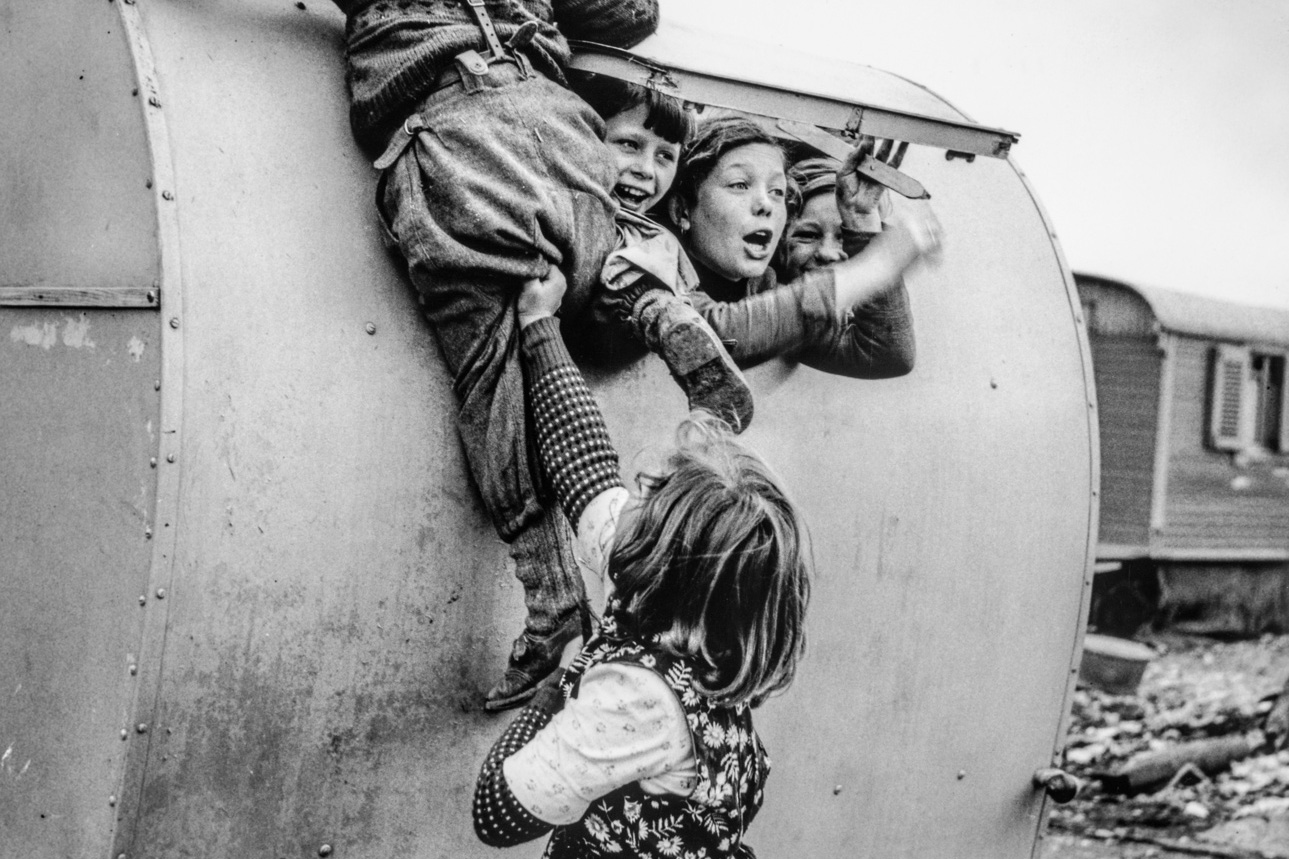
Yenish men, pictured in 1958 on a pitch in Zurich.
Keystone
The Swiss government has officially recognised as a “crime against humanity” its persecution of the nomadic group known as the Yenish. Such an admission has not yet been made in Norway or Scotland, where similar injustices happened. But even in Switzerland decades of advocacy were required to get to this step.
Forcible removal of children from Yenish families by the State between 1926 and 1973 constituted a crime against humanity. This was the conclusion of a government-sponsored research report by law professor Oliver Diggelmann. Switzerland accepts this finding.
The federal interior ministry commissioned Diggelmann about a year ago to determine whether the wholesale removal of children from their families met the definition of genocide or a “crime against humanity”. Two advocacy organisations had called for the episode to be recognised as a case of genocide.
Crime against humanity
In late February the federal government published the report and accepted the finding that there had been a crime against humanity. The report established that the removal of children and the intended destruction of family bonds had to be regarded as such a crime. To call it a genocide, however, would require the presence of an intention to bring about the “physical destruction” of the group, and there wasn’t enough evidence for that.
The report also emphasised that the persecution of the Yenish as a group would not have been feasible without the involvement of the state.
Switzerland is one of the first European countries to recognise its past treatment of nomadic cultural groups as a crime against humanity.
No more than an apology
Experience has shown that European countries are reluctant to recognise their own history of injustice towards the nomadic populations traditionally known as Gypsies and to offer compensation to the victims, notes Neda Korunovska of the Roma Foundation for Europe. The extermination of half a million Roma and Sinti under Nazism was recognised only in 1982 as a genocide by the German Federal Republic.

Neda Korunovska of the Roma Foundation for Europe
zvg
“Most countries have gone no further than issuing an official apology – even where the injustices are well documented,” adds Korunovska. A rare exception is the Czech Republic, which has been compensating Roma since 2022 for compulsory sterilisation schemes that happened between 1966 and 1990.
In other countries where the travelling people were victims of state persecution, organisations advocating for victims have noted with approval the recognition now provided by Switzerland.
It makes a “huge difference” whether a government just apologises for its past behavior or admits it to be a crime against humanity, says Lillan Støen, secretary of the organisation of Norwegian Roma, Taternes Landsforening.
An important aspect of this recognition is that crimes against humanity are not subject to any statute of limitations. Offenders may be prosecuted even decades after the events.
Compensation and apology in Norway
Norway has not so far recognised persecution of travelling people as a crime against humanity. It may yet happen. The issue was publicised in Norway later than in Switzerland. Whereas in Switzerland the first advocacy organisations of Yenish and Sinti were founded as early as the 1970s and 1980s, this happened in Norway only in the 1990s. Pressure from these groups and media exposure eventually resulted in historical study and efforts at compensation.

Lillan Stoen, secretary of Taternes Landsforening, the largest umbrella organisation of Norwegian Romani.
zvg
In 1986, the then Swiss president Alphons Egli made an initial apology for the government’s involvement in the notorious operation known as “Children of the Roads”, whereby Yenish children were taken from their parents and placed with non-Yenish settled families. As late as 1998, on the other hand, the Norwegian government and the then established Church of Norway made their initial apology for the injustices done to their own travelling people.
Both countries passed legislation to provide for financial compensation. In Switzerland, in 1988 and 1992, parliament budgeted CHF11 million ($13.3 million) for compensation of victims – up to CHF20,000 per person. Norway decided on a similar measure in 2004. There, however, affected individuals received no more than 20,000 kroner each – the equivalent of about CHF1,600. A fund was also established to support projects for compensatory efforts favouring the minority as a group, such as the exhibition on Romany history and culture Latjo Drom in the open-air Glomdal Museum.
In both countries comprehensive historical research into the topic has been published since that time. In Switzerland in 2007, three projects reported on their findings. In Norway in 2015, it was the turn of the “Tater/Romani committee” especially set up for this purpose.
It can hardly be said that these studies were immune to criticism. Some Traveller organisations such as the Taternes Landsforening have complained that funding of projects beginning in 2019 was now the prerogative of the government’s cultural advisory council. Previously the Cultural Fund Foundation controlled by members of the minority administered funding – until the government took away the powers of the foundation due to irregularities.
Switzerland’s recent decision on the “crime against humanity” itself got off to a rather shaky start. An apology from the government already planned was cancelled again in the course of the bureaucratic process, as the left-wing weekly Wochenzeitung (WOZExternal link) revealed to the public.
More
More
How Switzerland, Scotland and Norway seized children from itinerant families
Instead, Interior Minister Elisabeth Baume-Schneider did no more than repeat the apology made in 2013, which was addressed to all past victims in general of social welfare “scoops” and child removals. Some advocacy groups were displeased that no specific apology for persecution of Yenish and Sinti was made.
Scotland: rethinking under way
n Scotland, the historical reappraisal of the removal of children from their families is – in contrast with Norway and Switzerland – only beginning.
It was only in the past five years that victims of the removal of children and the grimly-titled “Tinker experiments” to settle travelling people in compulsory housing began to call for an official apology for this dark chapter in the country’s history. As a result, in 2023 the Scottish government commissioned the University of St. Andrews to carry out a research project to document the matter.
The project was inadequately funded – and funding was withdrawn from a follow-up oral history project to record the stories of victims. The research team took critical aim at this decision in their final report: “It is important to be aware that even today there are victims of this policy still living, whose stories need to be heard and themselves compensated in some way.“
This view is shared by Dr. Lynne Tammi-Connelly, a Traveller activist, who has been campaigning in Scotland for research, an official apology, and financial compensation of victims. “What happened is not just something in the past, it lives on in the present”, she told SWI swissinfo.ch.
This activist came in for media attention last February, when she put the unpublished research project on the Internet. She justified her action by saying that the report, completed in September 2024, had been so far suppressed by the government. She fears that officialdom may want to delete unfavourable elements in the report.
A Scottish parliamentarian told The TimesExternal link last February that the government would work with the researchers but that they “had not agreed yet on a final version”. This suggests that the Scottish government has its own agenda, whatever the findings of independent research.
More

More
Our weekly newsletter on foreign affairs
Meaning for the present day
Whether the Scottish government will ever admit to the injustices of the past and take action on compensation is an open question at the moment. Even when the report becomes available, the official response could take quite a while. As Switzerland and Norway show, the process can be long-drawn-out.
Yet an appropriate response is called for, so that the errors of the past are not repeated and there is a better understanding of the current situation of these minority groups. “We are not talking about some policy that was in place centuries ago,” emphasises Korunovska of the Roma Foundation for Europe. In the memory of the Roma themselves, the campaigns to eradicate them are still a painful memory.
The same holds true for Yenish, Norwegian Romani and other Travelling people. Those who had their children taken away, or who were subjected to forcible sterilisation and assimilation, and the children themselves are still living with the consequences. The traumas are handed on from generation to generation, along with a deep mistrust of officialdom.
Korunovska says: “The structural and systemic persecution and discrimination against Roma and other [Traveller] groups, which went on until very recent times, need to be brought to awareness among the general public.” Only with this awareness can there be a shifting of attitudes and real change in society.
Edited by Benjamin von Wyl/ds
Adapted from German by Terence MacNamee