


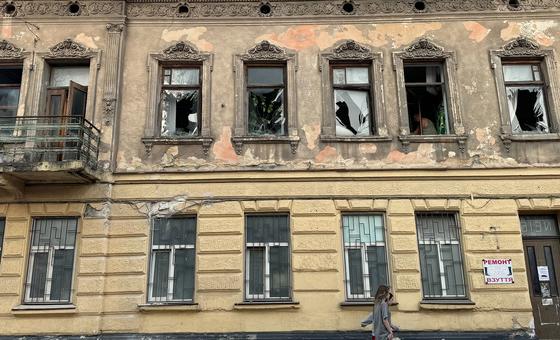
According to the rights mission, while the majority (89 per cent) of civilian casualties were documented in Ukrainian-controlled territory as a result of attacks by the Russian armed forces, the remaining occurred in territory occupied by Russian authorities, including in attacks that struck public transport and clearly marked ambulances.
While individually less destructive than artillery or missiles, “the sheer scale and increasing frequency of short-range drone attacks have made them one of the deadliest weapons in Ukraine,” said Danielle Bell, Head of HRMMU.
Not compliant with laws of war
Forcing residents to drastically restrict their movements, limiting access to essential goods and affecting livelihoods, the large number of short-range drone attacks exacerbated an already dire humanitarian situation.
Most short-range drones have on-board cameras that provide operators with a real-time view of potential targets.
However, the high number of civilian casualties resulting from drone attacks suggests that these weapons have been deployed in ways that violate international humanitarian law, in particular the principles of distinction and precaution, HRMMU noted.
In some instances, drone operators appear to have intentionally attacked civilians or civilian objects, including medical transport and personnel, which would amount to war crimes, it added.
“It is clear that these weapons are not being used in compliance with the laws of war,” Ms. Bell said.
Call for accountability
Information verified by the mission showed that the number of civilian casualties from short-range drones steadily increased in late 2023 and early 2024, before spiking in July 2024 and reaching record numbers in April 2025.
Casualties continued in May and June, such as during a strike on a minibus in Kostiantynivka, Donetsk region, on 23 June, in which the 65-year-old driver was killed.
On 22 May, a 58-year-old woman, a local volunteer, was killed in a frontline village in Kharkiv region when a drone dropped a munition on the balcony of a two-story residential building, according to the HRMMU.
“Each of these attacks must be investigated,” Ms. Bell said.
“Those responsible for targeting civilians and humanitarian personnel must be held to account.”


