


It is still not clear whether mines, which can sink vessels of all types if activated, have been deployed in the Strait of Hormuz, as part of the ongoing conflict in the Middle East.
Most shipping has not been able to pass through the strategically important strait as Iran continues its war with the United States, Israel and other countries in the region, amid ongoing bombing of Iranian targets.
It remains a key objective of the global community to reopen the strait to facilitate the flow of oil and fertilizer.
Paul Heslop is an expert with the UN Mine Action Service (UNMAS) which focuses on clearing land-based mines.
He spoke to UN News’s Nathalie Minard ahead of the International Day for Mine Awareness and Assistance marked annually on 4 April.
UN NEWS: Do you have any information about naval mines being deployed in the Strait of Hormuz?
Paul Heslop: We do know that the Iranian navy had a massive stockpile of sea mines prior to the conflict.
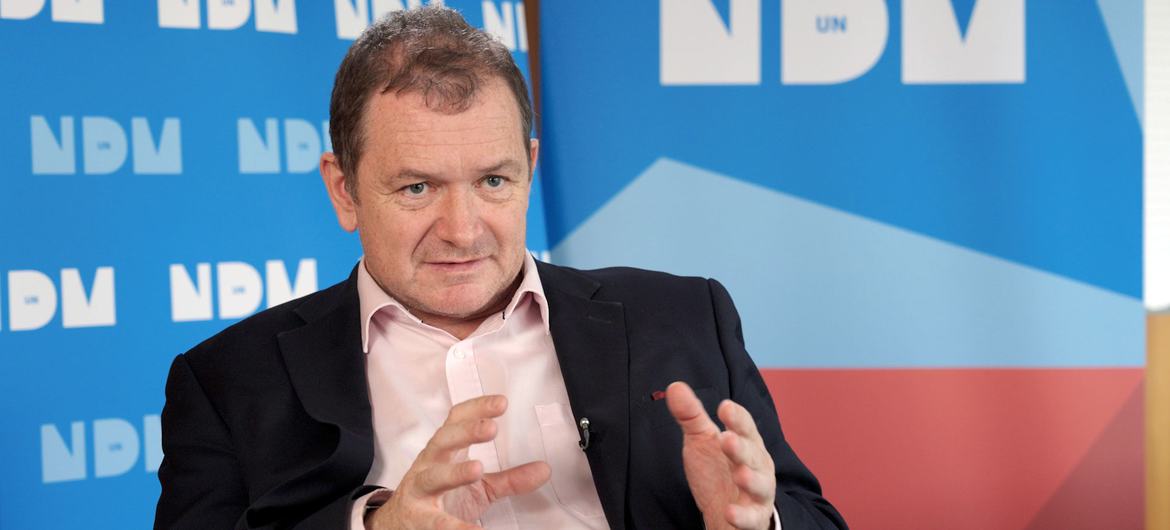
Paul Heslop, UNMAS
We have no confirmed reports stating exactly the number or types that have been used, but sea mines are relatively easy to deploy.
You can take them out in a fairly small boat, a fishing boat, a dhow, or a dedicated minelayer.
UN NEWS: What types of sea mines could be deployed?
Paul Heslop: If you consider a landmine, it is normally either laid on or below the surface. And once it is laid, it stays in place, unless there is an earthquake, landslide, or a large volume of water that moves it.
The challenge with sea mines is that they can be laid in three layers: floating on the surface, floating inside the water or deployed to the bottom of the seabed.
Obviously, if they’re floating, they are vulnerable to tidal currents and can move location. They can also be tethered and secured in one location.
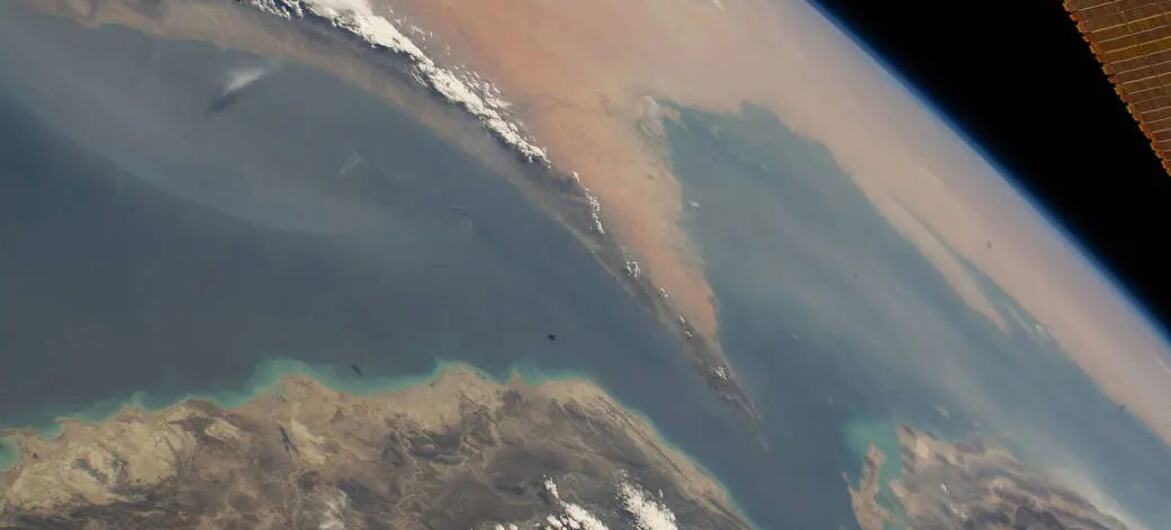
A satellite photo shows the strategically important shipping route of the Strait of Hormuz.
They can be made from plastic or metal. Their activation mechanisms include contact with a hull, magnetic influence, or they can be remotely detonated, or timed to detonate.
UN NEWS: Why are sea mines more challenging to clear?
Paul Heslop: Clearing landmines is difficult, but clearing sea mines is even harder.
You’re not only working in three different depths, so three dimensions, but also a fourth dimension, which is time.
Over time, the mines may move. If an area is cleared, and there is a tidal surge or other current then that same area may be contaminated again.
Moreover, some mines move through the water, driven by a propellant mechanism so deminers are working in a dynamic and changing environment.
UN NEWS: How can they be detected?
Paul Heslop: If they are metal, a magnetometer (which measures changes in magnetic fields) would find them. There are also a range of sophisticated sonar (sound wave) and radar (radio wave) detection tools for locating underwater devices.
Another challenging factor in water are temperature layers which can act as a reflector and make detection more difficult.
So, if the mine is at a depth where there is a different temperature layer above it, and a sonar has been deployed, the sonar may be degraded or deflected because of those temperature layers.
This is why finding and clearing sea mines is extremely challenging and very dangerous for the ships that are doing it.
UN NEWS: Which countries have minesweeping ships and the capacity to technically intervene in that specific area of naval mines?
Paul Heslop: Most navies will have some capability to deal with mines.
This conflict is happening at a time of transition from the old-fashioned minesweeper boats with crew, to new technologies that use drones or underwater robotics to locate mines.
UN NEWS: If sea mines were a proven threat to shipping, what would be the solution to allow traffic to resume once peace is restored?
It’s a bit like in a peacekeeping mission: you may have an insurgent group that, at night, goes and puts a mine on the road to target a convoy.
So, each morning, you do a patrol with a mine-protected vehicle to check that there’s been no mines laid the night before.
If there is a peace deal or an agreement in the Strait of Hormuz and mines have been deployed, then for the foreseeable future, there will probably be a requirement, because of the dynamic nature of sea mines, to form a convoy and sweep for mines in front of that convoy.
A convoy would probably operate in a channel a couple of kilometres wide which has been cleared of mines. It would not be the case that every square metre of the Strait of Hormuz would be cleared every day.
And obviously, depending on currents, tidal shifts, some areas are more likely to become re-contaminated than others.


