


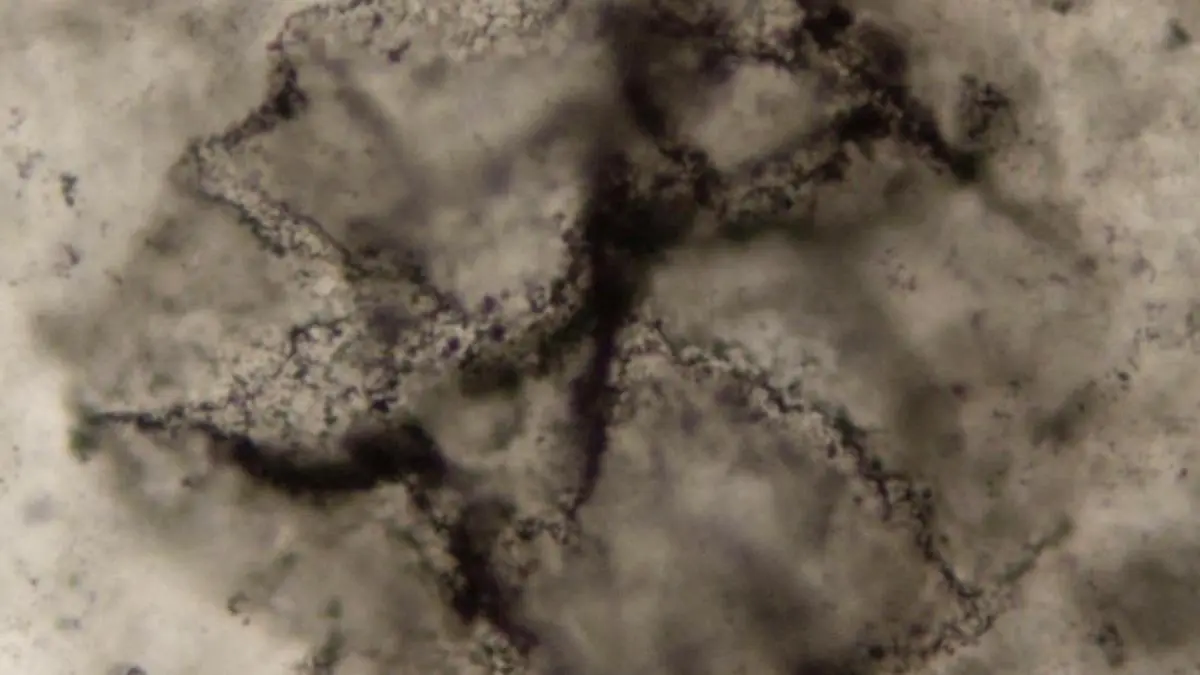
Biomolecular fragments that may indicate photosynthetic activity is detected in this 2.52-billion-year-old rock from South Africa’s Gamohaan Formation in this picture released on November 17, 2025.
| Photo Credit:
Andrew D. Czaja/Handout via REUTERS
Scientists have detected
some of the oldest signs of life on Earth using a new method
that recognizes chemical fingerprints of living organisms in
ancient rocks, an approach that also holds promise in the search
for life beyond our planet.
The researchers found evidence of microbial life in rocks
about 3.3 billion years old from South Africa, when Earth was
roughly a quarter its current age. They also found molecular
traces left by microbes that engaged in oxygen-producing
photosynthesis – conversion of sunlight into energy – in rocks
about 2.5 billion years old from South Africa.
The scientists developed an approach, harnessing machine
learning, to distinguish in ancient rocks between organic
molecules with a biological origin – like from microbes, plants
and animals – and organic molecules with a nonliving origin at
greater than 90% accuracy. The method was designed to discern
chemical patterns unique to biology.
“The remarkable finding is that we can tease out whispers of
ancient life from highly degraded molecules,” said Robert Hazen,
a mineralogist and astrobiologist at the Carnegie Institution
for Science in Washington and co-lead author of the study
published this week in the journal Proceedings of the National
Academy of Sciences. “This is a paradigm shift in the way we
look for ancient life.”
“We collect and concentrate carbon-rich molecules, analyze
them in a way that identifies thousands of tiny molecular
fragments, and then look at their distributions with machine
learning. The human eye just sees hundreds or thousands of
little ‘peaks’ of different molecules, but the machine learning
method teases out subtle patterns that distinguish molecules
that were once alive from those that were not,” Hazen said.
Scientists hunting for evidence of Earth’s earliest life
have relied primarily on finding fossil organisms. Earth formed
approximately 4.5 billion years ago. Its first living organisms
may have been microbes that arose perhaps hundreds of millions
of years later at marine hydrothermal vents or terrestrial hot
springs.
The oldest definitive fossils of living organisms are
mound-like microbial deposits called stromatolites about 3.5
billion years old in Australia and microbial mat structures of
similar age in South Africa. But such fossils are exceptionally
scarce.
Another way to find evidence of early life is to look for
traces of biomolecules – chemicals related to living organisms –
in ancient rocks. The new approach takes that path.
For instance, the researchers discovered organic molecular
evidence that oxygen-producing photosynthesis, which over time
oxygenated the planet’s atmosphere and enabled the evolution of
complex aerobic life, was underway by marine bacteria more than
800 million years earlier than previously documented by this
type of data.
“It was well known from other evidence that Earth became
oxygenated by 2.5 billion years ago and maybe even a little
earlier. So we have provided the first convincing fossil organic
molecular evidence, with the prospect of pushing the record even
farther back,” Hazen said.
All of the ancient biomolecules, like sugars or lipids such
as fats, are gone and fragmented into little pieces with only a
handful of carbon atoms. Yet the distribution of those fragments
is remarkably different for suites of organic molecules in life
versus nonlife.
“First, we’ve roughly doubled the age at which we can
identify signs of life using organic molecules, from 1.6 billion
to 3.3 billion years,” said study co-lead author Anirudh Prabhu,
a Carnegie Institution for Science mineralogist, astrobiologist
and data scientist.
“Second, this biosignature technique can distinguish not
just life from nonlife but different kinds of life, such as
photosynthetic organisms. Third, our paper shows how machine
learning can identify the fingerprints of life in ancient rocks,
even when all original biomolecules are degraded,” Prabhu said.
NASA rovers have collected rock samples on Mars in a quest
to learn whether Earth’s planetary neighbor ever harbored life.
Other destinations in our solar system also hold potential in
the search for life, including Saturn’s moons Enceladus and
Titan and Jupiter’s moon Europa.
The researchers have received a NASA grant to develop their
approach for identifying evidence of life.
“One key application area for our project is astrobiology,”
Prabhu said.
Hazen said, “We are very excited about the prospects of
using this method on samples from Mars, ideally those returned
to Earth but possibly on a future rover mission. We are also
thinking about ways to sample the organic-rich plumes of
Enceladus or the surface of Titan or Europa.”
Published on November 18, 2025


