


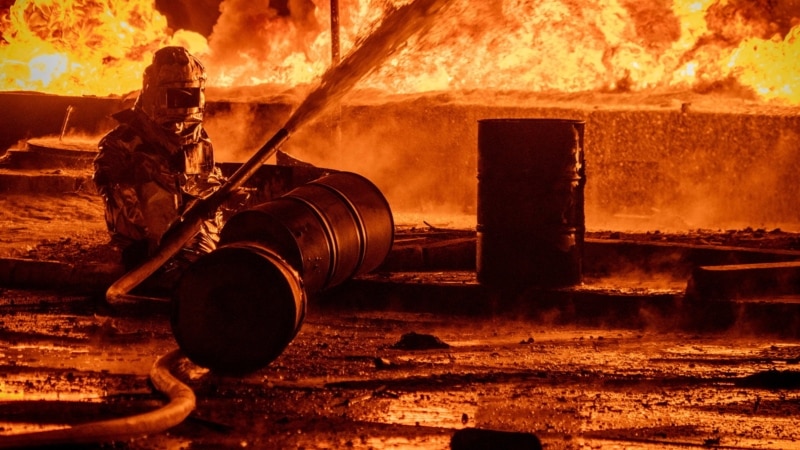
Russia kept up its relentless air attacks on Ukraine, hitting energy facilities in at least two regions and targeting several other locations across the country amid uncertainty over the prospects for peace efforts following summits in the United States in recent weeks.
Drone strikes damaged four power facilities in the Odesa region early on August 31, cutting power to more then 29,000 customers, regional head Oleh Kiper said on Telegram, adding that private homes and other buildings were also damaged and one person was injured.
“Critical infrastructure is being powered by generators,” Kiper said. He said Chernomorsk, a coastal city south of Odesa, was hit hardest.
A drone attack hours later hit civilian energy infrastructure in the Chernihiv region in northern Ukraine, leaving 30,000 house households in the Nizhyn district without electricity, regional governor Vyacheslav Chaus said. He said power had been restored to the main hospital and the city water system.
The new attacks came as allies of a prominent Ukrainian politician shot dead in the Western city of Lviv a day earlier pointed the finger at Russia, and as Russian President Vladimir Putin arrived in China for the annual meeting of a regional organization that also includes China, India, and seven other countries.
Nationwide, air defenses neutralized 126 of the 142 drones they detected overnight, while the rest hit in 10 locations and fragments of downed drones rained down at six other sites, the Ukrainian Air Force said.
The barrage followed attacks in the northeastern Sumy region on the Russian border on August 30, where a top village official was wounded, authorities said.
Putin was due to meet with the leaders of China, India, and others at a August 31-September 1 summit of the Shanghai Cooperation Organization (SCO) in Tianjin, China, amid tensions with the West over Russia’s invasion of Ukraine and other issues.
China has been a crucial partner for Russia since Putin launched the full-scale invasion of Ukraine in February 2022, fueling its war economy with oil and gas purchases, providing dual-use items for its military arsenal in the face of Western sanctions, and giving Moscow diplomatic backing on the world stage.
Mourners Pay Tribute To Andriy Parubiy
Meanwhile, in Lviv, mourners brought flowers to the site where Andriy Parubiy, a nationalist lawmaker and former parliament speaker, was shot dead in broad daylight on a street near his home on August 30.
As law enforcement authorities sought to identify and apprehend the attacker and searched for clues to a possible motive in the shooting, several associates of Parubiy blamed Russia.
Lawmaker Mykola Knyazhyskiy said he believed Parubiy’s killing was “Russian revenge for his stance,” suggesting he was targeted for his support for Ukraine’s sovereignty, security, and unity in the face of the Russian invasion.
“This is a murder [intended] to frighten and destroy those people who are real, strong, responsible Ukrainian leaders, so that the Ukrainian nation has no future,” Knyazhytskiy said.
Parubiy, 54, played a prominent role in the Maidan protests of 2013-14, known in Ukraine as the Revolution of Dignity, when huge rallies over then-President Viktor Yanukovych’s decision to distance Kyiv from the European Union and move closer to Russia instead led to the collapse of his rule and his flight to Russia.
Parubiy was also an important figure in the Orange Revolution, when the declared victory of Yanukovych, the Kremlin favorite in a 2004 presidential election, was overturned following massive protests over evidence of widespread fraud.
“Whoever carried it out, the one who ordered it and the one who must bear responsibility is Putin,” former President Petro Poroshenko, who heads the European Solidarity party, of which Parubiy was a member, said of his killing.
Ukrainian authorities have not named any suspects in the contract-style killing of Parubiy, who was speaker of the Verkhovna Rada, Ukraine’s parliament, from 2016-19.
When asked by RFE/RL why Parubiy may have been targeted, the head of the regional police in Lviv said there were many possible theories, including a political motive and the involvement of Russia. No evidence has been presented.
The developments came amid questions about the future of efforts to end the war following US President Donald Trump’s meeting with Putin in Alaska on August 15 and with Ukrainian President Volodymyr Zelenskyy and European leaders at the White House three days later.
Trump and Zelenskyy have called for a meeting between the Ukrainian and Russian presidents, but Russian officials have thrown cold water on the idea, suggesting that the positions of the two sides are too far apart to make that worthwhile. Some in the West say Putin is stalling and has no intention of ending the war.
Trump, in an interview with conservative news site Daily Caller aired on August 30, expressed less confidence than he had earlier in the prospect of a one-on-one Putin-Zelenskyy meeting in the near future, but said he believed a three-way meeting with him included would happen.


