


In this week’s Inside Spain we look at how the record number of foreign self-employed workers are ensuring the Spanish economy stays afloat, and how popular tourist towns and British tour operators want to put a stop to ‘tourismphobia’.
In the last three months, Spain’s population has increased by 75,865, reaching 49,153,849 inhabitants, the highest figure on record.
Once again, this was due to an increase in the number of foreigners moving to Spain, while native born Spaniards continue to decrease in numbers.
Spain now has 9.4 million residents who were born overseas, compared to 42.2 million born in Spain.
Colombians, Moroccans, Venezuelans, Peruvians, returning Spaniards, Italians, Hondurans and Ukrainians make up the majority of new arrivals.
Advertisement
Many of these new residents are going at it alone, becoming self-employed workers despite the notorious challenges that come with working for yourself in Spain.
READ ALSO: Eight key lessons I’ve learnt about being self-employed in Spain
In March 2025, Spain had 471,755 self-employed workers of foreign origin, representing almost 14 percent of those registered with the Special Regime for Self-Employed Workers (RETA).
That’s the highest figure of foreign autónomos ever. In fact, they’ve almost doubled in number over the past 10 years, having increased by 92 percent since 2015.
According to new data from Spain’s Union of Professionals and Self-Employed Workers (UPTA), they work primarily in the trade and retail sector with 103,672 self-starters; the hospitality industry with 77,042; and construction with 67,815.
But UPTA has also detected a “boom” in the representation of foreign-born self-employed workers in highly skilled activities such as IT and communications, scientific fields, technical activities, healthcare and education.
The majority of foreign autónomos come from non-European countries, representing 61 percent of the total, compared to 39 percent of autónomos from other EU countries.
Spanish self-employment authorities have been open about the pivotal role foreign self-employed workers are playing in Spain, in a context marked by an ageing population, the depopulation of ‘Empty Spain’, the lack of interest among Spaniards in trade jobs and the lack of generational renewal.
“Foreign entrepreneurship is a fundamental pillar of our country’s economy,” UPTA President Eduardo Abad has said, with his organisation estimating that Spain will need another 200,000 more foreign autónomos in the next five years.
“It is essential that migrants, who have left behind family, country, and culture to begin a new life project, find institutional support to pursue solid and sustainable entrepreneurship.”
Since 2019, Spain has lost 930,000 native-born workers of a working age but the arrival of 2.1 million foreigners during the same period has kept the Spanish economy afloat.
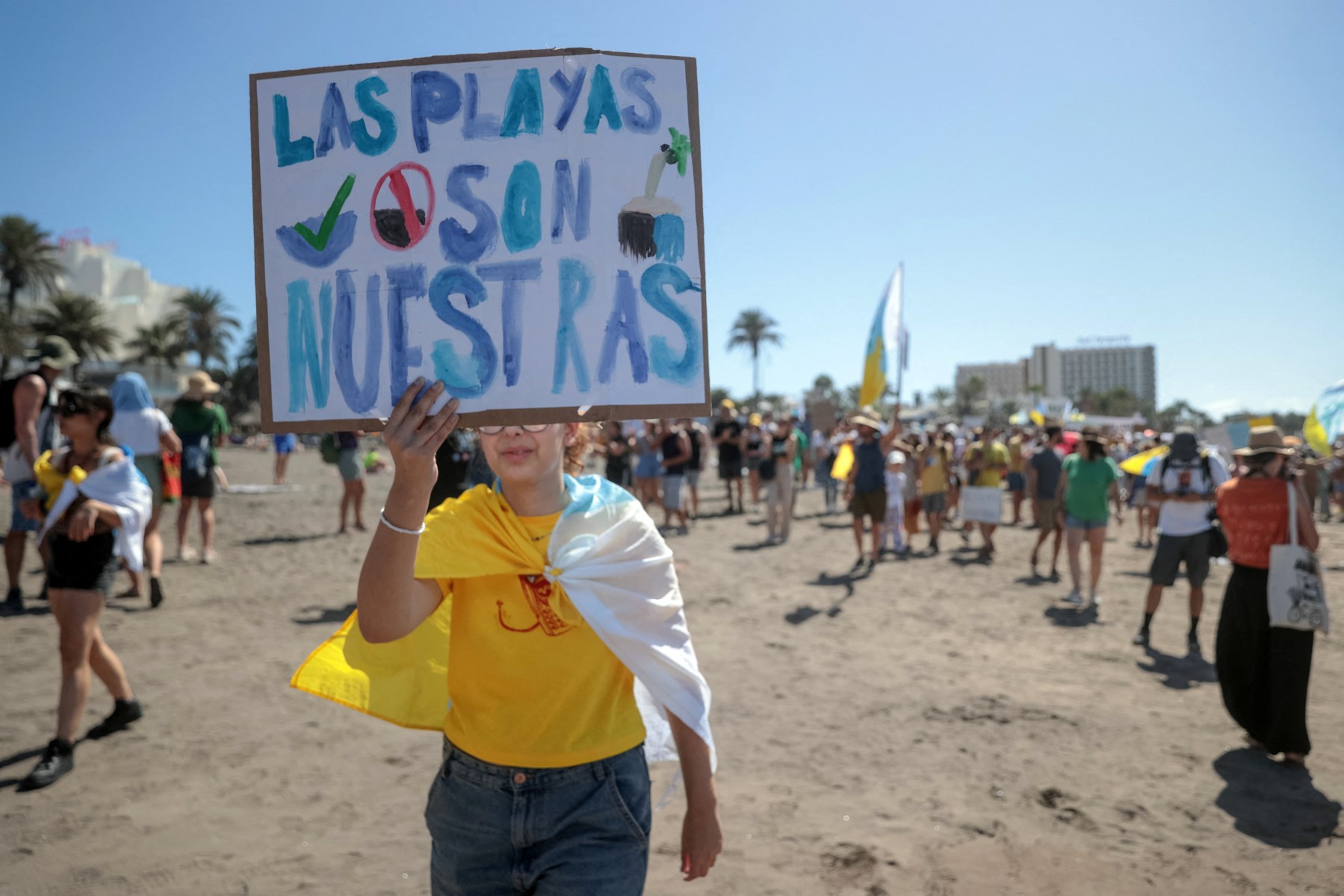
A protester holds a sign reading “The beaches are ours” during a demonstration against mass tourism, in the touristy municipality of Arona in the south of Tenerife. (Photo by DESIREE MARTIN / AFP)
In other news, the mayors of eight popular Spanish tourist towns met with British tour operators in London this week to agree on how to fight the so-called ‘tourismphobia’ that’s been brewing in the country recently.
The alcaldes (mayors) of Adeje, Arona, Benidorm, Calvià, Lloret de Mar, Salou, San Bartolomé de Tirajana, and Torremolinos, which together form Spain’s Alliance of Sun and Beach Tourist Municipalities (AMT), took part in talks at the Spanish Embassy in London with major British tour operators such as TUI and Jet2.
“Faced with this anti-tourism sentiment, we will promote ‘tourismophilia,’” said the mayor of Benidorm Antonio Pérez while participating in the Sustainable Tourism Forum.
Advertisement
Mark Tanzer, head of the Association of British Tour Operators and Travel Agents (ABTA ) stressed that “it’s important that we act before it becomes a problem and people feel afraid or too unwelcome to travel to Spain.”
Tanzer added that “residents who express their concern about the impact of tourism on their daily lives must not be ignored” and that organisations such as his must help to “educate” British tourists so that they “respect local customs, as well as the residents’ right to a peaceful life”. They also want to “discourage antisocial behaviour and try to ensure that where alcohol is available, it is in a controlled manner”.
Spain is gearing for mass tourism protests which will take place across the country on June 15th in locations such as Barcelona, Palma de Mallorca, Ibiza, the Canary Islands, and San Sebastián.
READ MORE: What to expect from the mass tourism protests across Spain in June
2024 marked the year Spain truly started to question whether the downsides of mass tourism now outweigh the benefits, especially with regard to the impact short-term holiday lets are having on housing prices.
There were numerous protests across the country last year, from Madrid down to Málaga, and as the busy 2025 summer season approaches it looks likely that there will be even more anti-mass tourism demos given that little has changed.


