


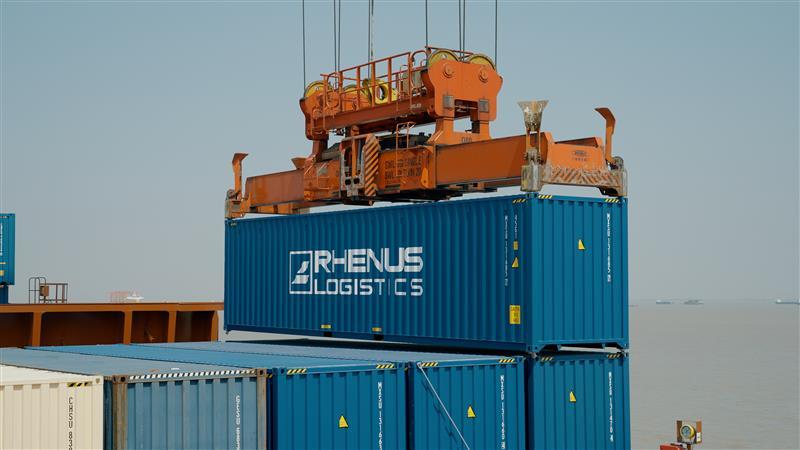
BAKU, Azerbaijan, November 18. The
international logistics group Rhenus Logistics, headquartered in
Germany and specializing in multimodal transport and supply chain
management, is gradually expanding its activities along the Middle
Corridor as part of its long-term regional strategy covering
Türkiye, the South Caucasus, and Central Asia, a source at the
Germany-based international logistics group Rhenus Logistics told
Trend in an exclusive
interview.
Meanwhile, the company specializes in multimodal transport and
supply chain management.
The company noted that Azerbaijan plays a central role in this
corridor as a transit country and as a developing logistics hub
connecting Asia and Europe. In particular, the Port of Baku and its
infrastructure are a key element of the corridor, and Rhenus is
closely monitoring these changes and assessing investment
opportunities in the country.
Rhenus Logistics strengthens its logistics network along
the Trans-Caspian corridor
After transforming its representative office in Baku into a
legal entity in 2024, Rhenus began considering several new
investment projects across the country, including a port logistics
project that is currently under evaluation.
“Although specific details are not being disclosed at this
stage, the initiative reflects the Rhenus Group’s intention to
strengthen multimodal and maritime connectivity in Azerbaijan. The
project is currently under review, and further steps will be
determined once the review is complete.
In addition to individual projects, Rhenus is focused on
developing integrated multimodal solutions that efficiently and
sustainably connect maritime, rail, and road transport. This
includes the modernization of transshipment points, the creation of
new depots, and the digital integration of customs, port, and rail
processes,” the source says.
Rhenus Logistics works closely with customers, partners, and
authorities and invests where there is real demand, with the
long-term goal of supporting Azerbaijan’s economic development and
creating a reliable and sustainable logistics infrastructure along
the Trans-Caspian corridor.
Azerbaijan as a key bridge in the multimodal supply
chain
“The Trans-Caspian corridor provides strategic diversification
and resilience for global supply chains. It provides an alternative
route connecting China, Central Asia, and Europe via the Caspian
Sea, helping to reduce dependence on northern routes and ensuring
more predictable transit times. For many shippers, this is an
opportunity to remain independent of geopolitical risks and
maintain continuity of transport in changing conditions.
Azerbaijan plays a central role as a bridge between Asia and
Europe. The potential is significant: the country has already
proven its ability to establish effective multimodal connections.
For example, cargo arriving in Baku can be shipped by rail to
Georgia and on to the Black Sea or Turkey in just a few hours,
saving a significant amount of time compared to northern routes,”
emphasizes Rhenus Logistics.
This efficiency makes the corridor increasingly attractive for
diversifying trade and strengthening the logistical resilience of
Eurasia.
However, the route faces infrastructure and operational
challenges, such as fragmented infrastructure and bottlenecks. In
many places, there is a lack of modern terminals, intermodal hubs,
and coordinated cross-border handling, which can lead to increased
transit times.
Technical obstacles also remain: differences in rail gauge,
limited rolling stock, and long distances between major cities
complicate operations planning. In addition, differences in
national regulations, tariff systems, and administrative procedures
continue to slow progress, requiring closer regional coordination.
Equally important are shippers’ growing expectations for
predictability and transparency throughout the route,” the company
noted.
Ultimately, the main advantages of the Trans-Caspian corridor
are connectivity, predictability, and diversification. The main
challenge is to turn these strengths into a fully compatible,
reliable, and economically competitive logistics route — a goal
that Rhenus is pursuing through long-term investment, local
cooperation, and technical expertise.
Rhenus Logistics’ forecast for freight volumes on the
China–Azerbaijan–Europe route
“The company sees high and sustainable growth potential for
freight volumes on the China–Azerbaijan–Europe route. As global
supply chains diversify and companies seek more sustainable
transport solutions, the Trans-Caspian corridor has evolved from a
backup option to a major trade route.
Over the past two years, container traffic on the Trans-Caspian
route has increased by approximately 35-40 percent per year,
reaching about 3.2 million tons in 2024 compared to 1.5 million
tons in 2022. With continued investment in key hubs such as Baku,
Aktau, and Kuryk, as well as improved coordination of rail services
between Kazakhstan, Azerbaijan, and Georgia, freight volumes are
expected to double by 2030,” notes Rhenus Logistics.
Further development of port and rail infrastructure, together
with effective multimodal coordination, is likely to continue to
stimulate growth in transport volumes in the coming years.
Rhenus’ active presence in the region and at key terminals
enables the company to support this growth and provide reliable,
sustainable logistics solutions along the corridor.
Rhenus Logistics boosts digitalization of the
Trans-Caspian corridor
“Digitalization is a key element of the Rhenus Group’s logistics
strategy, including its activities in Azerbaijan and throughout the
Trans-Caspian Corridor. One of the promising areas is the
introduction of digital corridor management systems that bring
together customs, port, and railway structures on a single
platform.
Such systems help to avoid bottlenecks, provide real-time
visibility of processes, and use predictive analytics for more
efficient capacity planning,” the company notes.
Rhenus is also developing its own software for managing
terminals and transshipment operations, drawing on its experience
in designing and managing high-performance logistics hubs.
“The company intends to apply this experience in the region,
reducing cargo handling times and costs, making the Trans-Caspian
route more competitive compared to alternative routes. Reliable
transit times and stable, predictable pricing are critical to the
long-term success of the corridor.
Digitalization is closely linked to sustainability. Since Rhenus
began operations in Azerbaijan in 2015, the company has expanded
its range of services from road transport to multimodal services
with a rail component, reducing emissions and increasing capacity
utilization.
As part of COP29 in Baku, Rhenus supported local logistics
operations with an environmentally friendly electric truck,
demonstrating how practical innovations contribute to cleaner and
more efficient logistics,” Rhenus Logistics concludes.


