


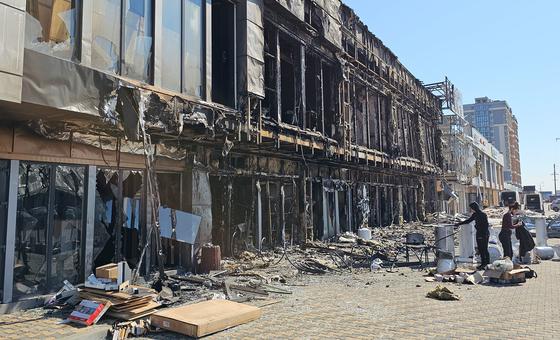
It covers the period from 1 December 2024 to 31 May 2025, during which 986 civilians were killed and 4,807 injured – a 37 per cent increase compared to the same period the previous year.
“The war in Ukraine – now in its fourth year – is becoming increasingly deadly for civilians,” said Danielle Bell, Head of the UN Human Rights Monitoring Mission in Ukraine (HRMMU).
“We continue to document patterns of violence that are inconsistent with obligations under international humanitarian law.”
Concern over use of short-range drones
Most casualties occurred in areas under Ukrainian Government control, primarily due to Russian attacks using long-range explosive weapons in populated areas and short-range drones near frontline locations.
Nearly half of all casualties were caused by missiles, loitering munitions and air-dropped bombs in densely populated areas. At least three attacks involved the use of missiles with fragmentation warheads which detonated above ground and scattered fragments across large open areas, killing and injuring many civilians at once.
The use of short-range drones is driving the rise in civilian casualties, the report said. OHCHR verified that 207 civilians were killed and 1,365 injured in these attacks.
Among the deadliest incidents was a Russian drone strike on a civilian bus transporting employees of a mining company to work in the Dnipropetrovsk region. Eight women and two men were killed, and 57 people were injured.
“The high number of civilian casualties from the use of short-range drones, which allow operators to see their targets in real time, raises grave concerns,” Ms. Bell said.
“Our findings strongly suggest a failure to distinguish between civilian and military targets, and to take all feasible precautions to verify the military nature of those targets – or worse, an intentional decision not to.”
During the same period, Russian forces struck at least five hospitals directly. Some of the attacks used multiple loitering munitions, suggesting potential deliberate targeting of the hospitals in violation of international humanitarian law.
Prisoners of war
Serious violations against prisoners of war (POWs) also remain a major concern, according to the report. OHCHR documented credible allegations that at least 35 Ukrainian POWs and one Russian POW were executed during the reporting period.
Staff interviewed 117 recently released Ukrainian POWs and two detained medical personnel, nearly all of whom described being tortured and ill-treated in captivity. This included severe beatings, electric shocks, sexual violence, dog attacks, and deliberate humiliation, often carried out by personnel wearing balaclavas to conceal their identities.
Ms. Bell said the continued brutalization of Ukrainian prisoners of war is not only inhumane, but a serious violation of international law.
“These are not isolated incidents – they point to well-documented patterns of widespread and systematic torture that demand urgent and unambiguous accountability, and measures toward prevention,” she said.
Meanwhile, more than half of the Russian POWs and third-country nationals held by Ukraine also reported abuse – including torture, ill-treatment, threats, and internment in unofficial facilities – which mostly occurred in transit places before arrival at official places of internment.
Rights concerns in Russian-occupied areas
The report highlights ongoing human rights concerns with Ukrainian civilians unlawfully detained by Russian authorities, predominantly in occupied territory. People who have been released described torture, ill-treatment, and dire conditions of detention.
Ukrainians in occupied territory faced increased coercion to adopt Russian citizenship. OHCHR documented over 16,000 homes listed by Russian occupation authorities as potentially “abandoned” and therefore at risk of being confiscated.
Displaced residents faced severe legal and logistical obstacles, as well as security risks, to reclaim their property.
Ukrainian children recruited
Another issue covered in the report is the recruitment and use of Ukrainian children “for sabotage activities of increasing gravity against Ukrainian military objectives.”
The children reportedly were recruited by unidentified actors, likely affiliated with Russia, according to Ukrainian law enforcement authorities. Some of these youngsters were killed or injured, while others are facing prosecution after being enticed via social media to commit arson or plant explosives.
“Using children to commit acts of sabotage or violence exploits their vulnerability and endangers their lives,” Ms. Bell said. “It compounds their suffering by exposing them to violence, coercion, and harsh legal consequences.”
OHCHR also voiced concern over the situation of older people, mainly women, as well as persons with disabilities, who remain at disproportionate risk, particularly in frontline areas.
Many are unable to evacuate due to poverty and limited housing options, while those who can often face long stays in shelters that lack appropriate facilities, or they are placed in institutional settings due to the absence of suitable alternatives.


