


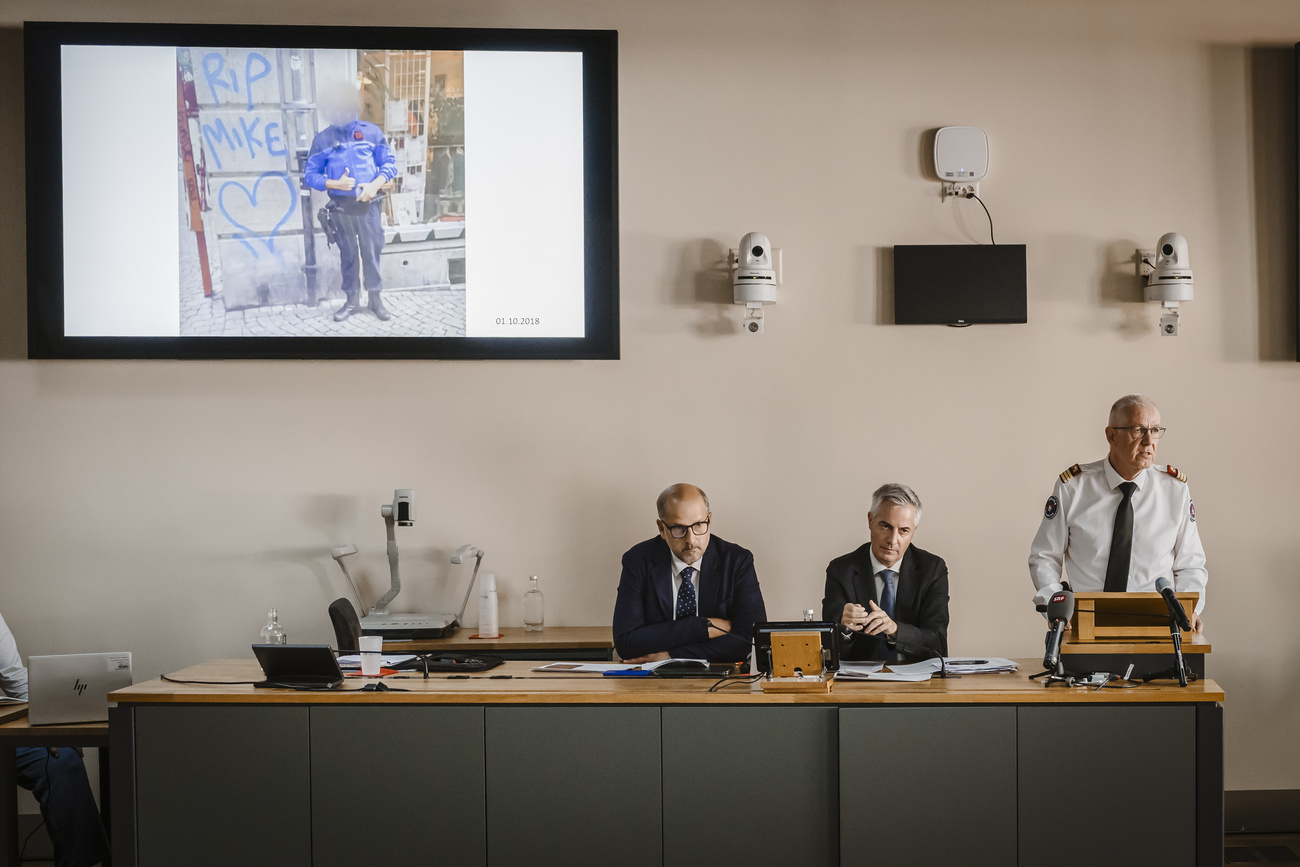
City and police representatives from Lausanne face the media after the report of the police group chats, Monday, August 25.
Keystone / Gabriel Monnet
For the first time, a culture of discrimination and systematic racism has been documented within a Swiss police force – is Lausanne a one-off case?


The content of recently uncovered WhatsApp chats shared among members of Lausanne’s police force cover the entire spectrum of discrimination: racist messages, sexist “jokes”, homophobic remarks, glorification of Nazism and the Ku Klux Klan. People with disabilities also come in for ridicule.
That the messages came to light this week is thanks to the work of the attorney general’s office. It started with a photo, showing a police officer in front of a graffiti reading “RIP Mike” – a tag commemorating Mike Ben Peter, a dark-skinned man from Nigeria who died in a violent police operation in 2018. The policeman in the photo is raising his thumb.
One in 10 officers
After Swiss public broadcaster, RTS, published the photo online, the public prosecutor’s office got involved, seizing the mobile phone of the officer. There, they came across the private chat groups in which 48 members of the Lausanne police force were active – 10% of the entire corps.

The photo which started the investigations.
RTS
The fact that there was a problematic subculture within this particular force was an open secret for many. Frédéric Maillard, who has spent decades developing police training modules, told RTS he had “been pointing out abuses and racism within the Lausanne police force since 2005”. Up to now, he said, “there has been a lack of evidence”.
Maillard is currently working with the Lausanne police in a transformation process which was initiated after senior officers recognised the extent of the undesirable culture and took action.
More
More
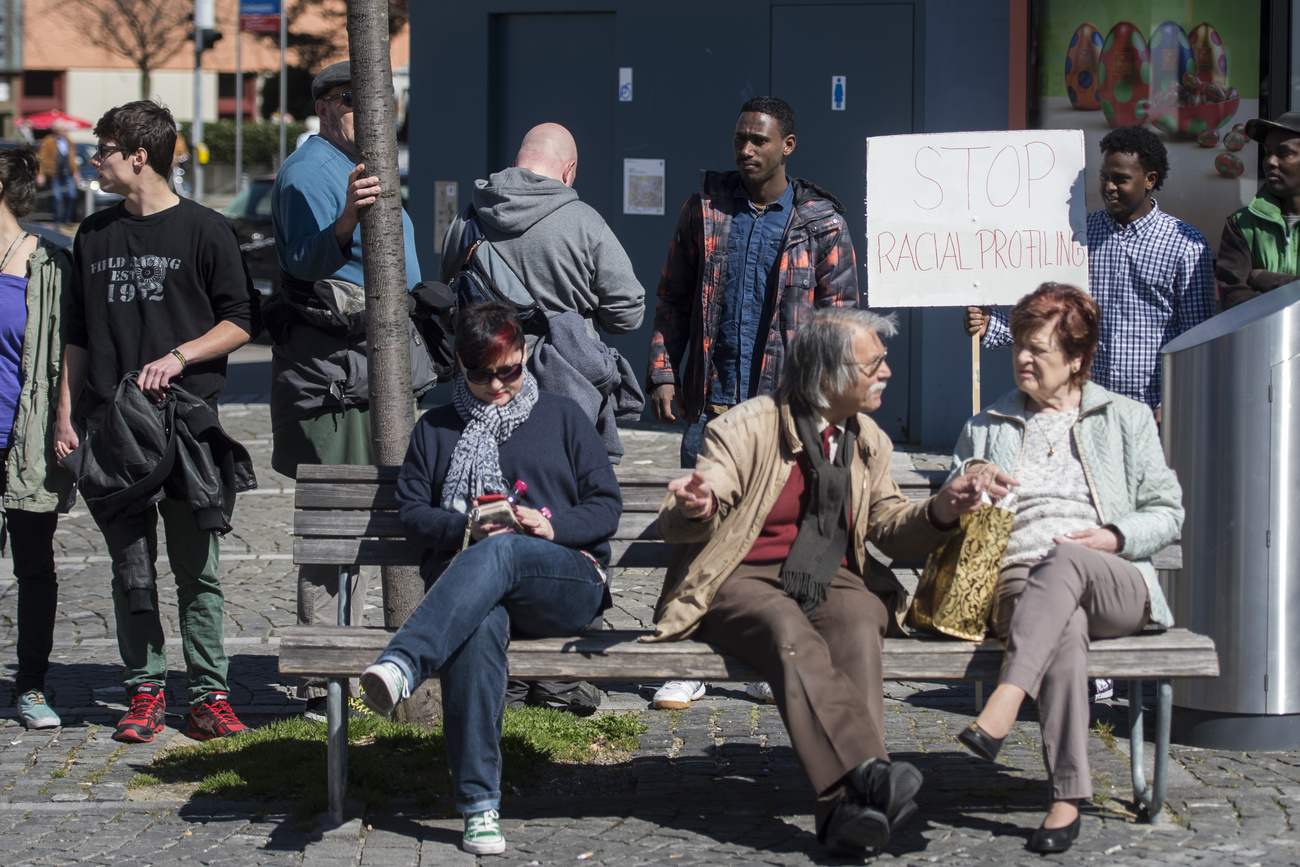
Racial profiling judgement against Switzerland: ‘a hopeful moment’
‘Everyone knew, nobody denounced’
Maillard speaks of a minority phenomenon, ongoing for over two decades. “Everyone knew or suspected it,” he told RTS. But none of the members of the chat ever denounced any of the others. Omertà, the law of silence, prevailed.
Olivier Botteron, commander of the Lausanne police, described the revelations as “extremely shocking”. “These messages are contrary to all our values,” he said. Four police officers have already been suspended, with more to follow.
Is Lausanne an isolated case? Or is structural racism within the police force more widespread in Switzerland? For Maillard, the revelations won’t go unnoticed elsewhere. “I can imagine that other police forces in Switzerland will also have to do some soul-searching,” he told RTS.
At the same time, he warned against drawing simple conclusions. “Some officers who deviate internally behave in an exemplary manner externally,” he said, adding that “racial profiling happens, but it is not necessarily linked to these chats”.
In early 2024, the European Court of Human Rights (ECHR) ruled against Switzerland due to a check by Zurich city police on a man called Mohamed Wa Baile in 2015. The incident, which the ECHR found to be discriminatory and against human rights, is unusual in that it was taken to the highest judicial body – thanks largely to a support committee. Many other people affected by such cases are intimidated by the legal system and don’t report their experiences.
Another high-profile case dates back to 2009, when Wilson A., a dark-skinned man with a heart condition, was checked and forcefully detained by police on a Zurich tram. The case occupied Swiss human rights organisationsExternal link and the media for years. In 2024, Zurich’s high court ruled that the incident was not a case of racial profiling.
Maillard’s statements seem to confirm what rights groups like Amnesty InternationalExternal link and Human Rights WatchExternal link, as well as the Swiss Federal Commission against Racism (FCRExternal link) – an extra-parliamentary and independent commission of experts – have been criticising for years.
Police in Switzerland are also repeatedly accused of racial profiling: making discriminatory checks and intervening based on external characteristics, rather than on grounds of concrete suspicion.
Does systemic racism have an impact in practice?
In recent years, various international bodies have also pointed the finger at Switzerland due to discriminatory police practices. The European Commission against Racism and Intolerance (ECRI) did so in 2019External link, while independent UN experts expressed concernExternal link in 2022.
In 2023, the Swiss federal government acknowledged that structural racism was a “reality” in the country. And in a detailed reportExternal link, the Service for Combating Racism (SCRA) pointed out that the police is one area in which such racism is expressed.
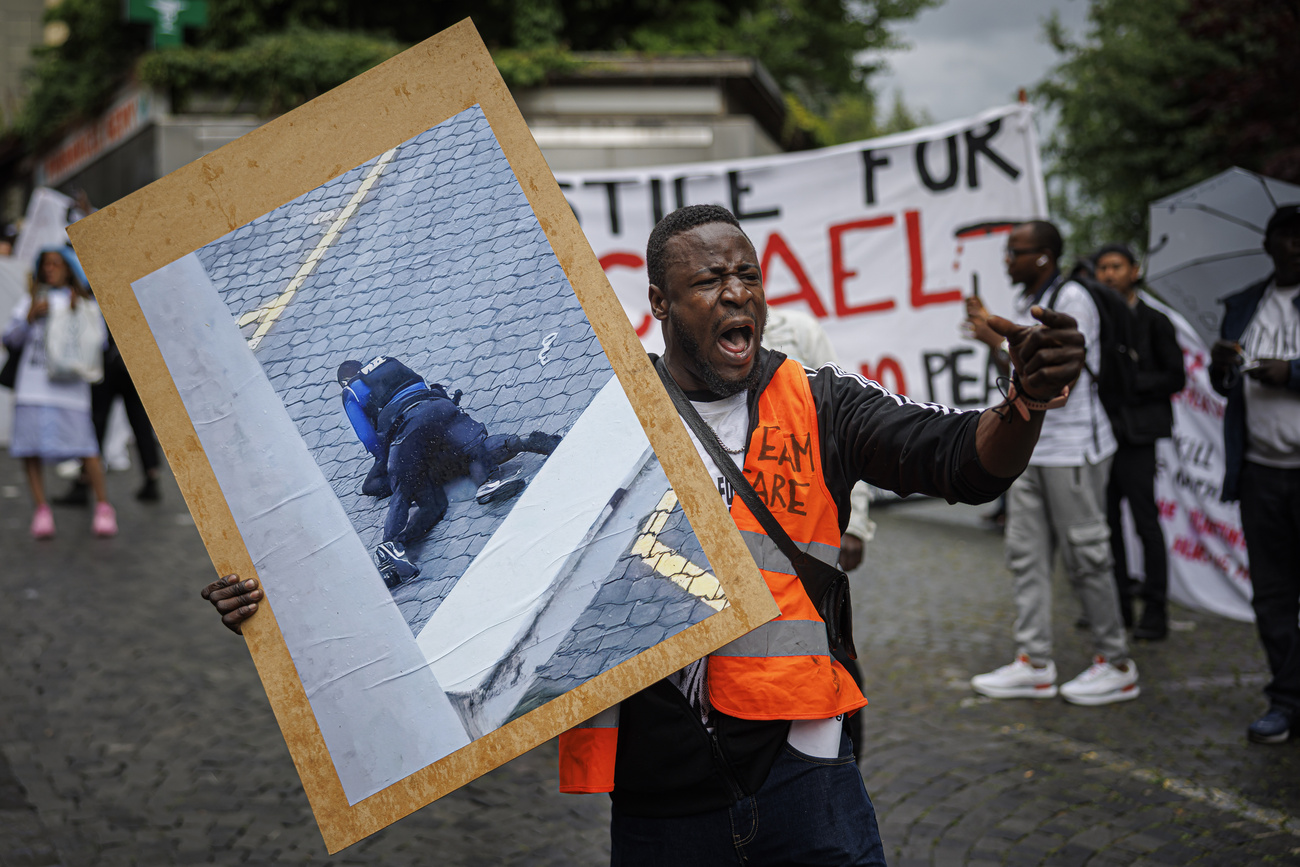
A demonstration in Lausanne after the death in police custody of a Nigerian man, Michael, in May 2025.
Keystone / Valentin Flauraud
The report particularly emphasised the problem of “discriminatory police checks” – i.e. racial profiling. “Checks based on appearance are structural racism insofar as they combine power relations, stereotypes and common practices,” it said, adding that this is not a marginal phenomenon.
More and more cases
In its reports, the FCR summarises incidents logged annually by a network of some 20 support centres for victims of racism across the country. Numbers are increasing from year to year, which could indicate that more and more incidents are being reported.
But the figures also give an impression of what kind of things are happening.
Of the over 1,200 reported cases of racial discrimination in 2024External link (which marked a 40% jump on 2023, most of the increase being due to cases within private companies), 116 cases involved the forces of law and order – and 76 involved the police. Around 60 incidents, or 5% of the total, were about racial profiling.
According to further statistics from the Federal Statistical Office (FSO), 7% of victims of racial discrimination stated that it was linked to a context involving police.
Some groups more affected than others
In its 2019 report on Switzerland, the ECRI found that allegations of police abuse particularly affected “people with a nomadic lifestyle” – such as Yenish and Roma – as well as black people. These latter were “particularly affected by police checks, which often involved arrests and body searches for drugs”, the report noted.
The UN experts also expressed their alarm at the treatment of people of African descent by law enforcement agencies and the justice system in Switzerland. The SCRA meanwhile notes that “skin colour is the decisive factor” in racial profiling, and that it also affects people perceived as Asians or Muslims.
In order to know more about what kind of training, recruitment and organisational development measures are in place to prevent a toxic subculture, Swissinfo contacted several police forces, two directors of police schools and the Conference of Cantonal Police Commanders. A day after the Lausanne revelations, however, nobody was prepared to provide any information.
Edited by Marc Leutenegger; translated from German by DeepL/dos


