


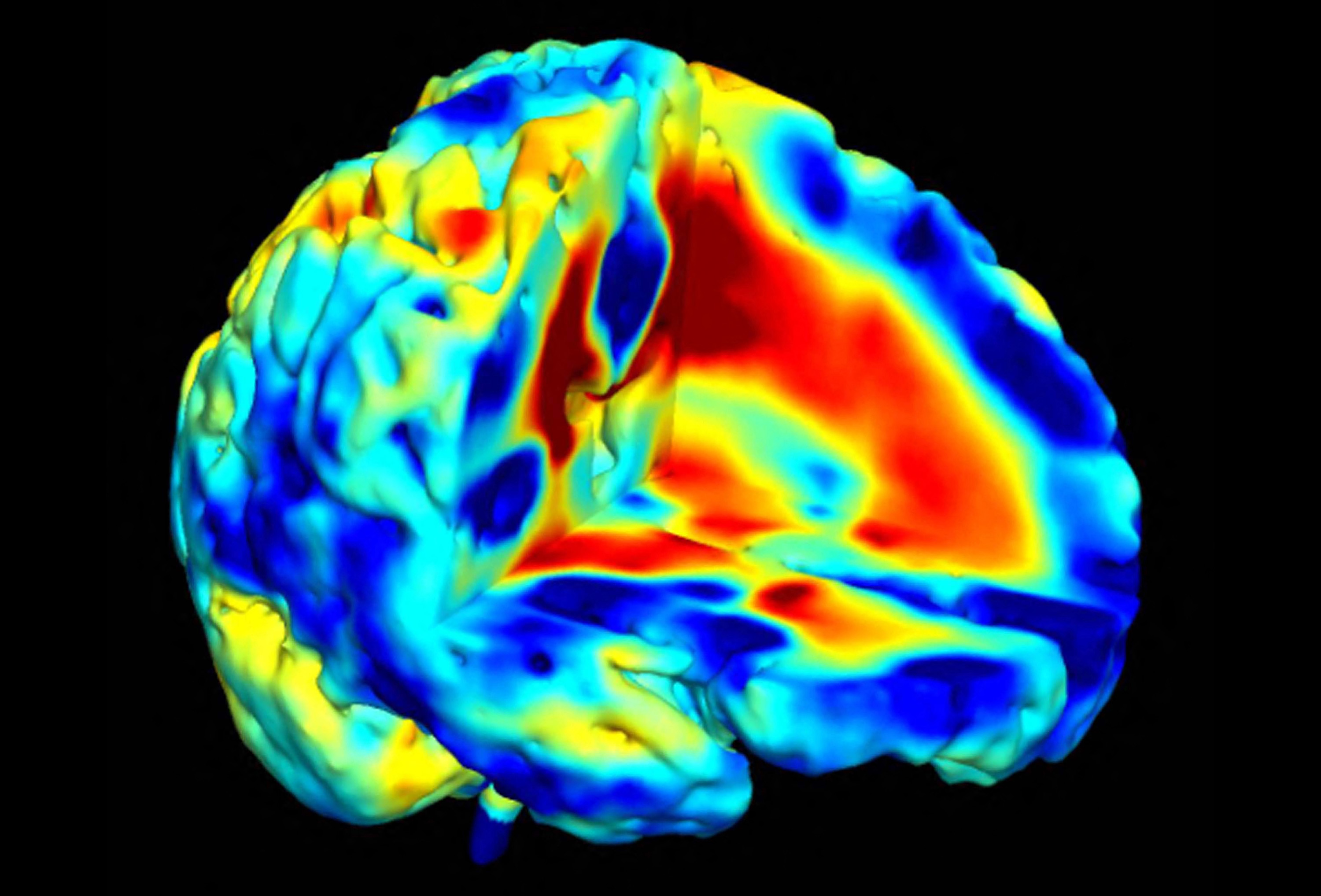
A scan showing areas of brain growth and loss of tissue for a patient with childhood-onset schizophrenia.
AFP
Psychiatrists and neuroscientists at a Swiss hospital are combining artificial intelligence (AI) with personalised brain stimulation to move beyond trial-and-error treatment. The goal is to identify which therapy works best for which patient and to deliver it faster.
Today, psychiatric treatments for illnesses such as depression can take weeks to show effects, for others such as schizophrenia, medicine fails to address all the symptoms. Doctors frequently need to try different medications and doses before finding the right one. More time to find the right treatment means potential side effects from the wrong treatments and more suffering for the patient.
Researchers at HUG (Geneva’s university hospitals) and the University of Geneva (UNIGE) are combining AI technology and brain imaging to tailor treatment to each patient’s brain.
Rather than a lengthy trial-and-error phase, patients could, in the future, undergo a brain scan. Their clinical history and biological data would be analysed using artificial intelligence, helping doctors identify the treatment most likely to work – whether medication, psychotherapy or brain stimulation. This could be a revolution for how mental health is treated and diagnosed.
More
More
Is psychedelic therapy about to go mainstream?
From understanding the brain to personalising treatment
For years, neuroscientists have observed how the brain works to identify the different areas involved in mental health disorders. “We worked on imaging to better understand what happens in the brain,” says Stefan Kaiser, professor of psychiatry at UNIGE and Head of Psychiatry at HUG. “Now we want to use this neuroscientific knowledge to improve care.”
Matthias Kirschner, a psychiatrist and researcher at HUG, describes the broader ambition as improving “the crosstalk between research and clinic”. At Campus Biotech, where he receives patients, a new AI hub brings together clinical psychiatry, neuroscience and data science under one roof. The goal of this centre, which opened in December, is not only to test new therapies but to refine them continuously through close interaction between researchers and clinicians.
Elena Beanato coordinates the collaboration between these specialists, helping facilitate communication with the roughly 50 professionals working within the new structure. “For years, Campus Biotech has been a centre for neuroscientific research,” she explains. “The consultation for brain and mental health has joined this environment, creating a setting that now benefits both patients and researchers.”
Artificial intelligence is expected to play an important role in this model. In December, the centre integrated with Campus Biotech’s AI hub. “In the future, data collected through clinical consultations, brain imaging and research protocols could be analysed to identify patterns that help predict how individual patients respond to treatment,” explains Kirschner. The aim is to move beyond broad diagnostic categories and towards more precise therapeutic choices.
More

More
How AI is used in diagnostics
Personalised neuromodulation
One of the most promising tools of precision psychiatry is neuromodulation, through transcranial magnetic stimulation (TMS). Kirschner describes this as a technique that uses magnetic stimulation to influence brain activity.
TMS is widely used in many countries to treat depression. Although it is available as a clinical treatment in Switzerland, neuromodulation is not covered by basic health insurance so its costs have to be covered privately.
Patients coming to the hub can access this new therapy as part of a research protocol for the treatment of loss of motivation in patients suffering from schizophrenia. Thirty of them have already taken part in the trial, out of the objective of 70 participants. A larger trial will start in 2027.
“If our trials yield conclusive results, an application for regulatory approval could be considered by 2030,” says Indrit Bègue, who leads this research. Transcranial magnetic stimulation is non-invasive. “Magnetic fields are applied to specific brain regions, stimulating circuits of nerve cells and triggering a therapeutic response.”
In Geneva, the innovation lies not only in the technique itself but in how it is used.
Traditionally, neuromodulation targets the same spot brain region in all patients’ brains. The Geneva team is moving away from this one-size-fits-all model.
“Brains come in all shapes and sizes. If we target the same coordinates in everyone, we will get varying results or no result in some patients,” Bègue explains.
Instead, researchers map circuits at the individual level. “We conduct MRIs on each patient to map their own brain circuit, which serves as brain stimulation targetdetermine their ideal target,” she says. “The stimulation parameters are then adapted accordingly.”

A researcher observes a woman undergoing transcranial magnetic stimulation (TMS) while under hypnosis.
Keystone
Targeting apathy in schizophrenia
The main focus of this trial is schizophrenia, particularly its negative symptoms: apathy and loss of motivation.
While hallucinations and delusions can often be reduced with medication, pharmacological treatments “show very little effect on apathy”, Kaiser explains.
Bègue’s team identified a link between the cerebellum and the reward system in schizophrenia. The cerebellum “participates like a conductor in reward mechanisms”, according to Bègue. By stimulating this circuit intensively over five days, researchers aim to improve motivational deficits.
The objective is to create what she describes as a “reset of circuits”, potentially allowing longer-term improvement.
Bègue cannot yet comment on the results of this ongoing study. “What is encouraging is that this approach seems, so far, to be well tolerated by patients,” she notes.
With minimal risk of side effects, personalised neuromodulation could, in the long term, complement or reduce reliance on certain psychiatric medications. Researchers believe the approach could eventually extend to other disorders such as certain types of depression.
The AI dimension: predicting response
If personalised neuromodulation changes how psychiatrists intervene, artificial intelligence could transform how they make decisions.
Today, psychiatric care often involves sequential testing of treatments. “It’s still a bit trial-and-error,” says Kaiser.
At Campus Biotech’s new AI hub, the ambition is to develop tools that can analyse clinical and imaging data to better characterise patient profiles. The longer-term goal is to identify in advance which kind of therapy is most likely to work for which individual.
“Not everyone responds to psychotherapy, and not everyone responds to medication or neuromodulation,” says Bègue.
She envisions doctors combining patient history, behavioural data and brain scans to recommend the most appropriate treatment from the outset – whether stimulation, psychotherapy, medication, or a combination.
A laboratory for precision psychiatry
“There are so many subsets of mental diseases. Depression, for example, is a word that covers a lot of different realities,” says Kaiser.
Precision psychiatry means recognising that heterogeneity and targeting treatment accordingly.
For patients, that could mean fewer months lost to ineffective therapies, and a healthcare system that adapts to the individual brain, rather than forcing them to follow standardised treatment pathways.
Edited by Virginie Mangin/ts


