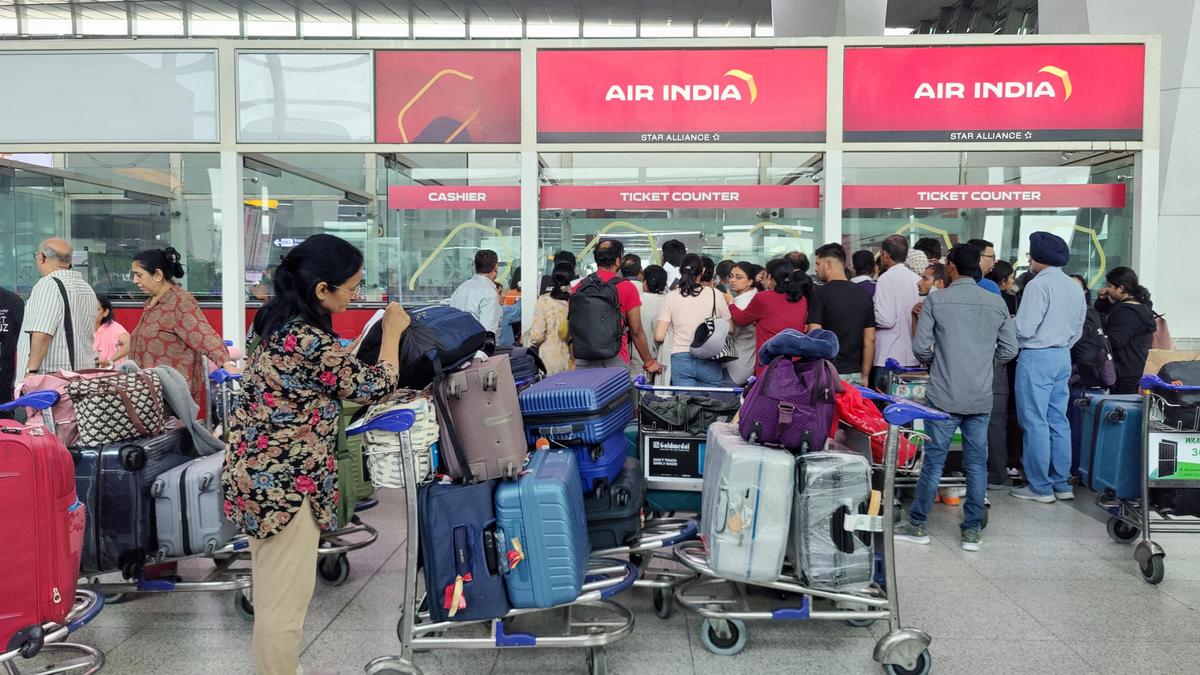
Setting a time limit for airlines to process a refund will help address the inordinate delays in returning the money
| Photo Credit:
BHAWIKA CHHABRA
Recent draft regulations released by the Directorate General of Civil Aviation regarding refund of airline tickets on cancellation is a long overdue step, which will provide relief to air travellers. Around one-fifth of the complaints being received by DGCA relate to delays in refund of money on ticket cancellations, deduction of arbitrarily high amounts as cancellation charges and airlines setting off the cancelled air-ticket against future bookings.
The lack of transparency and standardisation in this sphere has become a pain point. The new rules that align with global best practices prescribe the minimum standards to be followed by airlines while refunding cancelled tickets, giving airlines the room to provide better terms, if they so desire. This is likely to benefit customers given the intense competition among airlines. The most important provision is the introduction of a look-in option of 48 hours from the time of booking the ticket, when the passenger can cancel or alter the ticket without any additional charge. This option is common globally, to help in cases where travel plans change suddenly or if there is an error in entering the travel details while purchasing the ticket. The proposed rule is better than the rules in the US and Europe where passengers are provided a look-in period of only 24 hours to cancel without a penalty. In many countries, this option is provided only if the tickets are booked directly from the airline, but DGCA appears to be covering tickets purchased directly through the airline as well as through travel agents.
The rules address the lack of transparency by requiring that airlines mention the amount of refund on cancellation and the break-up in the ticket or on a form accompanying the ticket. Asking airlines to display their refund policies prominently on their websites is also a good idea as passengers can compare these policies across airlines. The maximum limit for cancellation charges though is being set at the basic fare and fuel surcharge. This is quite high as the airline can take almost the entire ticket cost as cancellation charge. This could have been lowered, at least for cancellations 48 hours before travel, to around 80 per cent of basic fare and fuel surcharge so that travellers are not penalised excessively. In most instances, especially on high traffic routes, airlines sell seats at a premium to those booking last minute. The chance of an empty seat due to a cancellation, and therefore a loss, is minimal.
Setting a time limit for airlines to process a refund will help address the inordinate delays in returning the money. . It is also good that the onus is now being put on airlines to ensure that the travel agent returns the money on cancellation, within 21 working days. When tickets are purchased through travel agents, customers tend to face greater difficulty in getting refund with the travel agents blaming the airlines and vice versa.
Published on November 9, 2025