


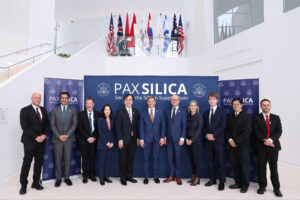
THE PHILIPPINES wants to join the United States’ Pax Silica initiative to boost its participation in the supply chain of critical minerals and artificial intelligence (AI) infrastructure, the Department of Trade and Industry (DTI) said.
“The Philippines is very much interested to be part of the Pax Silica initiative of the US,” Trade Undersecretary Ceferino S. Rodolfo told reporters on the sidelines of a forum on Friday.
“For us, Pax Silica rests on two pillars — to have a secure supply of critical minerals, rare earth elements that are needed for both defense and high-technology industries; and the second piece is on AI digital infrastructure.”
The country’s inclusion in the US-led Pax Silica partnership would also allow the Philippines to become a player in the production of digital infrastructure amid the AI boom, Mr. Rodolfo said.
“You will need the critical minerals for you to be able to produce all of necessary equipment, components for your digital infrastructure.”
Pax Silica is a US-led economic partnership seeking to build global silicon supply chain across critical minerals, semiconductors, advanced manufacturing, transportation logistics, and AI infrastructure.
The framework also aims to promote “a shared and trusted ecosystem of AI developers and vendors to renew legacy industries and unlock new markets and services,” according to the US Department of State’s website.
Current signatories to the Pax Silica initiative include Australia, Greece, India, Israel, Japan, Qatar, Republic of Korea, Singapore, United Arab Emirates, and the United Kingdom. Meanwhile, Taiwan serves as a non-signatory participant to the agreement.
Mr. Rodolfo added that the country is interested in pursuing a critical minerals agreement with Canada.
This after the Philippines and US signed a memorandum of understanding in February to support the local processing of critical and rare earth minerals — key components to advanced manufacturing.
The Philippines also expects to conclude talks for a free trade agreement (FTA) with Canada this year, ahead of the Association of Southeast Asian Nations (ASEAN)-Canada FTA, Mr. Rodolfo said.
“The Philippines-Canada FTA is very important because that would be the framework where Canada could be our entry point to the broader CUSMA (Canada-United States-Mexico,)” he said.
Through the bilateral FTA, the Philippines could also serve as Canada’s entry point to the wider ASEAN bloc, Mr. Rodolfo said.
The Philippines and Canada is scheduled to hold its second round of FTA talks in April.
Canadian Ambassador to the Philippines David Hartman it “remains fully committed” to seal negotiations for the Philippines-Canada FTA this year.
He cited the importance of an FTA with the Philippines to ensure economic security amid ongoing geopolitical tensions.
“In this environment, resilience cannot be built on isolation. Economic security increasingly depends on cooperation amongst trusted partners,” Mr. Hartman told the forum. — Beatriz Marie D. Cruz


