


On Tuesday and Wednesday this week, peacekeepers with the UN Interim Force in Lebanon (UNIFIL) discovered rocket launchers, rocket shells, mortar rounds, bomb fuses and a tunnel containing munitions in separate incidents in Sectors East and West, UN Spokesperson Stéphane Dujarric told reporters in New York.
All finds were referred to the Lebanese Armed Forces in line with standard procedure.
UNIFIL also observed continued Israel Defense Forces activity, including an airstrike in Sector West and artillery fire from south of the Blue Line – which separates Israeli and Lebanese armed forces – into Sector East.
To strengthen Lebanese military capacity, the mission has been training personnel in surveying and removing explosive devices, securing contaminated sites and navigating mined areas.
“Such training activities are crucial now as the Lebanese Armed Forces engages daily in identifying and securing areas contaminated with unexploded ordnances and explosive remnants of war,” Mr. Dujarric said.
Complex operational space
Southern Lebanon remains a challenging operational environment, where UNIFIL works to implement Security Council resolution 1701, which brought an end to the 2006 hostilities between Israel and Hezbollah militants.
The Mission’s mandate includes monitoring the cessation of hostilities, supporting the deployment of the Lebanese Armed Forces in the south, and helping to ensure that the area between the Blue Line and the Litani River remains free of unauthorized weapons.
The region has experienced recurring tensions, including a sharp escalation last year marked by numerous Israeli airstrikes and ground operations. These incidents have affected local communities and resulted in damage to several UN positions, and injuries to several ‘blue helmets’ serving with UNIFIL.
Unprecedented water crisis
Lebanon’s largest reservoir, Lake Qaraoun, has dropped to its lowest level on record, the Litani River National Authority said.
Inflows during this year’s wet season reached just 45 million cubic metres – compared to an annual average of 350 million – following months of low rainfall and an intense heat wave.
The decline comes amid a wider nationwide emergency.
In early July, the UN Children’s Fund (UNICEF)-led water, sanitation and hygiene (WASH) group reported that rainfall had fallen by more than half in many regions along with decreased snow-melt, and several reservoirs and aquifers had dried up.
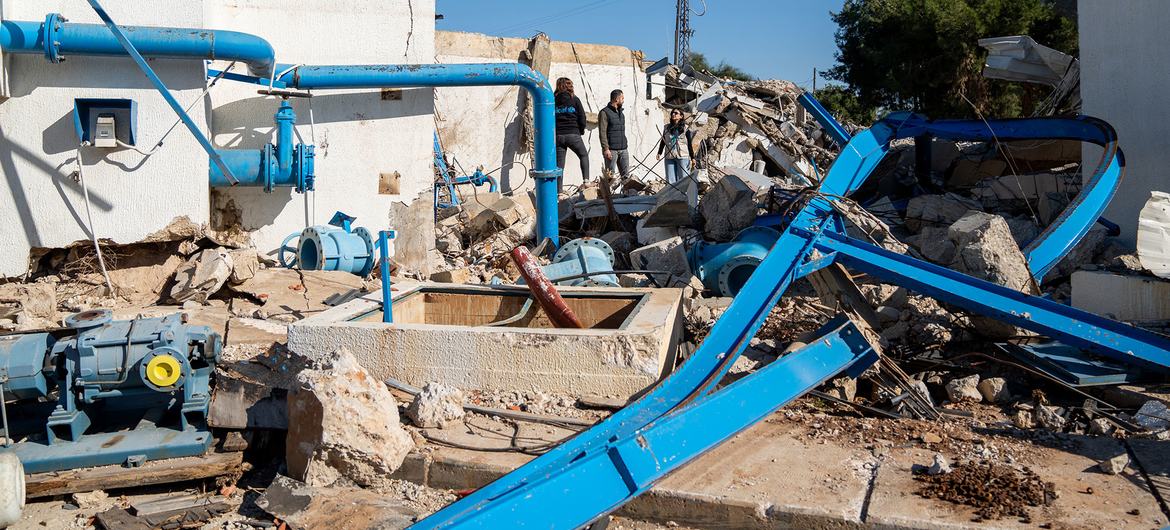
A water pumping station in southwest Lebanon damaged during the recent conflict.
Health risks rising
The drought is affecting all sectors, from agriculture and healthcare to education and local governance. An estimated 1.85 million people live in areas highly vulnerable to drought, with more than 44 per cent of the population dependent on costly and often unsafe water trucking services.
The severe strain on public water systems have been compounded by damaged infrastructure stemming from the recent fighting between Israel and Hezbollah and electricity shortages.
Health risks are rising, particularly in overcrowded settlements with poor sanitation, where residents may resort to unsafe water sources, heightening the threat of waterborne disease outbreaks, the WASH cluster warned.
Food security worries
The drought has also caused a sharp decline in food production and increased reliance on expensive imports, deepening food insecurity.
Wildfire risks are also mounting due to prolonged dry conditions.
The WASH cluster warned that without urgent international support to restore water systems and protect vulnerable communities, the crisis could further destabilize an already fragile nation.


