


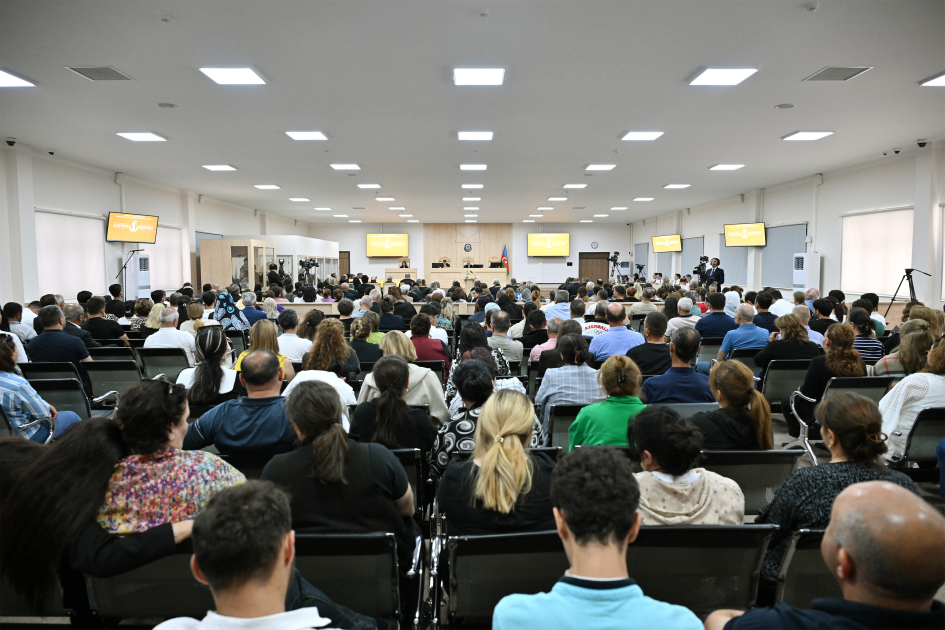
BAKU, Azerbaijan, June 22. The open court
hearing continued on June 23rd in the criminal case against
Armenian citizens Arayik Harutyunyan, Arkadi Ghukasyan, Bako
Sahakyan, Davit Ishkhanyan, David Babayan, Levon Mnatsakanyan, and
others. They are accused of crimes against peace and humanity, war
crimes including the planning and waging of aggressive war,
genocide, violations of the laws and customs of war, as well as
terrorism, financing of terrorism, forcible seizure of power,
forcible retention of power, and numerous other crimes as a result
of Armenia’s military aggression against Azerbaijan, Trend reports.
The court hearing was held in the Baku Military Court, presided
over by Judge Zeynal Agayev, with judges Jamal Ramazanov and Anar
Rzayev (reserve judge Gunel Samedova). Each defendant was provided
with an interpreter in their native language and legal counsel for
their defense.
The defendants, their lawyers, some of the victims, their legal
successors and representatives, as well as the state prosecutors,
were present at the hearing.
During the court session, defendant Arayik Harutyunyan answered
questions from the prosecutors. Responding to questions from Tugay
Rahimli, Assistant to the Prosecutor General for Special
Assignments, Harutyunyan stated that he was a member of the
“Hayastan” All-Armenian Fund (established in 1992 by decree of
Armenian President Levon Ter-Petrosyan – ed.), whose headquarters
are located in Yerevan, and that he attended all meetings of the
fund.
He claimed that the “Hayastan” Fund was engaged in charitable
projects both in Armenia and in the self-proclaimed entity. “The
fund implemented infrastructure projects in Karabakh. It was
involved in the construction of schools and kindergartens, as well
as other charitable projects,” he added.
The defendant stated that funds for the fund were not collected
in cash, but were transferred through banks.
Harutyunyan said that it did not matter whether the contractors
carrying out the work with the funds allocated by the fund were
from Armenia or the self-proclaimed entity: “Whoever won the
tender, they carried out the work.”
The defendant confirmed that the main connection between the
formerly occupied sovereign territories of Azerbaijan and Armenia
was via the two roads built with funds from the fund (the
Yerevan-Gorus-Khankendi and Yerevan-Basarkechar-Khankendi highways)
and added: “There were also roads in the southern direction, but
these were mainly dirt roads and were not used as widely. There
were no restrictions on the implementation of transportation and
cargo transportation on the main roads. However, there were
restrictions in some areas. For example, a restriction was imposed
on the transportation of forest trees. Sanitary control measures
were taken, but there were no special restrictions in other
areas.”
He stated that there were no restrictions on the transportation
of military equipment on these roads either.
The defendant, also claiming that the fund’s funds were not used
during the Second Karabakh War, said: “During the war and in the
following days, a lot of money was collected – approximately more
than 100 million US dollars. It was all collected for housing
construction.”
Harutyunyan stated that after the 44-day war, the construction
of several settlements was started with these funds, and several
asphalt roads were built. However, the construction of the houses
remained unfinished.
He also confirmed that people brought from Syria and Lebanon
were illegally settled in the formerly occupied territories of
Azerbaijan.
He added that some of the Armenian citizens living in the
regions bordering Azerbaijan — Gorus and Gafan regions of Armenia
— came to the then-occupied Zangilan, Gubadli, and Lachin regions
and settled there illegally: “Because there were great
opportunities to operate, especially in the agricultural sector, in
those territories. The resettled people were mainly engaged in
agricultural work. You know the geography of the Syunik region.
There are no extensive opportunities to engage in agriculture
there. In Zangilan, Gubadli, and Lachin regions, there were more
opportunities in this area.”
Harutyunyan said that, compared to those coming from other
countries for illegal settlement, those coming from Armenia were
not specially encouraged: “We did not hinder them. They themselves
chose where to live and what to do.”
He confirmed that people of Armenian nationality were
subsequently illegally settled in the Lachin and Kalbajar regions:
“This happened later. There were no Armenians living in the Lachin
region before. As far as I know, the situation was the same in the
Kalbajar region.”
Harutyunyan also said that a settlement called “Arachamukh”
consisting of approximately 30 houses was built in the Jabrayil
region: “The construction of these houses was financed by the
“Tufenkian” Foundation. The houses in Zabukh were built by the
“Ari” Foundation.”
He also said that a settlement called “Sydney” was established
in Kalbajar, and the construction of about 25 houses was financed
by the Armenian community in Australia.
Harutyunyan said that funds were allocated annually from the
Armenian budget in the name of “interest-free credit” for the
purpose of forming the budget of the self-proclaimed entity, but
they had no role in financing the “army” of the regime: “The army”
was financed separately (by Armenia – ed.). We did not participate
in “army” matters.”
Harutyunyan also answered the prosecutor’s questions about the
“banking system” of the self-proclaimed entity established in the
territories of Azerbaijan formerly occupied by the Armenian armed
forces. He said that he himself had previously worked in bank
branches operating in the self-proclaimed regime. Harutyunyan said
that “Artsakhbank,” which was presented as the main “bank” of the
self-proclaimed regime, was a bank registered by the Central Bank
of the Republic of Armenia. He stated that the place of
registration of that bank was the capital of Armenia. He added that
the license for that bank was issued by the Central Bank of
Armenia. However, its main branch operated in the city of
Khankendi, which was under occupation at that time. That bank also
had branches in the central areas of other formerly occupied
territories of Azerbaijan.
“That bank had no advantages or privileges compared to other
banks in Armenia. The Central Bank of Armenia also determined the
discount rate in the bank,” added A. Harutyunyan.
In addition, branches of other Armenian banks also operated in
the formerly occupied Azerbaijani territories. A. Harutyunyan also
said that the branches operated at a loss.
Then, Harutyunyan was asked questions by Vusal Aliyev, Senior
Assistant to the Prosecutor General, about the companies “Frank
Muller Group,” “Vallex Group,” “Zolotaya Zvezda” and “Base Metals,”
which is part of “Vallex Group,” which illegally operated in the
territories of Azerbaijan formerly under Armenian occupation.
Harutyunyan said that these companies operated after 2008. The
defendant said: “Base Metals” operated in the mining sector. Their
activities mainly covered the years 2008–2013 related to the
exploitation of the “Drombon” (Heyvalı – ed.) gold deposit.”
Saying that “Base Metals” was the largest company operating in
the occupied territories of Azerbaijan, the defendant added: “It
had approximately 1,500 employees. The company paid 25-30 million
dollars in taxes. The director of the company was Artur Mkrtumyan,
and the owner was Valeriy Mejlumyan.”
Harutyunyan said that “Zolotaya Zvezda” invested more than 30
million dollars in the Vejneli gold deposit in the Zangilan region,
but the project was unsuccessful.
In response to questions about “Karabakh Telecom,” the defendant
said that the owner of the company was a citizen of Lebanon, that
the company operated from 2001-2002 to 2023, and that it paid an
average of 4-5 million dollars in taxes every year since 2008.
According to him, this company was the second largest taxpayer of
the self-proclaimed entity.
During the continuation of the court session, documents related
to the time when Harutyunyan was the “head” of the self-proclaimed
entity were examined, and he was asked questions in this direction.
In one of the documents, he claimed that he had “awarded” soldiers
who had damaged Azerbaijani tanks during the 2020 war.
According to another document, Harutyunyan says that the strikes
on the city of Ganja were carried out on his instructions.
Answering the prosecutor’s questions, the defendant stated that
he did not give an order to bomb the city of Ganja: “I did not have
such authority.”
He recalled that the “army” of the self-proclaimed entity is an
armed formation of the armed forces of the Republic of Armenia: “It
did not have the authority to act independently. That formation did
not have the right to obey us, to implement our instructions.”
Harutyunyan also said that, in general, the “army” of the
self-proclaimed entity did not have destructive weapons (“Smerch”,
Tochka U”, etc. – ed.) in its arsenal: “I did not have information
about which units and specifically who carried it out. I heard
about the bombing of oil pipelines here.”
Protocols on the obstruction of flights, as well as the
detection of vehicles in Khankendi and Khojali containing equipment
for jamming signals, a system for striking UAV signals, etc.,
received from “Azerbaijan Airlines” CJSC and other relevant
institutions, and the examination of them were examined in
court.
State prosecutor of the Prosecutor General’s Office Vusal
Abdullayev reminded Harutyunyan about the discovery of mass graves
during construction work in those lands after Azerbaijan liberated
its territories from occupation and asked him questions in this
direction.
He “explained” the reason why mass graves were not discovered
during the construction work carried out by Armenia and the
self-proclaimed entity during the occupation period as follows:
“All the construction work we did was a few percent of what
Azerbaijan is doing now. That’s why we didn’t find it…”
The defendant confirmed that the deputy prime ministers,
ministers, and deputies of Armenia came to the then-occupied
territories of Azerbaijan during the 44-day war and named several
of them. He stated that these persons were Ararat Mirzoyan, Suren
Papikyan (the current Minister of Defense of Armenia – ed.) and
others.
The court hearing will continue on June 30.
It should be noted that 15 defendants of Armenian origin are
accused in the criminal case on numerous facts of crimes committed
during the aggressive war waged by the Armenian state, including
the aforementioned criminal association, on the territory of
Azerbaijan in violation of domestic and international legal norms,
for the purpose of military aggression against Azerbaijan, created
under the direct leadership and participation of the Armenian
state, officials of its state institutions, its armed forces and
illegal armed formations, their written and verbal orders,
instructions and guidelines, material, technical, and personnel
support, centralized management, as well as under the strict
control, as well as under the leadership, direct and indirect
participation of Robert Sedraki Kocharyan, Serzh Azati Sargsyan,
Vazgen Mikaeli Manukyan, Vazgen Zaveni Sargsyan, Samvel Andraniki
Babayan, Vitali Mikaeli Balasanyan, Zori Hayki Balayan, Seyran
Musheghi Ohanyan, Arshavir Surenovich Garamyan, Monte Charles
Melkonyan and others.
The said persons, i.e. Arayik Vladimiri Harutyunyan, Arkadi
Arshaviri Ghukasyan, Bako Sahaki Sahakyan, Davit Rubeni Ishkhanyan,
David Azatini Manukyan, Davit Klimi Babayan, Levon Henrikovich
Mnatsakanyan, Vasili Ivani Beglaryan, Erik Roberti Ghazaryan, Davit
Nelsoni Allahverdiyan, Gurgen Homeri Stepanyan, Levon Romiki
Balayan, Madat Arakelovich Babayan, Garik Grigori Martirosyan,
Melikset Vladimiri Pashayan, are being charged under Articles 100
(planning, preparing, initiating and waging a war of aggression),
102 (attacking persons or organizations enjoying international
protection), 103 (genocide), 105 (extermination of the population),
106 (enslaving), 107 (deportation or forced displacement of the
population), 109 (persecution), 110 (enforced disappearance of
people), 112 (deprivation of liberty contrary to international
law), 113 (torture), 114 (mercenary service), 115 (violation of the
laws and customs of warfare), 116 (violation of international
humanitarian law during armed conflict), 118 (military robbery),
120 (intentional murder), 192 (illegal entrepreneurship), 214
(terrorism), 214-1 (financing terrorism), 218 (creation of a
criminal association (organization)), 228 (illegal acquisition,
transfer, sale, storage, transportation and possession of weapons,
their components, ammunition, explosives and devices), 270-1 (acts
threatening aviation security), 277 (assassination of a state
official or public figure), 278 (forcible seizure and retention of
power, forcible change of the constitutional structure of the
state), 279 (creation of armed formations and groups not provided
for by law) and other articles of the Criminal Code of the Republic
of Azerbaijan.


