


WASHINGTON — A bipartisan group of US lawmakers has introduced new legislation targeting what they describe as the Kremlin’s primary financial lifeline: oil exports.
The Decreasing Russian Oil Profits (DROP) Act of 2026, unveiled on February 11 by Republican Congressman Michael McCaul of Texas, would require targeted sanctions on any foreign individual or entity involved in the purchase, importation, or facilitation of Russian-origin crude oil and petroleum products.
The measure is designed to close what lawmakers say are persistent loopholes in the current sanctions regime and to curb Moscow’s ability to fund its war in Ukraine.
“Russian energy is the lifeblood of the Kremlin’s war machine, and the DROP Act would drain this primary source of revenue,” McCaul said in a statement announcing the bill.
He argued that Russian President Vladimir Putin has shown that he won’t be willing to seek peace “until the cost of his continued bloodshed is too high,” adding that the legislation would give US President Donald Trump additional leverage while pressing allies to do more. “It’s time for every nation and individual to choose between doing business with the free world or continuing to bankroll Putin’s brutality,” he said.
In the House of Representatives, the group includes Republicans McCaul and Mike Lawler of New York, along with Democrats Bill Keating of Massachusetts, Marcy Kaptur of Ohio, Mike Quigley of Illinois, and Josh Gottheimer of New Jersey.
In the Senate, the companion measure was introduced by Republican senators Dave McCormick of Pennsylvania and Jon Husted of Ohio, alongside Democrats Elizabeth Warren of Massachusetts and Chris Coons of Delaware.
Closing The ‘Shadow Fleet’ Loophole
Western governments have imposed successive rounds of sanctions on Moscow since its full-scale invasion of Ukraine in 2022, including price caps on Russian oil exports. But Russia has increasingly relied on a so-called “shadow fleet” of aging tankers and complex third-party arrangements to move crude at prices that often exceed international limits.
The DROP Act seeks to address that ecosystem directly.
According to its sponsors, the bill would strengthen existing designations on two major Russian oil companies, mandate sanctions on foreign actors complicit in purchasing Russian petroleum products, and close loopholes that have allowed some buyers to charge above the international price cap.
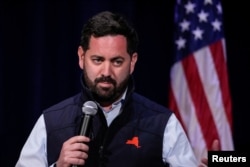
Lawler underscored enforcement as the core issue.
“Sanctions only work if they’re enforced,” he said, arguing that the legislation would strengthen the current sanctions regime and “cut off a key funding for Putin’s war machine.” He added that it is time to use “the full strength of American economic power to squeeze out the Kremlin.”
Keating framed the bill as part of a broader effort to ensure consequences for Moscow’s actions.
“Congress and the president must do more to ensure Putin and his war machine feel the consequences for their illegal actions,” he said, noting that the legislation would require sanctions on countries unless they meet specific criteria demonstrating support for Ukraine. As the war approaches its fourth anniversary, he added, the measure signals “continued bipartisan support for Ukraine.”
‘A Long Overdue Step’
For Kaptur, co-chair of the Congressional Ukraine Caucus, the moral dimension is central.
“If you traffic in Russian oil, you are funding Putin’s illegal war and full-scale invasion of Ukraine,” she said, calling the bill “a long overdue step” to cut off oil revenue and strengthen the prospects for a just end to the conflict.
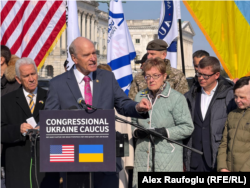
Quigley, also a caucus co-chair, said Russia has “weaponized the global oil ecosystem” since launching its invasion and argued the bill would “close the price gap loophole” and “cut off a major source of funding for Russia’s army.”
Similarly, Gottheimer said the legislation would “tighten the screws” on Russian oil exports, ensure “real consequences” for those purchasing oil above the price cap, and create stronger incentives to support Ukraine’s defense and reconstruction.
Strategic Flexibility — And Political Questions
The bill includes provisions allowing the administration to grant exceptions for countries that significantly reduce their Russian oil imports or provide substantial military and economic aid to Ukraine — a nod to concerns among some US partners about energy security and economic disruption.
Shelby Magid, deputy director at the Atlantic Council’s Eurasia Center, described the proposal as “an important and timely step.”
Speaking to RFE/RL on February 12, she said the legislation demonstrates bipartisan backing for Ukraine and reflects “justified frustration with Russia’s continued barrage of attacks on Ukrainian civilians.”
Magid noted that 2025 was the deadliest year for civilians in Ukraine since 2022 and pointed to sustained Russian strikes on energy infrastructure during a harsh winter.
“As Moscow escalates its assault against the Ukrainian people and undermines peace efforts, Congress is right to work to advance additional authorities to target key Russian revenue streams and strengthen sanctions enforcement,” she said. “Diplomacy cannot come at the expense of protecting Ukrainian civilians from weapons financed by Russia’s war economy.”
Still, analysts caution that bipartisan support in Congress does not automatically guarantee passage.
Tyson Barker, a former US deputy special envoy for Ukraine’s economic recovery who is now with the German Council on Foreign Relations, told RFE/RL that the effort is worthwhile, adding that he favored “anything that tightens the screws on Russia and imposes costs and chokes off the war machine.”
But he raised a critical question: whether the White House will actively back the measure.
Despite broad bipartisan support, Barker noted that congressional leadership may hesitate to bring it to the floor without administration endorsement. “The decisive thing would be active administration support for this legislation,” he said, suggesting that such backing will determine whether it can move forward.
Barker also pointed to what he described as diplomatic “whiplash” in Europe, as negotiations involving Russia, the United States, and Ukraine proceed alongside separate EU efforts to shape Ukraine’s accession path.
Oil As Leverage
Advocates of the bill argue that sanctions enforcement and additional pressure on Russia’s energy revenues are essential if cease-fire talks are to produce meaningful results.
“Despite multiple rounds of cease-fire talks, Putin’s war aims appear unchanged,” said Scott Cullinane, co-founder of the US–Europe Alliance, an American transatlantic advocacy organization.
“In order for any talks to achieve results, it’s increasingly obvious that additional leverage must be applied to Russia,” he told RFE/RL.
He called oil revenue Putin’s a “lifeline,” adding: “If we want to see progress with talks, the West can and must choke off Russia oil sales.”
Whether the DROP Act becomes law may hinge on political calculations in Washington. But its introduction underscores a growing consensus on Capitol Hill: that as long as Russian oil continues to flow freely onto global markets, so too will the funds sustaining Moscow’s war effort.


