


Science correspondent, BBC News

 Masato Hattori
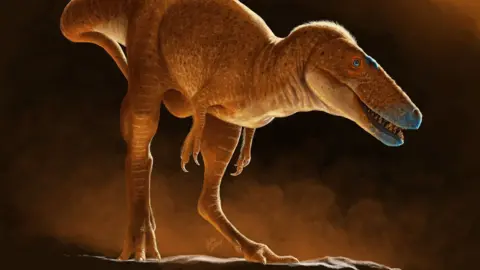
Scientists have discovered a new species of dinosaur – in the collection of a Mongolian museum – that they say “rewrites” the evolutionary history of tyrannosaurs.
Researchers concluded that two 86 million-year-old skeletons they studied belonged to a species that is now the closest known ancestor of all tyrannosaurs – the group of predators that includes the iconic T.rex.
The researchers named the species Khankhuuluu (pronounced khan-KOO-loo) mongoliensis, meaning Dragon Prince of Mongolia.
The discovery, published in Nature, is a window into how tyrannosaurs evolved to become powerful predators that terrorised North America and Asia until the end of the reign of the dinosaurs.
 Darla Zelenitsky
“‘Prince’ refers to this being an early, smaller tyrannosauroid,” explained Prof Darla Zelenitsky, a palaeontologist from the University of Calgary in Canada. Tyrannosauroids are the superfamily of carnivorous dinosaurs that walked on two legs.
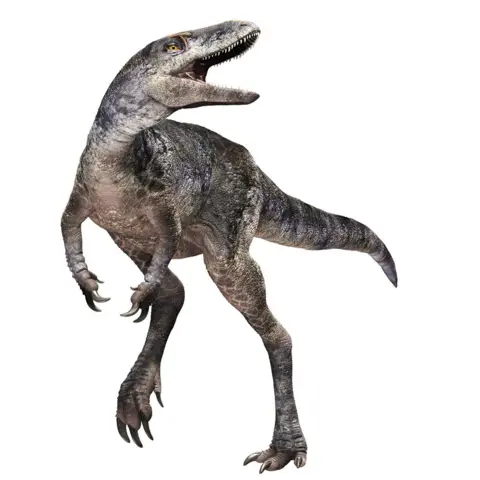
The first tyrannosauroids though were tiny.
PhD student Jared Voris, who led the research with Prof Zelenitsky, explained: “They were these really small, fleet-footed predators that lived in the shadows of other apex predatory dinosaurs.”
Khankhuuluu represents an evolutionary shift – from those small hunters that scampered around during the Jurassic period – to the formidable giants, including T-rex.
 Julius Csotonyi
It would have weighed about 750kg, while an adult T.rex could have weighed as much as eight times that, so “this is a transitional [fossil],” explained Prof Zelenitsky, “between earlier ancestors and the mighty tyrannosaurs”.
“It has helped us revise the tyrannosaur family tree and rewrite what we know about the evolution of tyrannosaurs,” she added.
The new species also shows early evolutionary stages of features that were key to the tyrannosaurs’ tyranny, including skull anatomy that gave it a strong jaw. Jared Voris explained: “We see features in its nasal bone that eventually gave tyrannosaurs those very powerful bite forces.”
The evolution of such powerful jaws allowed T-rex to pounce on larger prey, and even bite through bone.
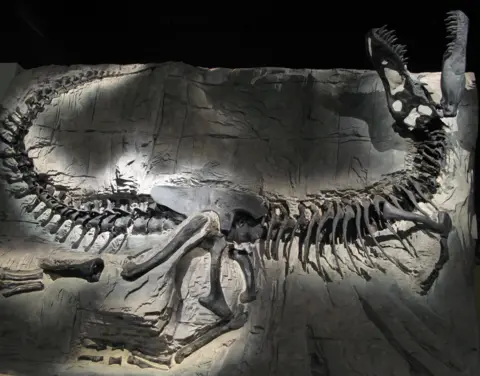
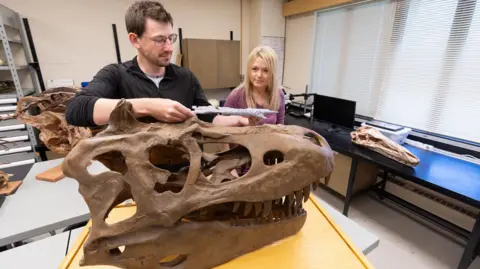
The two partial skeletons that the team examined in this study were first discovered in Mongolia back in the early 1970s. They were initially assigned to an existing species, known as Alectrosaurus, but when Mr Voris examined them, he identified the Tyrannosaur-like features that set it apart.
“I remember getting a text from him – that he thought this was a new species,” recalled Prof Zelenitsky.
 Riley Brandt/University of Calgary
The fact that this group of dinosaurs were able to move between North America and Asia – via land bridges that connected Siberia and Alaska at the time – also helped them to find and occupy different niches.
Mr Voris explained: “That movement back and forth between the continents basically pushed the evolution of different tyrannosaur groups” over millions of years.
Prof Zelinitsky added: “This discovery shows us that, before tyrannosaurs became the kings, they were they were princes.”


