


Members of the Anabaptist or Mennonite movement visit Zurich – the cradle of the Anabaptist movement.
taeufer-willkommen.ch
Some 3,500 Mennonites gathered in Zurich at the end of May to celebrate the 500th anniversary of this Protestant religious movement, which originated on the banks of the River Limmat before spreading throughout the world.
Even for a cosmopolitan city like Zurich, the streets offered a rather unusual sight on May 29, with people coming from all over the world for an event that was neither sporting nor cultural, but religious.
In 2025, Catholics are not the only ones celebrating a jubilee. The Mennonites are too. To mark the 500th anniversary of the founding of this branch of Protestantism, Zurich hosted a meeting entitled “500: The Courage to LoveExternal link”, at the invitation of the Mennonite World Conference. Other events are planned throughout the year, both in Switzerland and abroad.

The jubilee’s official poster.
Conférence mennonite suisse
Various encyclopaedias, including Wikipedia, state that the Mennonite movement was founded in 1540 by the Dutch reformer Menno Simons. So why celebrate its half-millennium in Zurich in 2025?
The explanation is simple. Mennonites belong to the Anabaptist family, like the famous Amish in the United States. The origins of Anabaptism can be found in Zurich. Some specialists even trace its creation back to a specific event: the first adult baptism by a group of former disciples of the reformer Zwingli in the house of Felix Manz, in Zollikon, on January 21, 1525.
More
More
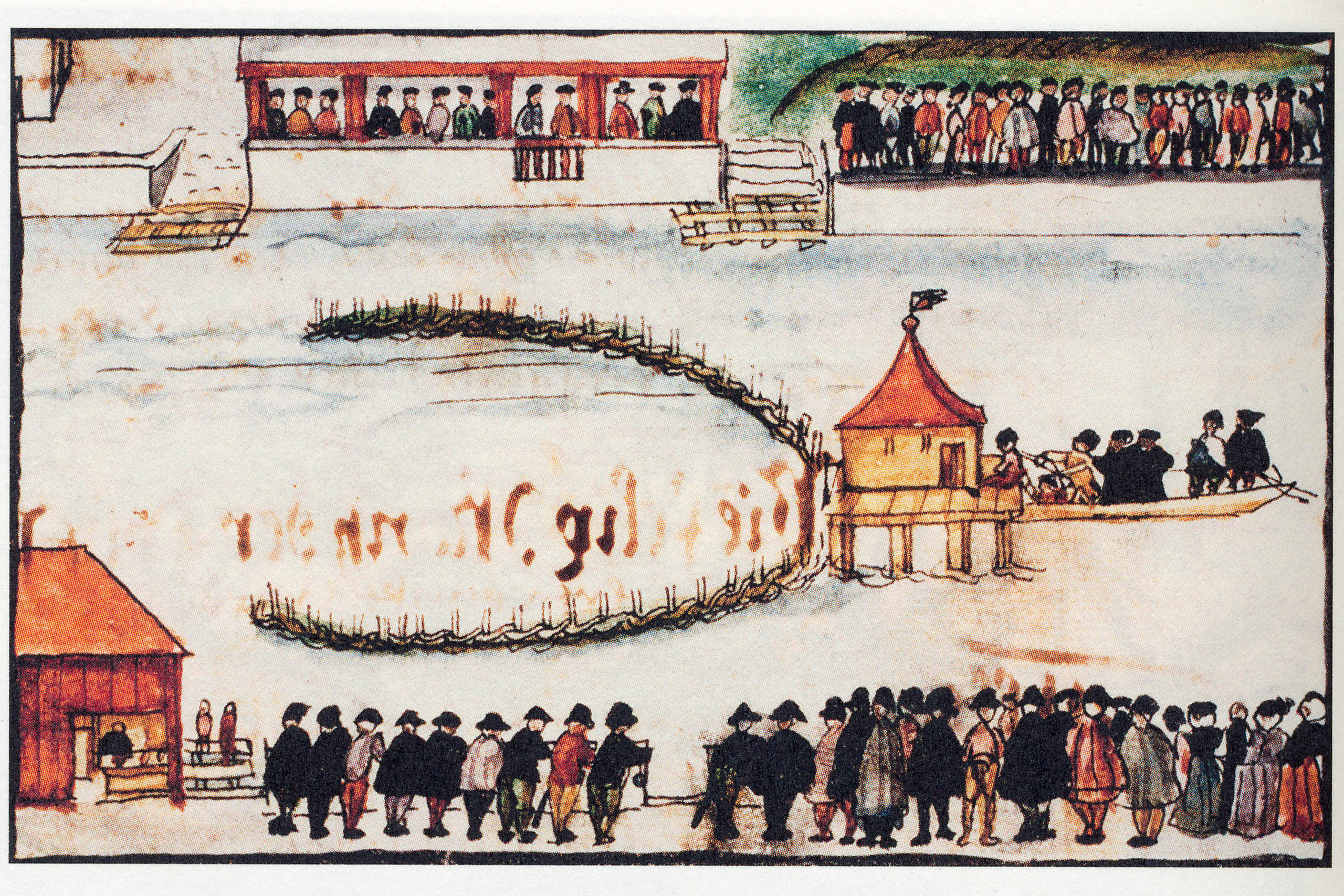
The Anabaptist Felix Manz meets a terrible end
The Anabaptist movement was in line with the Protestant Reformation of the 16th century. But this movement wanted to go further than the reformers Luther, Zwingli or Calvin and rediscover the Christianity of the origins through a “radical reform”.
Anabaptism was characterised by three main features. First, people only became believers after a process of conversion. This explains the importance given to adult baptism rather than the traditional infant baptism, which was not recognised. Second, the Anabaptists refused any intervention by the state in the affairs of the church. Finally, they also refused to engage in violence, bear arms or take oaths.
In addition to these religious considerations, the Anabaptists also had a more political and social outlook, particularly in favour of the peasants who were subject to the princes or cities. Anabaptism is sometimes referred to as the “left wing” of Protestantism.
Exile… at best
The stances taken by the Anabaptists not only won them followers, but also plenty of enemies. “Their radical criticism of the society and religious life of their time, and of the alliance between church and state, which they considered to be disastrous, quickly earned them the wrath of the authorities,” notes the Historical Dictionary of SwitzerlandExternal link.
The hostility of the authorities regularly forced the Anabaptists into exile. They took refuge in remote regions where they lived discreetly, particularly in the Emmental and the Bernese Oberland. In the French-speaking part of the country, the Prince-Bishop of Basel welcomed and tolerated them in what is now the Bernese Jura, but only at altitudes of over 1,000 metres and above the villages.
But sometimes the repression was far more severe, especially in the cantons of Bern and Zurich, where Anabaptists were burnt, beheaded or drowned.
More
More
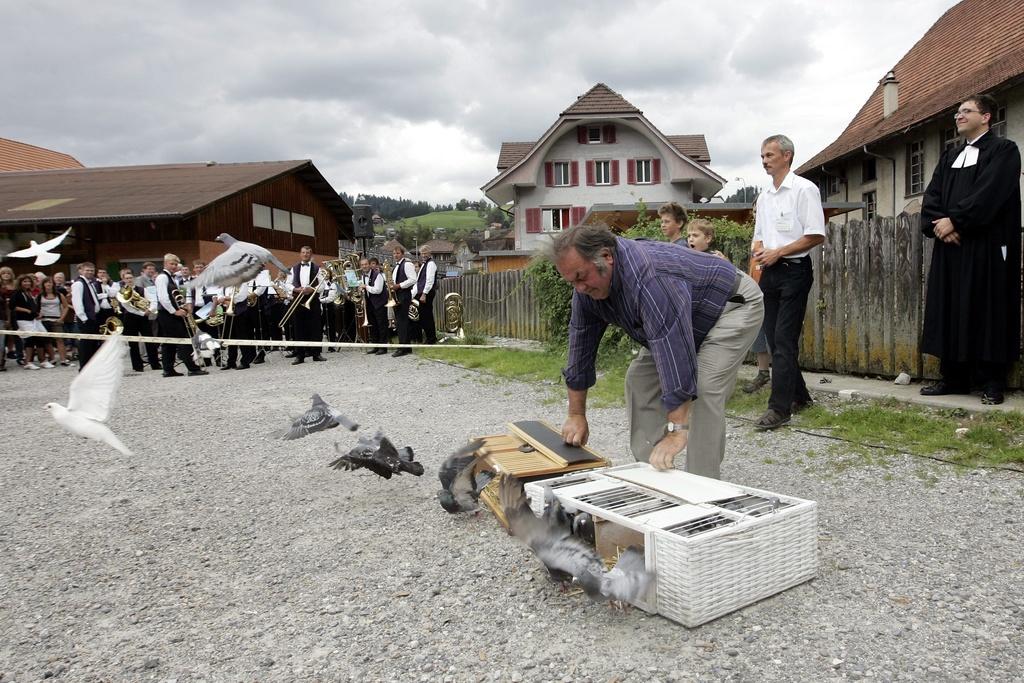
Swiss Mennonites forgive canton Bern for persecution
The various policies of repression in Switzerland and in other parts of the Holy Roman Empire forced Anabaptists to take refuge in ever more distant lands, as far away as the American continent and Tsarist Russia, which helped spread the movement.
More recently, the Mennonite movement has spread more through missionary activity. According to the latest statisticsExternal link from the Mennonite World Conference, based in Canada, the Anabaptist spiritual family now numbers 2.13 million baptised believers in 86 countries, mainly in Africa (36.43%) and North America (30.50%).
Switzerland as a place of remembrance
Switzerland has a modest 1,900 baptised members (0.09% of the world total) in 13 congregations, according to the Mennonite World Conference.
Geographically, the Swiss Mennonites are found mainly in canton Bern, in two areas that were once their refuge: the Emmental and the Bernese Jura, now also known as the Grand Chasseral.
Despite these small numbers, Switzerland still has a special place as a place of remembrance, as the jubilee reminds us. One of the most symbolic places is a commemorative plaque in Zurich, marking the spot where Felix Manz, considered the first Anabaptist martyr, was thrown into the Limmat in 1527.
Edited by Samuel Jaberg. Adapted from French by Thomas Stephens


