


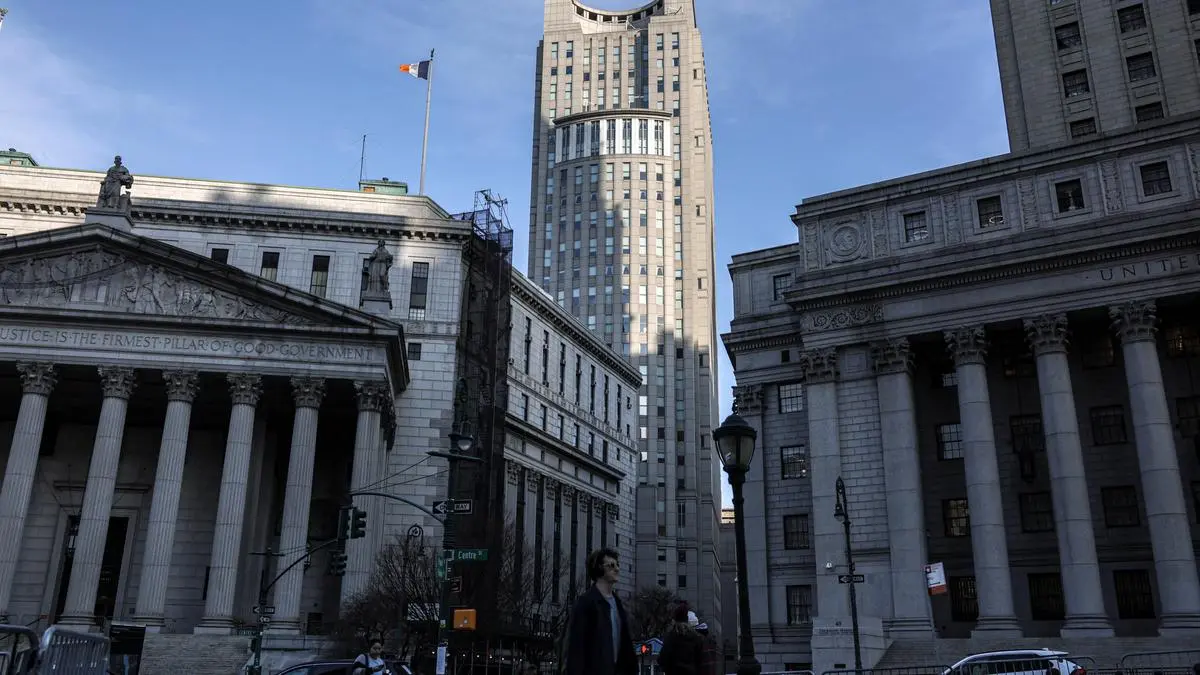
A general view of the Daniel Patrick Moynihan U.S. Courthouse, where ousted Venezuelan president Nicolas Maduro is due for a hearing on March 26, in Manhattan, New York City, March 25, 2026
| Photo Credit:
JEENAH MOON
Former Venezuelan President Nicolas Maduro returns to a New York courtroom Thursday as he seeks to have his drug trafficking indictment thrown out over a geopolitical dispute over legal fees.
Maduro’s lawyer contends that the US is violating the deposed leader’s constitutional rights by blocking Venezuelan government funds from being used to pay his legal costs.
It’s the first time that Maduro and his wife, Cilia Flores, will be in court since a January arraignment at which he protested their capture by US military forces and declared: “I am not guilty. I am a decent man, the constitutional president of my country.” Flores has also pleaded not guilty.
Both remain jailed at a detention centre in Brooklyn, and neither has asked to be released on bail. Judge Alvin Hellerstein has yet to set a trial date, though that could happen at the hearing.
Maduro, 63, and Flores, 69, continue to enjoy some support in Venezuela, with murals and billboards across the capital, Caracas, demanding their return.
But while Maduro’s ruling party remains in power, he has slowly been erased from the government of Delcy Rodriguez, Venezuela’s acting president.
Rodriguez has replaced senior officials including Maduro’s faithful defence minister and attorney general, reorganised agencies, appointed ambassadors and eliminated tenets of the self-proclaimed socialist movement that has ruled Venezuela for more than two decades.
She has even shaken up state television, which had been dominated by Maduro’s hourslong evening appearances.
Rodriguez favours much shorter appearances without the musical acts to which her predecessor often danced.
Venezuela has also reestablished diplomatic relations with the US, which in 2019 cut ties with Maduro’s government and recognised the then-head of the National Assembly, a member of the opposition, as the country’s legitimate leader.
The US has eased economic sanctions on Venezuela’s crucial oil industry and also dispatched a chargé d’affaires to Caracas.
But even that may not be enough to spare Maduro and Flores from having to foot their own legal bills.
In a court filing last month, Maduro lawyer Barry Pollack said the US Treasury Department’s Office of Foreign Assets Control, which administers sanctions, flip-flopped on a decision to let Venezuela pay for his legal fees.
The office approved the arrangement January 9, he said, but then rescinded it without explanation less than three hours later.
In a written declaration filed with the court, Maduro argued that he is “entitled to have the government of Venezuela pay for my legal defence.” Prosecutors responded that the US government had authorised Maduro and Flores to use personal funds to pay their legal fees but would let them do so from a fund controlled by a sanctioned government.
Maduro said in his declaration that he is unable to afford his defence. To qualify for a lawyer at US taxpayer expense, he would have to show he is too poor to pay for it.
Maduro and Flores were seized January 3 in a middle-of-the-night raid on their Caracas home.
A 25-page indictment accused him and others of working with drug cartels and members of the military to facilitate the shipment of thousands of tons of cocaine into the US.
Maduro and his wife are accused of ordering kidnappings, beatings and murders of those who owed them drug money or undermined their trafficking operation. That included the killing of a drug boss in Caracas, the indictment said. If convicted, they face life in prison.
Post-Maduro, everyday life for most Venezuelans remains the same.
Many public sector employees earn just about USD 160 per month, while the average private sector worker makes about USD 237. Last year the annual inflation rate soared to 475 per cent, according to Venezuela’s central bank, putting the cost of food and other essentials beyond the reach of many. (AP)
Published on March 26, 2026

