


On Tuesday, Germany’s Annalena Baerbock will become the first European woman to hold the post and only the fifth female President in the Assembly’s history.
On the eve of Baerbock’s inauguration, UN News spoke with one of her predecessors. María Fernanda Espinosa, a former Minister of Defence and Foreign Affairs of Ecuador, led the Assembly from 2018 to 2019 as the first woman from Latin America and the Caribbean to do so.
Hard work and skilled diplomacy
Espinosa described the General Assembly as “the laboratory of international law,” noting that the role of President demands “hard work, good diplomacy, and the ability to conduct fair negotiations.”
The last woman to preside over the Assembly said she sees in Annalena Baerbock all the qualities needed for a “brilliant performance” as the next President. She stressed that the German leader takes office at a time of “profound structural change within the institution, linked in part to financial challenges.”
Espinosa believes Baerbock will play an “absolutely central” role in implementing reforms under the UN80 process, as well as advancing commitments related to the Pact for the Future, adopted in 2024.
For Espinosa, the UN’s own history proves that it is “an irreplaceable organization, one humanity cannot do without – but which nonetheless must be reinvented.”
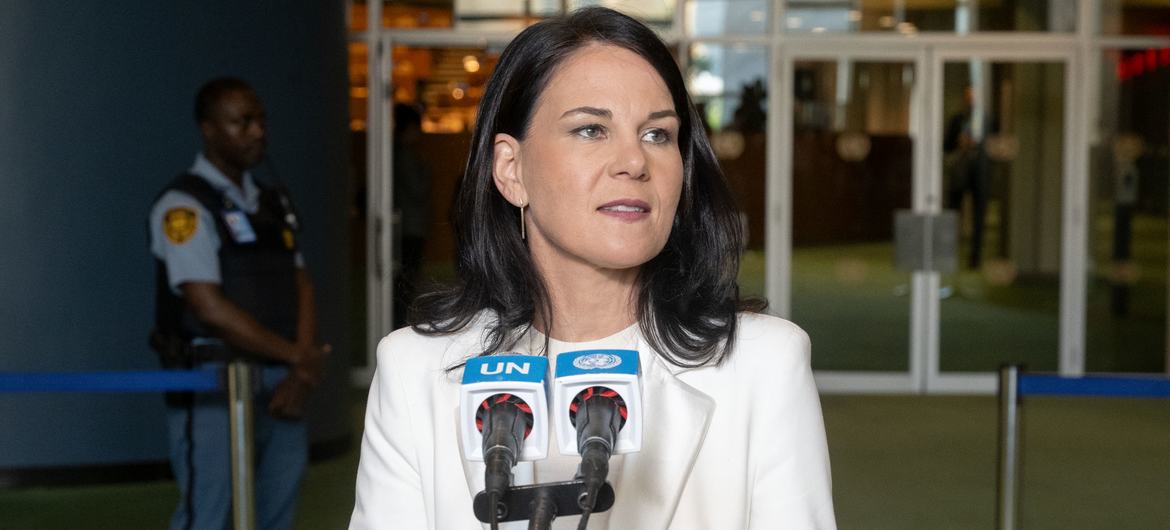
Annalena Baerbock, President-elect of the eightieth session of the UN General Assembly, addresses the reporters following her election.
‘Why not a woman as Secretary-General?’
While welcoming the election of the Assembly’s fifth female President in New York, Espinosa said this restructuring also provides an opportunity to rethink leadership styles and to finally consider a woman for the post of Secretary-General. The next appointment is expected in 2026.
“The real question is: why not?” she asked, stressing that a woman could bring qualities such as “strong management and bridge-building.” She added that a female Secretary-General would also represent an act of “historic justice,” after 80 years of male leadership at the UN’s helm.
The former Ecuadorian diplomat acknowledged one of the UN’s biggest challenges: the gap between resolutions adopted in the General Assembly and their translation into national policies and regulations. This, she said, prevents multilateral decisions from producing tangible improvements in people’s lives.
To address this, she called for a “more inclusive and networked multilateralism,” in which citizens are informed about, engaged with, and able to monitor the international decisions being made.
Building consensus behind the scenes
Espinosa emphasized that “most of the work of the Presidency takes place behind the scenes,” dealing with divisions and forging consensus.
She noted that the incoming President will increasingly face responsibilities linked to peace and security, as well as sustainable development.
Espinosa recalled that the very first resolution adopted by the General Assembly concerned the discovery of atomic energy, underscoring the need to adapt to a new force that could be harnessed for peaceful purposes but also cause “terrible effects.”
She highlighted defining moments during her own presidency, including the difficult negotiations that led to the adoption of the first Global Compact for Migration in 2018.
The diplomat also expressed pride in internal advances, such as the decision to phase out single-use plastics at the UN, recognizing the harm they cause to human health and ecosystems.


