


WASHINGTON — Russian President Vladimir Putin has not demonstrated a genuine desire to end the war in Ukraine, Latvia’s top diplomat said, arguing that only sustained military and economic pressure will compel Moscow to negotiate seriously.
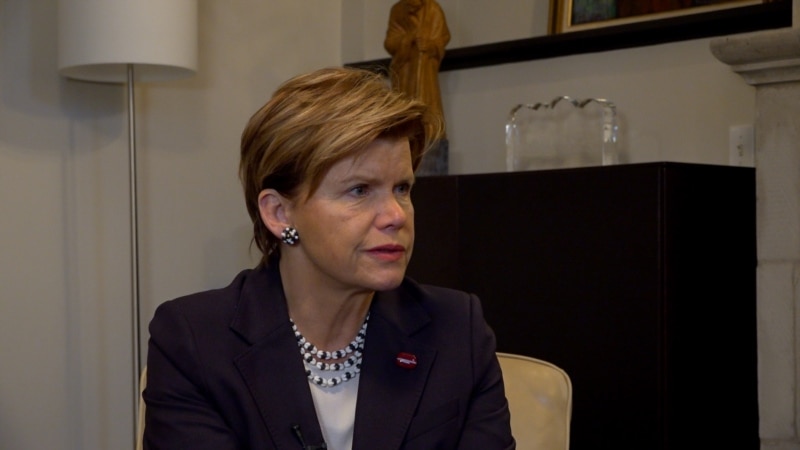
“We are not seeing that,” Foreign Minister Baiba Braze told RFE/RL in an interview in Washington on February 26 when asked whether Putin was serious about peace.
While there has been some technical-level military engagement, she said, “political commitment is not there.”
The Kremlin has taken part in several rounds of peace talks, but has so far given little indication that it is prepared to make any significant concessions on its war aims.
Braze, who was visiting Washington this week and attended the US President Donald Trump’s State of the Union address on Capitol Hill, said that everyone involved — Ukraine, the United States, and the European Union — understands what is at stake.
The challenge now, she said, is to generate the political will in Moscow “to seriously engage.”
Pressure On The Battlefield and Beyond
Braze endorsed what she described as a “peace through strength” approach led by Washington.
“In our belief, consistent pressure on Russia — both on the battlefield by supporting Ukraine and through sanctions and other policy instruments — will bring peace faster,” she said.
That pressure, she added, must include tightening and enforcing sanctions, preventing their circumvention, and denying Russia access to income, technology, and partnerships. Such steps, she argued, would accelerate the arrival of peace.
She said she believes US negotiators are realistic in their dealings with Moscow, but stressed that while “everybody wants peace,” the Kremlin has yet to show that it does.
Understanding Russia’s Objectives
For Latvia and other countries on NATO’s eastern flank, the war is part of a broader pattern in how Russia pursues its goals.
“Speaking about Russia and the way Russia operates,” Braze said, it is essential to understand both its objectives and its doctrine. The methods Moscow employs, she noted, depend on what it is trying to achieve.
In Ukraine’s case, she said, Russia’s objective has been to subjugate the country and prevent it from becoming “an independent, democratic, strong nation” — something that would not fit what she described as the Kremlin’s imperial ambitions.
***EMBED VIDEO HERE***
When nonmilitary means failed — including corruption and political influence through then-Ukrainian President Viktor Yanukovych — Moscow escalated.
Braze recalled how Yanukovych’s decision in late 2013 to abandon a plan to tighten ties with the EU sparked the Maidan protests, which culminated in his flight from Ukraine in February 2014. Soon afterward, Russia seized Crimea and set off a war in eastern Ukraine, which escalated with such incidents as the July 2014 downing of flight MH17 by a Russian Buk missile over territory held by Moscow-backed forces.
When Ukraine continued moving toward the EU and NATO, Russia launched its full-scale invasion in 2022. Putin, she said, miscalculated — expecting Ukrainians to welcome Russian forces or for Kyiv to fall within days.
Instead, Ukraine has entered its fifth year of war “strong,” more democratic than before, and confident in its European and Euro-Atlantic aspirations.
Beyond Ukraine, Braze warned that Russia is pursuing cyberattacks, hostile information operations, and sabotage in countries such as the United States, the Czech Republic, Britain, and Germany.
The aim, she said, is to confuse decision-making and divide societies, making it harder for governments to raise defense spending, maintain sanctions, or continue supporting Kyiv.
To prevent any “military illusions” in Moscow, she said, NATO allies must invest in hard defense capabilities.
“When we are strong, Russia can’t do anything against us,” she said, calling strength and awareness of Russia’s objectives the first criteria for success within NATO.
Ukraine’s EU Future
Ukraine’s long-term trajectory, Braze suggested, is closely tied to its European integration.
While Hungary is currently blocking the formal opening of EU accession negotiations, she said the practical work is advancing.
Kyiv is preparing to adopt the EU’s body of law and to meet the Copenhagen criteria — democracy, human rights, and a functioning market economy — so that it can proceed swiftly once talks formally begin.
Accession, she emphasized, is not merely about declaring a date. It requires building institutions capable of implementing EU legislation and preparing society and businesses for wide-ranging regulatory changes — from agricultural standards to water-quality directives.
From Latvia’s own experience, however, she acknowledged that having a target date in mind can help mobilize reforms, even if the final timeline shifts.
As for suggestions by Russian Foreign Minister Sergei Lavrov that the EU was not invited to peace talks, Braze was unequivocal.
“Only the EU decides about EU’s issues,” she said. “There will be no decisions about the EU without the EU.”
If Moscow believes someone else can represent the bloc’s interests, she added, “they are mistaken.”
Transatlantic Alliance — The Bedrock Of European Security
Despite strains and periods of political friction, Braze framed the broader transatlantic relationship as essential to security on both sides of the ocean.
“The European and the North American relationship? Let’s not forget Canada,” she said, describing ties between the two as among the closest and most profound partnerships in existence.
That community of like-minded democracies, she said, has ensured security and prosperity since NATO’s founding and must now be reinforced — not taken for granted.
“It’s not a very popular thing to bash your allies,” Braze said, urging leaders to remove unnecessary economic obstacles, deepen understanding, and resolve disagreements directly. “If we don’t understand something, let’s pick up the phone and call each other.”


