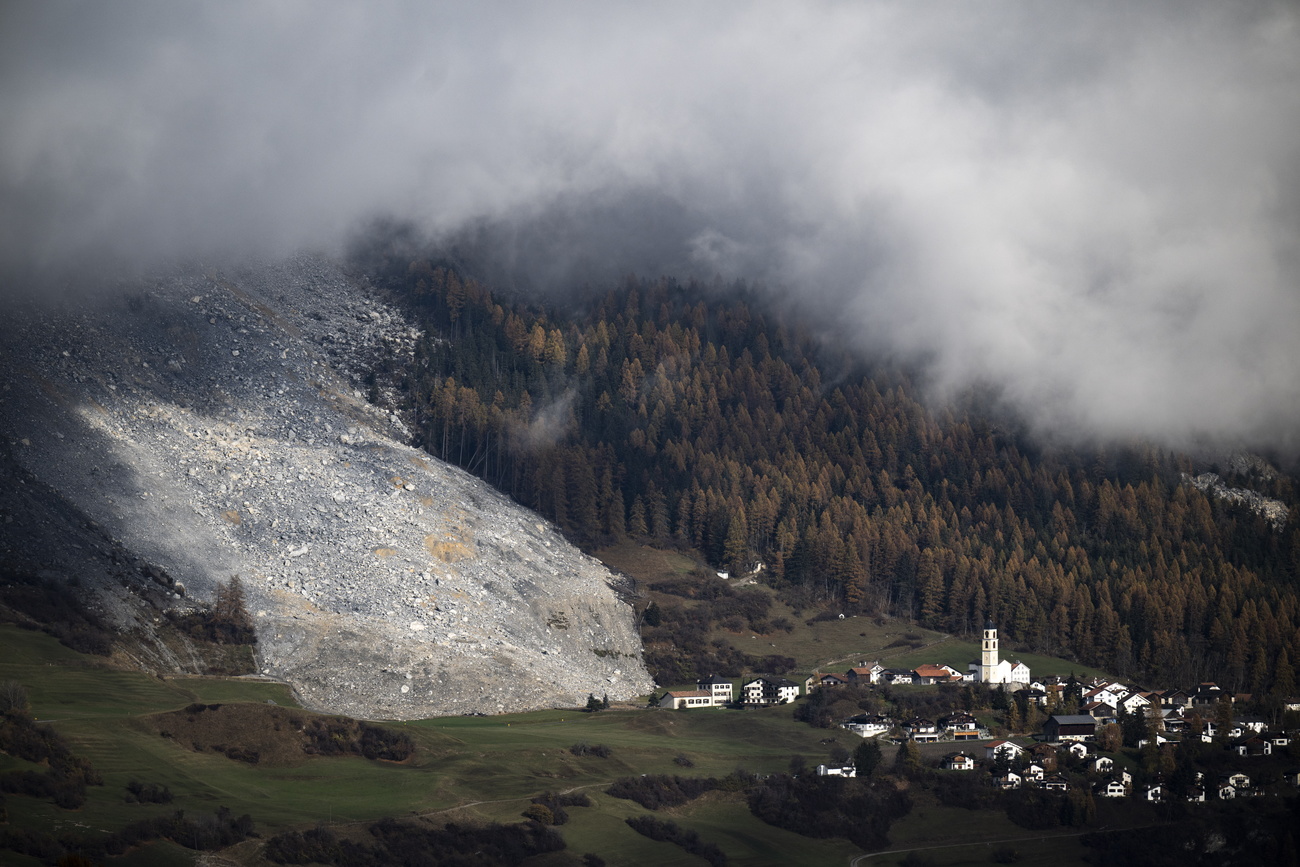
The local authorities fear that up to 1.2 million cubic metres of rock could crash down on the village of Brienz/Brinzauls, which narrowly avoided a huge landslide last year.
Keystone-SDA
The Swiss village of Brienz/Brinzauls in eastern Switzerland again is facing the threat of being hit by a rockslide from a mountain that looms overhead. The chief geologist monitoring the risks says the instability of the mountain face is a local phenomenon that has nothing to do with climate change.


The world’s eyes are again on Brienz, where movements in the upper part of the scree slope above the small village in canton Graubünden, near Davos, have accelerated sharply in recent weeks. Recent measurements have showed that the top of the rubble pile has been moving much faster than before – sometimes up to 40cm per day, reports Swiss public television SRF.
The local authorities fear that up to 1.2 million cubic metres of rock could crash down on the village, which narrowly avoided a huge landslide last year. In view of the imminent threat, an “orange” alert level has been declared and another preventive evacuation of residents has been organised.
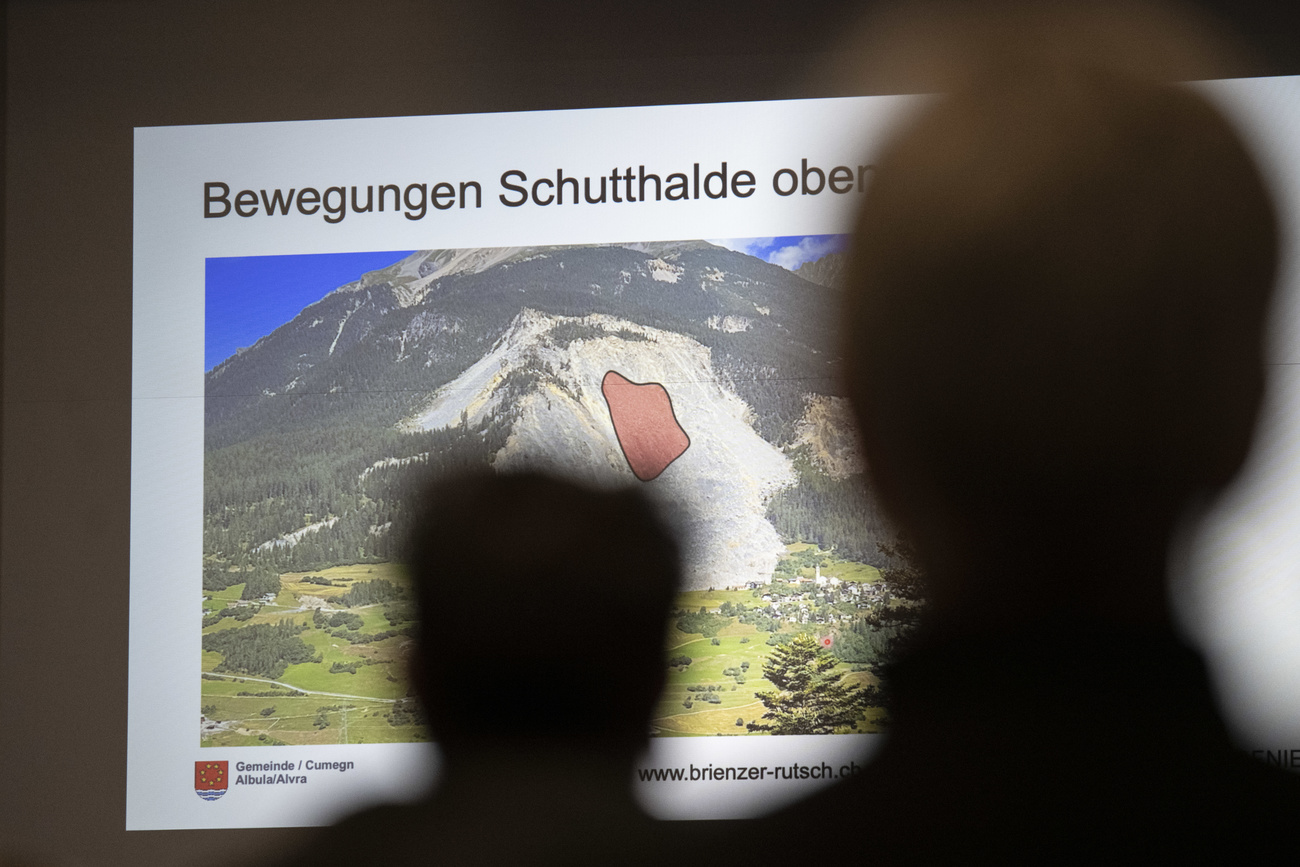
Brienz locals at a presentation which presented information on where movements in the upper part of the scree slope are threatening the small Graubünden village.
Keystone / Gian Ehrenzeller
The village must be evacuated by 1pm on Sunday, November 17, the local council has decided. All of its 100 residents must leave the village. The evacuation is expected to last several months.
Brienz was last evacuated in May 2023, when up to 2 million cubic metres of rock threatened to topple from the mountainside above the centuries-old village, which straddles German- and Romansh-speaking parts of the eastern Graubünden region.
+ Huge landslide narrowly misses Swiss mountain village
On the night of June 16, 2023, 1.2 million cubic metres of rock broke away in a huge flow, which stopped just short of the village. A few weeks later, Brienz residents were able to return to their homes. With the mountain again threatening to come down, local fears about the dangers are again very real.
Geologist Stefan Schneider, who is closely monitoring events, pointed out that landslides like the one in Brienz are common in the region. The instability of the mountain also has nothing to do with climate change, he said.
The phenomenon dates back many years, with the first recorded debris flow in Brienz occurring in 1878. At the time, similar-sized masses of rock were moving downhill towards the village by about four metres a day. This continued for 18 months, until the landslide finally stopped 100 metres from the village.
Dangerous local mud
Since then, there have been regular landslides of varying sizes, as well as rockfalls, explained the geologist. The subsoil beneath the village has also been moving for many decades.
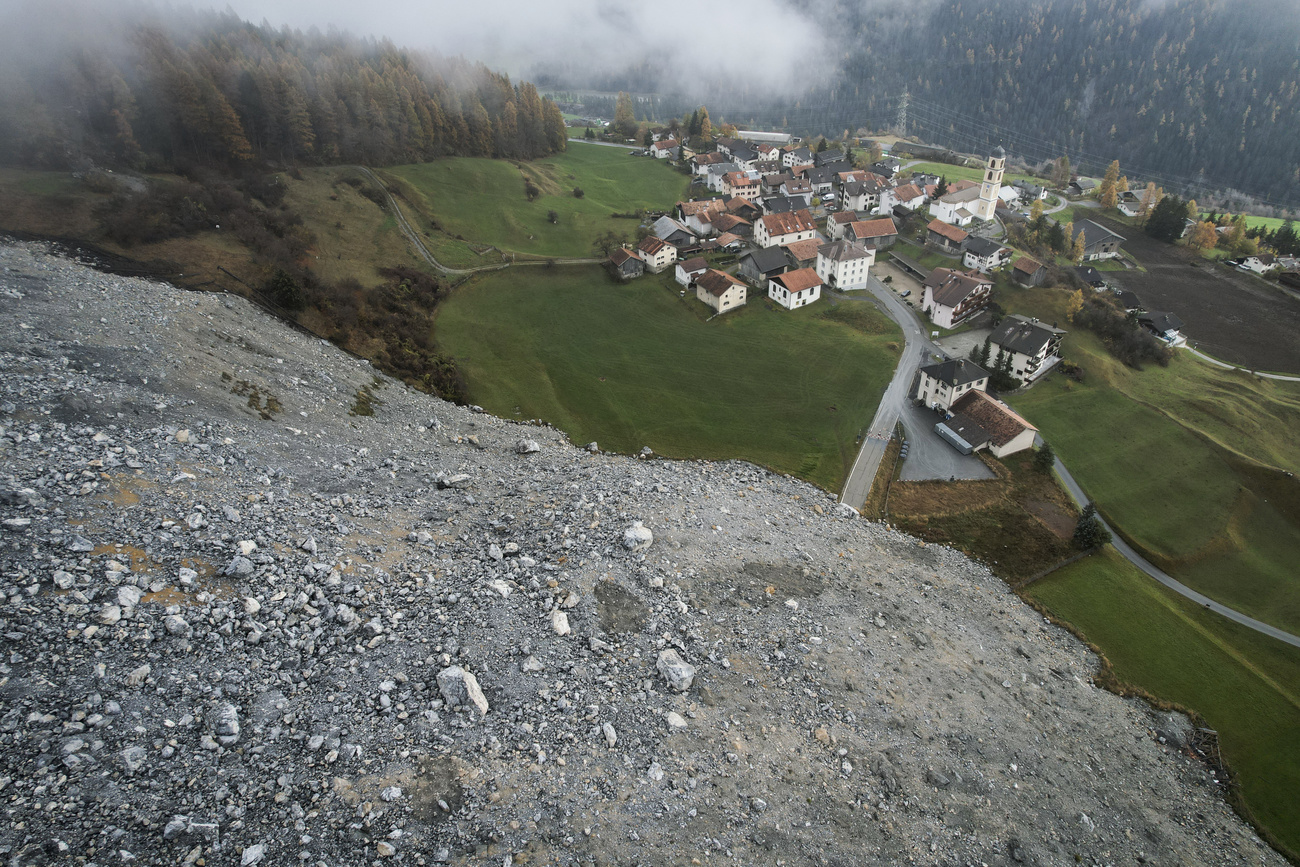
View of Brienz from the top of the scree slope that threatens the village.
Keystone / Gian Ehrenzeller
“Some people believe that the snowy winter of 1999 may have had a major influence on the movements,” Schneider told the Keystone-SDA news agency.
When large quantities of snow melt and the water seeps into the ground, it forms a dangerous mixture, he explained. The high plateau on which Brienz is located consists of shale and flysch, a local term to describe a very soft type of rock. If water mixes with it, “a thick mud forms”, said the geologist.
Together with the angle of underground rock formations, this causes the mountain above Brienz, and the village itself, to slide slowly downhill. Historically it has moved about 2.5 metres a year towards the valley, he added.
Extreme weather
Recent studies suggest that climate change is intensifying natural hazards in the mountains, posing major challenges for the Alpine region. Rockfalls in the high Alpine region have increased in recent decades; permafrost there is thawing and the glaciers are receding.
Schneider said extreme weather – heavier than normal and more frequent precipitation in the mountains – linked to climate change does not have a direct effect on the speed at which rocks slide downhill. Instead, it is the long periods of extreme weather, such as very wet summers or very snowy winters, that seem to have an impact. But these are not directly attributable to climate change, he insisted.
+ The deadliest landslides in Swiss history
The landslide in Brienz cannot be blamed on thawing permafrost either, said the geologist. The Alpine village, situated at an altitude of 1,100 metres, is far too low; permafrost is found only at altitudes of 2,300 metres and above.
More
More
Brienz rockslide threat and life in exile
Since the dramatic events of last year, experts have been working on possible solutions to prevent further landslides and protect the village.
One suggestion for slowing down the landslide could come in the form of a drainage tunnel to extract water from the rock below Brienz-Brinzauls and thus stabilise the surrounding area. An exploratory tunnel has already been drilled to give geologists and engineers a chance to assess the plan. This will be extended by 1.6km and the entire project is estimated to cost CHF40 million ($45.5 million). The problem is that the project will be unable to prevent the imminent dangers.
+ How to protect people and places from landslides in Switzerland
Other ideas, such as building a protective wall outside the village or organising a controlled explosion to trigger a rockslide to reduce the risk, have also been suggested. Schneider is not convinced by the use of dynamite on the slope for two reasons.
“One is safety,” he told SRF. “Blasting would require explosives to be placed above the slope. That is just too dangerous. The second is almost an insurance issue. If someone blows it up and the village is hit, the person who triggered the detonation is responsible. These are social and political issues that we need to discuss, but they are not easy.”
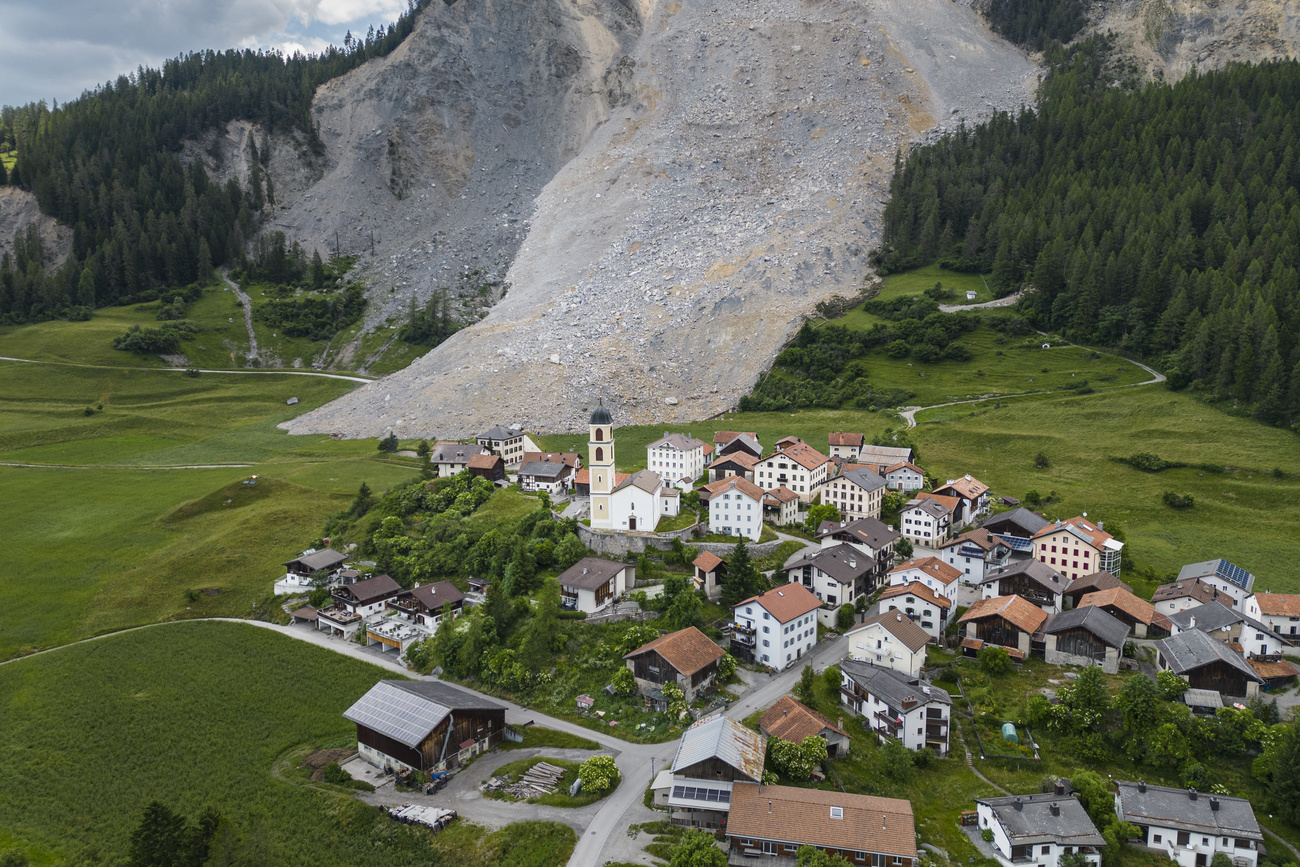
A general view of the village of Brienz below the rockfall on June 16, 2023.
Keystone / Michael Buholzer
More