


The Kremlin’s senior negotiator in talks on ending the war in Ukraine, Kirill Dmitriev, said he was on his way to Florida for fresh meetings with US counterparts on December 20 – hours after a Russian strike on Ukraine’s Odesa region killed eight people and injured 27.
The talks and attack follow another week of intense diplomatic and military activity as Russia’s full-scale invasion approaches the end of its fourth year.
US envoys held talks with European and Ukrainian officials, a European Union summit approved a $106 billion loan to Kyiv, and Russian President Vladimir Putin gave an uncompromising 4 ½-hour news conference at which he repeated previously stated demands along with debatable claims of battlefield advances.
US Secretary of State Marco Rubio indicated on December 19 that he may join the talks in Florida, adding that Washington would force neither side into a deal.
“We can’t force Ukraine to make a deal. We can’t force Russia to make a deal. They have to want to make a deal,” he said.
Details of the plans being hammered out remain sketchy, but the broad outlines envisage Ukraine making territorial concessions in return for security guarantees.
“On the way to Miami” Dmitriev wrote in English on social media, posting a video he said was from a previous visit of “light breaking through the storm clouds.”
Dmitriev, who as head of Russia’s sovereign wealth fund has been under US sanctions since February 2022, claimed that “warmongers” were seeking to undermine Washington’s peace efforts.
His words followed Russia’s missile attack on Odesa and its suburbs the previous evening. Ukrainian emergency services shared photos of a bus that they said was “the epicenter of the strike.”
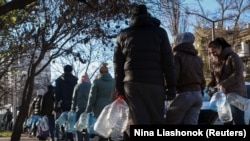
Russian forces have been attacking the Odesa region almost daily since the beginning of December. Tens of thousands of people have been left without electricity amid cold winter weather. Water supplies have also been affected.
Russia has denied targeting civilians since launching its full-scale assault in February 2022 but has repeatedly struck non-military infrastructure including schools, hospitals, power facilities, and residential buildings.
Putin again indicated on December 19 that Russia would achieve its aims militarily if Ukraine did not agree to its demands. Ukrainian President Volodymyr Zelenskyy has underlined security guarantees as the main sticking point in peace talks.
“What will the United States of America do if Russia comes again with aggression? What will these security guarantees do? How will they work?” he asked on December 18.
Meanwhile Ukraine has claimed two attacks that stretch the battlefield beyond its usual theaters.
On December 19, it claimed to have hit a Russian shadow fleet tanker off the coast of Libya, which would be the first such strike in the Mediterranean. On December 20, it claimed to have hit a Russian oil rig and naval vessel in the Caspian Sea – an area Ukraine has said that it has hit in the past.
“The drone’s onboard camera recorded a successful hit in the area of the platform’s gas turbine installation. Previously, SBU drones had already hit ice-resistant oil production platforms at the Filanovsky and Korchagin fields in the Caspian Sea, which led to the suspension of production processes,” a Ukrainian security source told RFE/RL’s Ukrainian Service.
The December 19-20 strikes could not be independently confirmed. They follow two other recent strikes on shadow fleet tankers in the Black Sea.
“We’re watching the birth of a new Tanker War. Like the 1980s Iran-Iraq conflict, merchant vessels are now economic weapons,” wrote maritime intelligence agency Windward in a social media post. “The message to Russia’s 1,300 dark fleet vessels: There is no sanctuary.”


