


Most Swiss cantons belong to German, French, or Italian linguistic regions. But there are also some where two national languages are spoken. Does that mean things can get complicated?
It is mind-boggling to many foreigners that a small country like Switzerland has four national languages: German (actually Swiss German), Italian, French, and Romansh, though the last one is only spoken by about 60,000 people in Graubünden.
READ ALSO: How did Switzerland become a country with four languages?
This is how the country is divided along linguistic lines, with blue designating French speaking areas, red German, green Italian, and yellow Romansh.
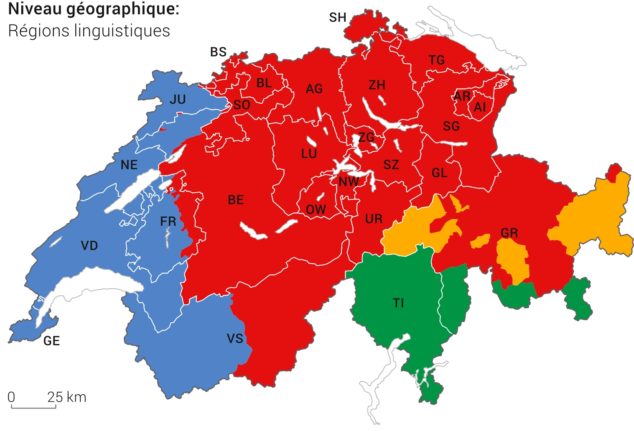
Image by Federal Statistical Office
As though all this wasn’t complicated enough, three of the 26 cantons are officially bilingual and one is trilingual, because — pourquoi pas?
This is where more than one language is spoken
Both French and German are spoken in the cantons of Bern, Fribourg, and Valais.
Additionally, in Graubünden, three languages are spoken: German, Romansh and Italian, depending on the proximity to neighbouring linguistic regions.
The demographic data indicates that most people in Bern (81 percent) speak German, with the exception of the area called Jura bernois, which is French-speaking.
Fribourg’s population is mostly French-speaking (63 percent), with German being prevalent in the eastern part of the canton, where it changes its name to Freiburg.
In Valais, 63 percent of residents speak French, and German is spoken in mountainous regions, where Valais becomes Wallis.
Advertisement
Not lost in translation?
For someone not accustomed to Switzerland’s linguistic diversity, all this may sound complicated and confusing.
But for the Swiss, it is all a matter of course — it is how the country is set up, and nobody questions it or is bothered by it.
MPs and public officials in bilingual cantons communicate in the official language of their choice, which means they must be fluent in both to be elected.
In public administration and official business, the district language takes precedence, though both could be used interchangeably.
Private residents, however, are not required to know both languages, even though many do.
READ MORE: Just how good are the Swiss at speaking the country’s different languages?
Doesn’t all this multilingualism contained within relatively small geographical areas lend itself to miscommunications and misunderstandings — and if so, why aren’t the Swiss at each other’s throats?
In reality, conflicts over languages (or over much else, for that matter) are not at all common in Switzerland. This wouldn’t be the Swiss way.
Advertisement
What language should you learn if you live in a bilingual canton?
For many foreign residents, becoming proficient in just one language is often difficult; having to master two would be a major headache.
But no worries: you should learn the language spoken in the part of the canton where you live.
And this brings us to another question: which language would be required to apply for Swiss citizenship, since candidates for naturalisation must demonstrate A2 level writing ability (elementary) and B1 (intermediate) spoken skills. This is the level set out in the Common European Framework of Reference for Languages.
Fortunately, you will need to demonstrate proficiency in only one of your canton’s official languages.


