


Iran is set to meet with officials from Britain, France, and Germany — the so-called European three (E3) — on July 25 in Istanbul to discuss the country’s nuclear program as Western nations turn up the pressure on Tehran to reach a settlement or face new sanctions.
Iranian Foreign Ministry spokesman Esmail Baghaei late on July 20 said the talks would be held at the level of deputy foreign ministers.
“In response to the request of European countries, Iran has agreed to hold a new round of talks,” Baghaei told state TV.
Earlier, Iranian Foreign Minister Abbas Aragchi confirmed that a meeting was in the works but said the time and place were still to be determined.
The E3 nations have warned that if a nuclear deal with Iran is not reached by the end of August, they will reinstate all UN sanctions against Iran by activating a so-called “snapback” mechanism.
On July 18, Aragchi called on the European powers to halt threats against Tehran, including the warnings about reinstating UN sanctions.
Under the 2015 nuclear agreement — the Joint Comprehensive Plan of Action (JCPOA) — long‑standing UN restrictions on arms sales, banking, and nuclear‑related technology were lifted a decade ago.
European governments can still invoke the deal’s snapback mechanism before an October 15 deadline, a step that would restore those sanctions and give them a narrow but significant source of leverage in current negotiations.
Iran suspended cooperation with the International Atomic Energy Agency (IAEA) in the wake of the US and Israeli bombing of its nuclear sites last month.
The European are pressing for UN nuclear inspectors to resume work in Iran, aiming in part to prevent Tehran from reorganizing its nuclear program after the damage caused by the strikes.
Under the 2015 nuclear deal, China and Russia — longtime supporters of Iran in such negotiations — cannot veto a snapback of sanctions. Although the formal window to trigger the mechanism closes in October, European governments could opt to postpone the move beyond that deadline to keep the door open for further talks.
On July 20, Russian President Vladimir Putin held previously unannounced talks in the Kremlin with Ali Larijani, the top adviser on nuclear issues to Iran’s supreme leader.
Larijani “conveyed assessments of the escalating situation in the Middle East and around the Iranian nuclear program,” Kremlin spokesman Dmitry Peskov said.
Peskov added that the Russian president had expressed Moscow’s “well-known positions on how to stabilize the situation in the region and on the political settlement of the Iranian nuclear program.”
Iranian and US negotiators were scheduled to meet in Oslo earlier this month, but the meeting was postponed, with no new date agreed upon.
While both sides claim to support diplomacy, Iran seeks assurances against future attacks. US President Donald Trump has signaled interest in a broader deal but warns of further strikes if Iran resumes high-level uranium enrichment.
A major unresolved issue is the fate of Iran’s stockpile of highly enriched uranium, enriched to 60 percent — above levels needed for civilian use but still below weapons grade. Iran is estimated to have had around 400 kilograms of this uranium.
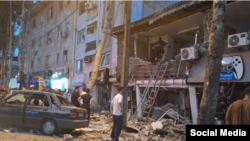
Meanwhile, Iran’s IRNA news agency on July 20 reported a massive explosion in a residential building in the city of Rezvanshahr in Gilan Province near the Caspian Sea.
A local official told the news agency the explosion occurred at around 1 p.m. on July 20 in a residential unit. The cause of the incident was being investigated, officials said.
“The residents of the residential unit where the explosion took place were not at home, so fortunately there were no casualties, but eight residents of the surrounding houses were injured due to the force and intensity of the explosion and were treated on the spot,” a local official said.


