

The amount foreigners earn in Switzerland obviously depends on their job and position, but new figures reveal those on certain permits earn more and when it comes to management posts, they earn more than the Swiss.
In 2024, the median salary for the private and public sectors combined in Switzerland stood at was 7,024 francs gross per month for a full-time position, new stats from Swiss authorities reveal.
However wages clearly varies at the top and bottom of the scale. In 2024 the lowest-paid 10 percent of employees earned less than 4,635 francs per month, while the highest-paid 10 percent earned more than 12,526 francs, the study revealed.
The study also shed light on the median salaries (the median wage is the wage at which half of the workers in an occupation earned more than that amount and half earned less) foreign workers in Switzerland pick up and how they compare to those of Swiss workers as well as how the vary depending on the type permit people have.
For example, when it comes to management positions for cross-border workers (G permit holders) the median salary is 11,207 francs per month – slightly less than that of permanent foreign residents (C permit holders) where the median salary is 11,966 francs a month.
The median salary for those on B permits was the highest, reaching 13,090 francs.
These figures were well above the median salary of Swiss nationals in management positions, which stood at 10,989 francs per month.
However when it came to non-management jobs the figures tell a different story.
At a median salary of 6,765 francs, the remuneration of employees of Swiss nationality not holding managerial positions proved to be higher than the median salaries of foreign workers, namely 5,421 francs for B permit holders, 6,034 francs for C permit holders and 5,950 francs for G permit holders.
Why do foreigners with B permits earn more than permanent residents – that is, C permit holders?
While the study did not address this point specifically, the reason for this phenomenon is that, in quite a few cases, top (and best paid) management positions in multi-national companies go to US and UK citizens who, as nationals of third countries, work in Switzerland under a B permit.
In fact, “for positions requiring a high level of responsibility, foreign workers generally earn higher salaries than those paid to employees of Swiss nationality,” the FSO reported.
READ ALSO: In which jobs in Switzerland do foreign workers earn more than the Swiss?
However, for jobs that do not require a high level of responsibility, the situation is reversed.
At 6,765 francs, the median pay of Swiss nationals not holding managerial positions was found to be higher than the median salary paid to foreign workers – namely, 5,421 francs for B permits, 6,034 francs for C permits, and 5,950 francs for G permits.
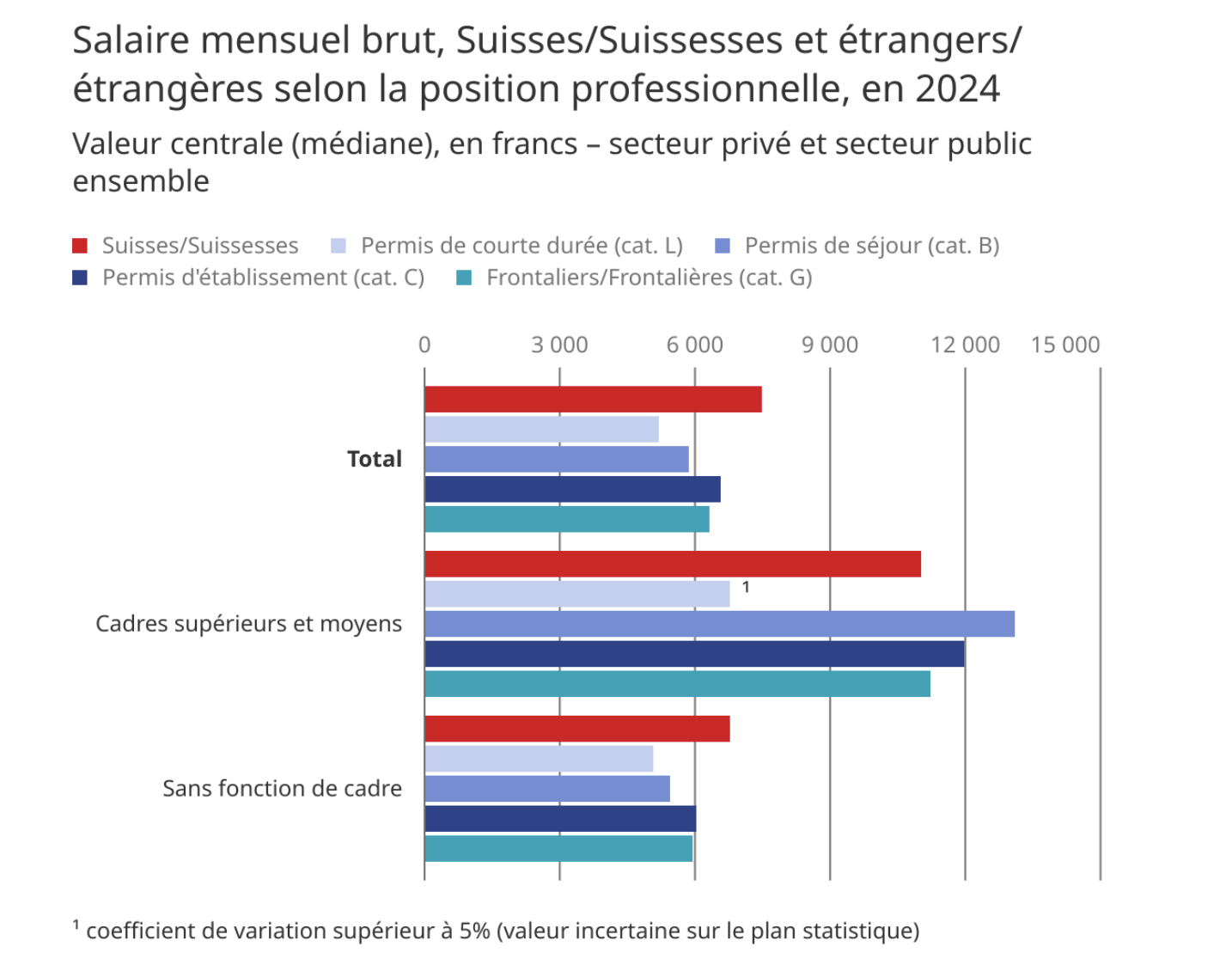
Chart shows the median salaries of different permit holders compared to Swiss nationals Image: Federal Office of Statistics
Advertisement
What else did the FSO find?
There are significant salary differences across sectors
Compensation levels were clearly higher than the median salary of 7,024 francs in high value-added sectors such as research and development (9,139 francs), the pharmaceutical industry (10,159 francs), banking (10,723 francs), and the tobacco industry (14,304 francs).
Sectors such as metallurgy (6,279 francs), construction (6,616 francs), air transport (7,134 francs), wholesale trade (7,478 francs), and the machinery industry (7,632 francs) were positioned in the middle of the salary range.
Among the sectors that were at the bottom of the wage pyramid were retail trade (5,214 francs), hospitality (4,715 francs), catering (4,744 francs), and personal services (4,496 francs).
Advertisement
Regional disparities exist as well
On average, median salaries were found to be highest in Zurich (7,502 francs) and lowest in Ticino – 5,708 francs.
For the top 10 percent of earners, gross salaries reached over 13,970 francs in the Zurich region, 12,636 francs in the Lake Geneva region, 11,030 francs in Eastern Switzerland, and 10,012 francs in Ticino.
At the other end of the spectrum, for the bottom 10 percent of earners, the median salary disparity between the major regions was less striking: 4,761 francs in the Zurich region, 4,585 francs in the Lake Geneva region, 4,563 francs in Eastern Switzerland, and 3,783 francs in Ticino.
READ ALSO: How Switzerland’s huge wealth is far from evenly spread


