


Duty-free shopping at airports was hit by flight cancellations due to the war.
Keystone / Gaetan Bally
From chocolate sales at airports to fertiliser trade bottlenecks – the Swiss food and commodity industry is already feeling the impact of the war in the Middle East. Consumers will be next.
The conflict in the Persian Gulf and the subsequent blockade of the Strait of Hormuz by Iran has disrupted the flow of essential goods and hiked energy prices. Switzerland, as a hub for large food multinationals and the global commodity trading industry, is feeling the pinch. Here are four under-the-radar sectors that are particularly vulnerable to disruption:
Fertiliser trade
Fertilisers are one of the most traded commodities, with 169 million tonnes crossing borders in 2024. About half of all fertiliser is used to grow cereals like rice, wheat and maize. However, this trade has been affected by export restrictions imposed since 2021 by China, the world’s largest producer of nitrogen and phosphate fertiliser, sanctions on major potash exporters Russia and Belarus, and a 10% tariff on fertiliser imports imposed by the Trump administration.
The conflict in the Middle East has made the situation worse for Swiss commodity traders. According to the UN Food and Agriculture Organisation (FAO), 20%-30% of the world’s fertiliser passes through the Strait of Hormuz. The price of urea went up as much as 60% after the conflict started. There is worse to come: the Gulf region produces 25% of the world’s sulphur and accounts for half of all sulphur exports used to manufacture fertiliser like DAP.
The price of wheat has increased by 6% in the US and the price of rice has gone up by 9% in Thailand. The FAO expects global household welfare to drop from 2.1% to 1.6%, with Asia and Africa most affected.
“About 35% of world urea and 25% of ammonia comes from the Gulf region. It is not possible to switch sources from one day to another,” Florence Schurch, secretary general of the Swiss commodity trading association SUISSENÉGOCE told Swissinfo.
More

More
Does your country have enough food reserves to withstand a crisis?
Schurch points out that the United States recently moved to ease sanctions against Belarus, one of the world’s major potash exporters, partly as a way to relieve fertiliser costs for farmers. She says a price increase of even a few dollars per tonne would have a big impact on farmers in poorer parts of the world. “For a rich country like Switzerland, this means higher food and fertiliser prices that hurt but could still be absorbed. For many poorer countries across Africa and Asia, price spikes and shortages are much more brutal: farmers end up using less fertiliser, crops yield less, and the risk of real food insecurity grows,” Schurch says.
Some Swiss fertiliser trading companies like Keytrade stayed away from trading through the Middle East before the war in Iran started.
“As a company, we made the right decision to have our positions out of the Arabian Gulf and focus instead for example on Europe, North Africa, the United States and Brazil. And when the war started, we have benefited from it because such a large supply coming out of the Arabian Gulf was no longer available,” Keytrade founder Melih Keyman told Swissinfo.
Glass bottle manufacture
Glass requires a lot of energy to produce. The raw materials silica sand, limestone and soda ash must be melted in furnaces at temperatures of 1,500°C and about 75% of the energy used by the glass industry to fire furnaces comes from natural gas.
“Glass production is energy intensive, and while we benefit from a high share of locally sourced recycled glass and sand, we are not fully insulated from fluctuations in energy, diesel and freight costs. We are monitoring the situation closely,” said a spokesperson of Swiss glass manufacturer Vetropack. “If energy surcharges become necessary, we will communicate this directly to our customers.”
The rise in energy prices could translate into higher prices of drinks, says the Swiss beverage industry that represents mineral water, beer and soft drinks manufacturers. Switzerland produced 510 million litres of bottled mineral water in 2024, of which 3.7 million litres were exported. Swiss company Nestlé is also the world’s top bottled water producer with about 20% of the market share with brands like Perrier and Vittel.
More
More
Stockpiling – a Swiss civic duty
If the situation does not improve, the cost of beer, soft drinks and spirits could rise due to a hike in the price of glass bottles. Members of the Swiss Beverage Industry Association ASG did not share details of price impacts but are working on reducing their vulnerability to high energy prices.
“Our members are responding to this with efficiency improvements, long-term supply contracts, and investments in sustainable energy solutions, such as the increased use of renewable energy and heat recovery,” said ASG spokesperson Marcel Kreber.
In the long-term, ASG sees the industry building more resilience by focusing on regional raw material sources, a high degree of automation, and forward-looking procurement strategies.
Plastic food packaging
The British Plastics Federation estimates that in Europe 4%-6% of oil and gas supply is used to make the raw material needed to manufacture plastics. According to the United Nations Environment Programme, about 36% of all plastic is used to make packaging for the food and beverage sector.
The Swiss Plastics Industry Association, KUNSTSTOFF.swiss, says it is observing the current geopolitical situation in the Middle East with great concern. In 2024, the sector consumed nearly 659,000 tonnes of plastic, of which the largest share (36%) went towards packaging.
“These raw materials and their precursors – including ethylene, naphtha, and styrene – are essential for polymer production in Europe. Furthermore, several production facilities have already been destroyed, further reducing the availability of such products,” the association said in a press release.
These raw materials are used to make products for the food industry like plastic bags, packaging films, plastic bottles, food containers and disposable cutlery.
More
More
Why are the Swiss debating stockpiles of coffee?
The blockade of the Strait of Hormuz is forcing the Swiss plastics industry to prepare for alternative logistics, higher transport costs, and longer delivery times.
Sales of chocolate
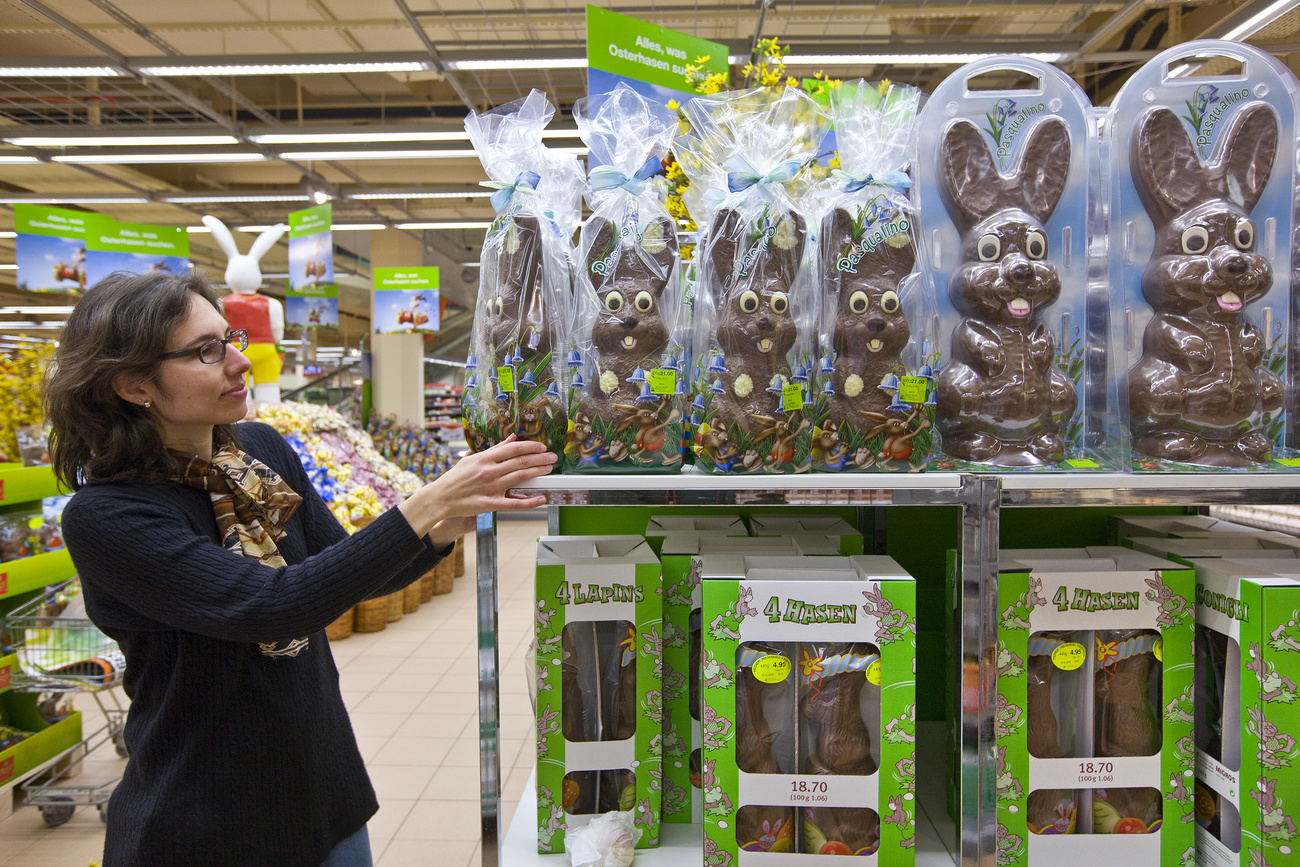
Global Travel Retail is one of the fastest-growing areas for sales of Swiss chocolate. In 2025, Lindt & Sprüngli’s sales at airport duty-frees grew 19.6%. According to the Swiss chocolate firm’s annual report, the success of its Lindt Dubai Style Chocolate was largely due to its distribution network in over 100 airports. The cancellation of flights to international airport hubs like Dubai, Abu Dhabi and Doha have already affected sales, the company said without specifying by how much.
“The current situation has an impact on Global Travel Retail as major airports in the region are closed. It also affects our distributors in the Gulf states,” a spokesperson told Swissinfo by email.
Lindt & Sprüngli cannot ship chocolates to its distributors in the United Arab Emirates and other Gulf states. The company’s new subsidiary in Saudi Arabia is being supplied via the Red Sea. “We expect logistics and energy costs to rise, which will also drive up raw material costs and inflate the entire food business,” said the Lindt & Sprüngli spokesperson.
More
More
How much more are you willing to pay for Swiss chocolate?
Another premium Swiss chocolate company feeling the effects of Strait of Hormuz blockade is Läderach. The company has shuttered its store in Bahrain due to the security situation and is keeping a close eye on rising energy costs and supply bottlenecks.
“Supply chains are heavily impacted; some countries in which we have stores cannot be supplied on a stable and regular basis. Additionally, prices for transport, not only to the affected region but also Asia, have increased,” said spokesperson Stefanie Merlo.
Some of Läderach’s suppliers are facing higher costs, but the company’s Swiss customers will not have to curb their cocoa cravings anytime soon, the company said. “We maintain substantial inventory in Switzerland, sufficient to meet production needs for the coming months,” Merlo said.
More
Edited by Virginie Mangin/ts


